Fine-Tuning vs. Frozen Embeddings: Strategic Approaches to Domain-Specific Large Language Model Adaptation

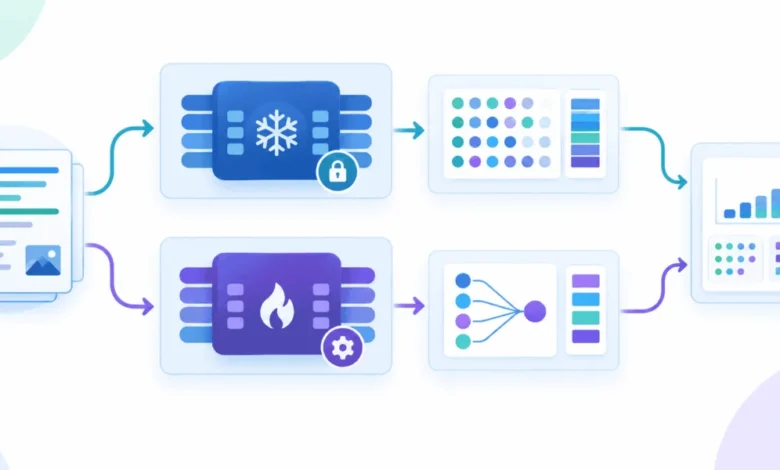
The rapid proliferation of Large Language Models (LLMs) has forced developers and data scientists to confront a central engineering dilemma: how to best align massive, general-purpose models with the specific requirements of a specialized domain. Historically, the machine learning community has favored full-parameter or parameter-efficient fine-tuning (PEFT) as the gold standard for model adaptation. However, as compute costs rise and the demand for lightweight, rapid-deployment solutions grows, an alternative methodology has emerged—using frozen model embeddings as features for traditional machine learning classifiers. This article provides a comprehensive evaluation of these two distinct architectural paradigms, comparing the efficiency of Scikit-Learn-based classification against the performance gains offered by Low-Rank Adaptation (LoRA).
The Evolving Landscape of LLM Customization
In the early stages of the generative AI boom, the focus was primarily on scaling model size. As the industry matured, the focus shifted toward "model steering." Fine-tuning, the process of continuing the training of a pre-trained model on a narrower, curated dataset, became the default pathway. By updating the internal weights of the model, fine-tuning allows the LLM to internalize specific terminologies, stylistic nuances, and structural requirements of a target domain.
Conversely, the frozen embedding approach treats the LLM as a sophisticated feature extraction engine. In this paradigm, the model weights remain static—or "frozen"—and the output of the model’s internal layers is extracted as a high-dimensional vector. These vectors serve as a dense representation of the input text, which can then be fed into traditional, non-neural classifiers such as Random Forests, Support Vector Machines (SVMs), or Gradient Boosted Trees. This methodology effectively decouples the representation learning (handled by the LLM) from the decision-making logic (handled by the Scikit-Learn classifier).
A Chronological Assessment of Deployment Workflows
To understand the practical implications of these two paths, one must look at the lifecycle of a typical classification project. In a production environment, the workflow for a frozen-embedding pipeline is notably compressed. The model is loaded into memory, a inference pass is conducted to generate embeddings, and a lightweight classifier is trained. This process is often completed in a fraction of the time required for backpropagation-based fine-tuning.
In contrast, the LoRA (Low-Rank Adaptation) workflow introduces the complexity of training loops. LoRA functions by injecting trainable rank-decomposition matrices into the transformer architecture while keeping the base model weights frozen. This approach significantly reduces the number of trainable parameters, typically by 98% to 99%, but it still requires the overhead of calculating gradients and updating the adapter weights over multiple epochs.
Empirical Analysis: The AG News Benchmark
A comparative analysis using the AG News dataset—a standard benchmark consisting of 120,000 news articles categorized into four classes: World, Sports, Business, and Science/Technology—reveals the trade-offs in action. When using a Qwen2.5-1.5B model as a feature extractor, the process of generating embeddings for a subset of data takes approximately 96.5 seconds on a T4 GPU. Training a Random Forest classifier on these embeddings is near-instantaneous, yielding an accuracy of 82%.
When the same dataset is subjected to QLoRA fine-tuning, the training duration extends to roughly 300 seconds. While the time investment triples, the accuracy climbs to 87%. This 5% performance delta is the critical data point for decision-makers. In scenarios where accuracy is non-negotiable—such as medical diagnostics or legal document classification—the 300-second training penalty is an acceptable, if not required, cost. However, for real-time sentiment analysis or basic topic filtering where 82% accuracy suffices, the efficiency of the frozen embedding strategy presents a significant advantage in terms of operational expenditure (OPEX) and power consumption.
Comparative Cost-Benefit Analysis
The implications for infrastructure are profound. Fine-tuning, even with parameter-efficient methods like QLoRA, requires a GPU setup capable of handling the memory overhead of the optimizer states and gradient storage. Even with 4-bit quantization, the VRAM requirements remain non-trivial.
The frozen embedding approach, however, allows for more aggressive hardware optimization. Because the LLM does not need to perform backpropagation, the VRAM requirements are limited to the inference-only footprint. This opens the door to running models on hardware that would otherwise be insufficient for training. For startups or enterprises operating within tight cloud-compute budgets, this could mean the difference between utilizing a local, private instance versus relying on expensive, managed API services.
Expert Perspectives on Model Strategy
Leading research institutions have increasingly noted that the "best" approach is rarely universal. Practitioners often emphasize that the "Generalization vs. Specialization" trade-off is the true bottleneck.
"When you fine-tune, you are essentially asking the model to re-learn the semantic relationship between your domain data and the labels," explains one lead researcher in the field. "When you use embeddings, you are asking the classifier to find the hyperplane that best separates the pre-existing semantic clusters the LLM has already learned. If your domain is highly technical, like molecular biology, the LLM’s pre-trained knowledge might be insufficient, making fine-tuning mandatory. If your domain is general news, the LLM’s pre-trained internal representations are likely already world-class, making fine-tuning redundant."
Broader Implications and Future Outlook
The industry is currently witnessing a push toward "Hybrid Inference." This involves utilizing a shared, frozen backbone for multiple downstream tasks. In such a setup, a single, massive LLM acts as the central hub, generating universal embeddings that are then routed to multiple, small, domain-specific Scikit-Learn heads. This architecture maximizes hardware utilization—since the LLM only needs to process the input once—while allowing for extreme flexibility at the task-specific level.
Furthermore, as quantization techniques improve, the line between these two methods may blur. We are seeing the rise of "Adapter Hubs," where organizations maintain a library of LoRA adapters that can be swapped in and out of a frozen base model in milliseconds. This suggests that the future of LLM deployment lies not in choosing between "frozen" and "fine-tuned," but in a modular architecture that combines the strengths of both.
Concluding Summary
The choice between using Scikit-Learn with frozen embeddings and employing LoRA-based fine-tuning should be dictated by the specific constraints of the project.
- Adopt Frozen Embeddings when: The primary constraints are development speed, minimal compute resources, and the requirement to avoid the complexity of training loops. It is highly effective for tasks where the LLM’s inherent understanding of language is already sufficient for the classification task at hand.
- Adopt LoRA Fine-Tuning when: The task requires deep domain expertise not captured in the base model’s pre-training, or when every incremental percentage point in accuracy is critical to the business value of the application.
As the machine learning ecosystem continues to refine these techniques, the ability to discern which strategy to deploy—and when—will become an essential skill for engineers tasked with building scalable, reliable, and cost-effective AI systems. While fine-tuning remains the most robust method for achieving peak performance, the efficiency and elegance of the frozen embedding approach offer a compelling alternative that will undoubtedly see wider adoption in the coming fiscal year. The era of blindly fine-tuning every model is coming to an end, replaced by a more nuanced, architectural approach to model adaptation that prioritizes the right tool for the specific domain problem.