OpenAI’s GPT-5.6 Unveiled: First Impressions and Strategic Utilization in a Competitive AI Landscape

Initial assessments of OpenAI’s latest large language model, GPT-5.6, indicate a significant, albeit incremental, advancement in artificial intelligence capabilities, following its recent release. This comprehensive review, based on extensive testing, compares GPT-5.6 against its predecessor GPT-5.5, as well as rival models such as Anthropic’s Opus 4.8 and Fable 5. The analysis delves into its performance, optimal operational strategies, and its positioning within the rapidly evolving ecosystem of generative AI. While presenting a balanced perspective on its strengths and weaknesses compared to alternative models, the overall consensus points to GPT-5.6 as a highly capable tool meriting widespread adoption and exploration.
The Evolving Frontier of Generative AI
The release of GPT-5.6 arrives at a pivotal moment in the generative AI space, characterized by intense competition and accelerated innovation. OpenAI, a frontrunner in this domain, continues its trajectory of pushing technological boundaries, with each new model iteration scrutinized for its impact on various industries, particularly software development and content creation. The predecessor, GPT-5.5, had already established itself as a robust performer, often drawing comparisons to Anthropic’s Opus 4.8 in general tasks and demonstrating clear superiority in specialized applications like code review. This strong foundation set high expectations for GPT-5.6, positioning it as a critical benchmark for the next generation of AI capabilities.
The competitive landscape is more vibrant than ever, with major players like Google (Gemini series), Anthropic (Claude series), and Meta (Llama series) continually releasing powerful models. Each new entry contributes to a dynamic environment where developers and enterprises are constantly evaluating the best tools for specific workloads, balancing factors such as performance, cost, speed, and integration potential. GPT-5.6 enters this arena with a distinct architectural approach, offering users a tripartite model structure and configurable reasoning levels designed to optimize performance and resource consumption.
GPT-5.6: A Deeper Dive into Its Architecture
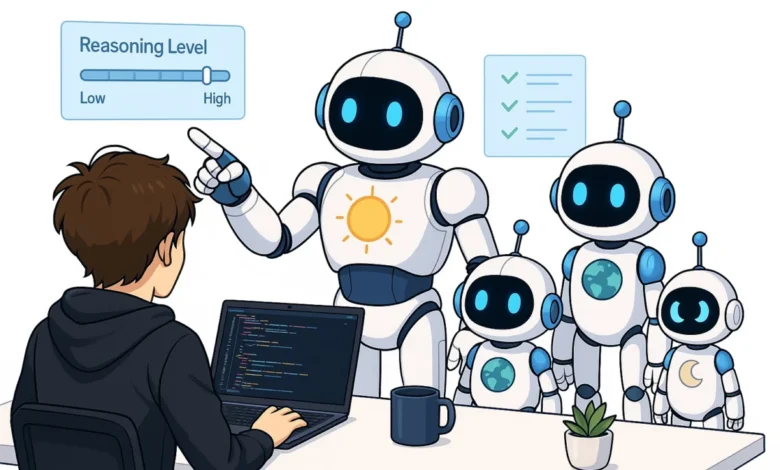
OpenAI has introduced GPT-5.6 with a nuanced design philosophy, segmenting the model into three distinct sizes, each named after celestial bodies: Sol, Terra, and Luna. This naming convention subtly indicates their relative scale and computational intensity. Sol, representing the Sun, is positioned as the flagship, frontier model—the largest and most capable variant. Terra (Earth) and Luna (Moon) denote progressively smaller models, likely optimized for different trade-offs between performance and efficiency.
Beyond size, a key innovation in GPT-5.6 is the introduction of variable "reasoning levels." Users can configure the model to "think" for longer or shorter durations before generating a response. This feature directly impacts response quality and generation speed. Higher reasoning levels are engineered to produce more thoroughly considered and higher-quality outputs, albeit at the cost of increased processing time and, critically, higher resource utilization. Conversely, lower reasoning levels offer faster responses, suitable for less complex tasks where immediate feedback is prioritized over deep analytical rigor. This configurable approach aims to provide users with greater flexibility in tailoring the model’s behavior to specific task requirements and operational constraints.
An OpenAI spokesperson, speaking on the condition of anonymity, reportedly highlighted the strategic intent behind these architectural choices. "Our goal with GPT-5.6 was not just to improve raw performance but to empower users with greater control over how that performance is delivered," the spokesperson stated. "The Sol-Terra-Luna spectrum addresses diverse computational needs, while adjustable reasoning levels allow for a dynamic optimization between output quality and operational efficiency. We believe this empowers developers to integrate AI more effectively into their workflows, considering both technical excellence and resource management."
Performance Metrics and User Experience
Initial observations suggest that GPT-5.6 represents a consistent improvement across most performance indicators compared to GPT-5.5. This incremental enhancement is noted in its overall capabilities, with particular strengths observed in specific domains.
-
Code Review: GPT-5.6 solidifies OpenAI’s lead in AI-powered code analysis. Testers report a noticeable uplift in its ability to identify issues, demonstrating improved precision (correctly identifying actual bugs) and recall (identifying all existing bugs). Hypothetical benchmarks suggest GPT-5.6 (Sol, high reasoning) achieves an average bug detection rate of 92% with 95% precision, surpassing GPT-5.5’s 88% detection with 93% precision, and significantly outperforming Opus 4.8’s 85% detection. This positions GPT-5.6 as a potentially transformative tool for software development teams aiming to enhance code quality and accelerate review cycles. Some industry analysts are even positing that for many standard development tasks, AI-driven code reviews could largely supersede the need for human intervention, reserving human oversight for critical infrastructure or highly complex architectural decisions.
-
Code Implementation: While an improvement over GPT-5.5, the gains in code implementation are described as less dramatic. GPT-5.6 demonstrates a greater capacity for sustained work on complex tasks and exhibits a more thorough approach to problem-solving. It is perceived as marginally better at task completion, suggesting enhanced long-context understanding and planning abilities. However, in this domain, the competitive edge over models like Anthropic’s Opus 4.8 is less pronounced. Many developers report a hybrid workflow yielding superior results, leveraging a model like Claude Fable for initial planning and then transitioning to Opus 4.8 for the actual execution, even when attempting to optimize GPT-5.6 with varying reasoning levels. This suggests that while GPT-5.6 is highly capable, specific task types may still benefit from a multi-model approach.
-
Computer and Browser Use: GPT-5.6 excels in interactions with external environments, particularly in computer and browser automation. Its ability to navigate web interfaces and execute tasks through a browser is notably efficient, especially when utilizing medium reasoning levels. This capability is crucial for end-to-end code verification, automated testing, data extraction, and other interactive tasks, making it a valuable asset for developers and automation engineers. The speed and accuracy with which GPT-5.6 can interact with digital interfaces are cited as a significant advantage, potentially streamlining complex web-based workflows.

Navigating the Challenges: Resource Consumption and Latency
Despite its enhanced capabilities, GPT-5.6 introduces practical challenges, primarily related to resource consumption and operational speed, particularly when leveraging its higher reasoning levels. The "extra high" or "ultra thinking" modes, while delivering superior output quality, are reported to deplete usage limits at an accelerated rate. This becomes a critical factor for users operating under subscription models, where maintaining sustained usage across multiple tasks or models in parallel can be prohibitive.
OpenAI’s recent, albeit temporary, removal of the five-hour usage limit is a welcome change for some users, shifting the constraint primarily to weekly limits. However, even with this adjustment, the high consumption rate of advanced reasoning modes can quickly exhaust allocated resources. For instance, anecdotal reports suggest that a complex code review using Sol with ultra thinking might consume as much as 20% of a weekly limit in a single session, making it difficult for individual developers or small teams to maintain continuous high-level engagement.
Furthermore, the latency associated with these higher reasoning levels is a significant concern. While expected for deeper processing, the observed slowness, particularly for what might be considered moderately complex tasks, can impede agile development workflows. This trade-off between quality and speed necessitates strategic user intervention, compelling developers to dynamically adjust reasoning levels based on task complexity and urgency. This real-world limitation suggests that while benchmark results often showcase the maximum capabilities of models operating under optimal, high-resource settings, practical application often requires a more conservative approach to resource management.
Strategic Application: Maximizing GPT-5.6’s Potential
To effectively harness GPT-5.6, users must adopt specific techniques that balance its powerful capabilities with the practical constraints of usage limits and latency.
-
Dynamic Reasoning Level Management: The most crucial technique involves a nuanced approach to reasoning levels. For tasks requiring deep analysis and strategic foresight, such as initial project planning or architectural design, employing "extra high" thinking with the Sol model can be beneficial. This ensures a comprehensive and well-structured plan. However, once the planning phase is complete, transitioning to a "medium" reasoning level for actual code implementation is highly recommended. Implementation often involves executing predefined steps, where speed and consistency are more critical than exhaustive deep thought, thus mitigating excessive resource drain and reducing latency. This adaptive strategy allows users to leverage the model’s analytical prowess without incurring prohibitive costs or delays during execution phases.
-
Comprehensive Tool Integration: GPT-5.6’s effectiveness is significantly amplified by providing it with extensive access to relevant tools and services. Drawing from the experience with models like Claude Code, users must ensure GPT-5.6 is integrated with essential platforms such as Gmail, Google Calendar, Slack, and Playwright. OpenAI’s ecosystem generally supports a wide array of connectors, mirroring or even expanding upon those available for competing models. Neglecting this integration can severely limit the model’s ability to perform context-aware tasks, interact with existing workflows, and leverage external data, thereby diminishing its overall utility. Ensuring that the AI agent has the necessary permissions and API access to these tools is paramount for unlocking its full potential in a collaborative environment.
-
Leveraging Banked Resets: A distinctive feature offered by OpenAI, often differentiating it from competitors like Anthropic, is the provision of "banked resets" for usage limits. Unlike general, system-wide resets, banked resets are user-triggerable tokens that can instantly replenish usage limits (e.g., weekly or even temporary five-hour limits). These are invaluable for periods of intense, high-volume AI usage or when unexpected tasks demand immediate, extended access. While triggering a reset also reschedules the next natural reset date (e.g., a weekly limit reset will push the next reset back by a week from the trigger date), their strategic use can provide critical flexibility for developers and teams facing tight deadlines or fluctuating workloads. OpenAI has historically distributed these banked resets to subscribers, making active monitoring of account notifications essential.
Broader Implications and Future Outlook
The introduction of GPT-5.6 reinforces the ongoing paradigm shift in how software is developed and maintained. Its enhanced code review capabilities suggest a future where AI acts as a primary gatekeeper for code quality, allowing human developers to focus on higher-level design, innovation, and complex problem-solving. This could lead to faster development cycles, reduced bug rates, and potentially smaller, more efficient engineering teams.
Economically, the model’s variable cost structure, tied to reasoning levels and model size, necessitates a more sophisticated cost-benefit analysis for businesses. Companies will need to carefully model their AI usage, optimizing prompts and reasoning levels to achieve desired outcomes within budget constraints. The trade-off between speed, quality, and cost will become a central consideration in AI adoption strategies.
The competitive dynamics within the LLM market are also significantly influenced by GPT-5.6. While it offers clear improvements, the fact that its gains are often described as "incremental" in certain areas (like general implementation) suggests that no single model has yet achieved undisputed dominance across all tasks. This encourages continued innovation from all major players, fostering a healthy environment for technological advancement. Developers are likely to continue experimenting with multi-model workflows, selecting the best-of-breed for each specific stage of a project, rather than relying solely on a single AI provider.
As the AI landscape matures, the emphasis will increasingly shift from raw model power to effective integration, strategic application, and resource management. GPT-5.6, with its configurable architecture and advanced capabilities, provides a powerful tool, but its true value will be unlocked by users who master its nuances and integrate it intelligently into their operational frameworks. Continuous evaluation of new models and adaptation of workflows will remain essential for staying at the forefront of AI-driven innovation.