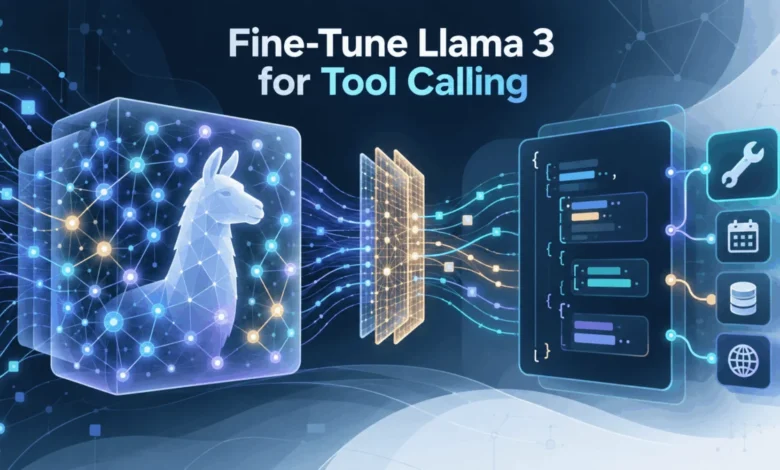
The rapid evolution of Large Language Models (LLMs) has shifted the focus from mere text generation to agentic workflows, where models act as autonomous intermediaries between natural language queries and structured digital environments. While models like Meta’s Llama 3 8B demonstrate exceptional generalist capabilities, they frequently struggle with the rigid, deterministic requirements of API interaction. When tasked with producing structured JSON payloads, base models often suffer from "format drift," where they inject unnecessary conversational prose or deviate from strict schema requirements. This instability presents a significant barrier to the widespread adoption of autonomous agents in enterprise environments. By leveraging Unsloth and Quantized Low-Rank Adaptation (QLoRA), developers can now fine-tune these models to function as reliable, high-precision tool callers, effectively hardening the model’s output for integration into production-grade pipelines.
The Shift Toward Specialized Agentic Behavior
The necessity for fine-tuning in the context of tool calling stems from a fundamental distinction between knowledge retrieval and behavioral conditioning. Retrieval-Augmented Generation (RAG) effectively addresses the model’s need for external data, but it does not fundamentally alter how the model processes or formats its response. Conversely, fine-tuning is an intervention at the weight level, designed to embed specific behavioral patterns—such as the adherence to strict JSON syntax—into the model’s core logic.
Historically, the computational overhead required to retrain or fine-tune models of this scale necessitated expensive GPU clusters, making specialized agent development the exclusive domain of large research organizations. However, the introduction of QLoRA has democratized this process. By freezing the majority of the model’s base parameters and injecting small, trainable adapter matrices into the attention layers, practitioners can achieve high-performance results while training less than 1% of the total parameter count. This efficiency makes it possible to fine-tune Llama 3 8B on hardware as accessible as a free-tier Google Colab T4 GPU, reducing the barrier to entry from thousands of dollars in compute costs to near-zero.
Technical Prerequisites and Environment Setup
To begin the optimization process, the environment must be configured to leverage optimized libraries. The installation of Unsloth—a framework specifically engineered to accelerate the fine-tuning of Llama, Mistral, and Phi-3 models—is the primary requirement. By utilizing customized kernels that bypass the inefficiencies of standard PyTorch implementations, Unsloth allows for faster gradient computation and lower memory utilization.
Once the dependencies—including trl, peft, accelerate, and bitsandbytes—are installed, the next stage involves loading the 4-bit quantized version of the Llama 3 8B Instruct model. This approach is standard for resource-constrained environments, as it allows the entire model to reside in memory without sacrificing the structural integrity required for fine-tuning. The attachment of LoRA adapters follows, where the r parameter (rank) is typically set to 8. This specific rank provides a balance between learning capacity and the risk of overfitting, ensuring that the model learns the "syntax" of the API schema without losing its general linguistic fluency.
Chronology of Data Preparation
The efficacy of a fine-tuned agent is strictly gated by the quality and structure of its training data. The process of building a tool-calling dataset involves three distinct components: the system prompt, which defines the available API tools and their associated schemas; the user query, which provides the natural language intent; and the target output, which must be a perfectly formatted JSON payload.
In a typical development timeline, the construction of this dataset is the most time-consuming phase. It is not sufficient to provide a handful of examples; developers must curate a dataset that spans a spectrum of complexities. This includes:
- Simple Queries: Direct requests that map clearly to a single tool.
- Ambiguous Queries: Inputs that might appear to require one tool but actually necessitate another, testing the model’s discrimination.
- Multi-Argument Tool Calls: Scenarios where the model must extract multiple parameters from a single sentence.
By using the tokenizer.apply_chat_template() function, developers ensure that these data structures conform to the specific formatting expectations of the Llama 3 architecture. This mapping process is critical, as it synchronizes the model’s pre-training expectations with the new, specialized behavioral constraints being introduced.
Evaluating Training Dynamics and Performance
The training phase is managed by the TRL (Transformer Reinforcement Learning) SFTTrainer. During this stage, monitoring the training loss is the primary diagnostic tool. A healthy training run exhibits a consistent downward trend, typically settling between 0.1 and 0.3. If the loss drops too rapidly, it serves as a warning sign of overfitting, suggesting the model is merely memorizing the training samples rather than learning the generalized logic of JSON structure.
Once the training cycles are complete, the model must be transitioned into inference mode. The final validation test involves presenting the model with unseen, synthetic queries that mimic real-world usage. A successfully tuned model will output the JSON payload—for instance, "name": "fetch_stock_price", "arguments": "ticker": "AAPL"—without any conversational framing. The contrast here is stark: while a base model might preface its response with phrases like "Certainly, I can help you with that," a fine-tuned agent adheres strictly to the schema, rendering it immediately compatible with downstream parsers and API callers.
Broader Implications for Enterprise AI
The ability to reliably chain LLMs to API functions represents a pivotal shift in the architecture of enterprise software. Traditionally, software systems relied on brittle, hard-coded logic to facilitate user interaction. Integrating a tool-calling model allows for "natural language interfaces" that are both intuitive for the user and structurally robust for the backend.
The implications of this shift are profound for several sectors:
- Financial Services: Automated agents can perform complex data lookups and execute trades based on natural language commands, provided the model maintains the high level of accuracy achieved through specialized fine-tuning.
- Customer Support: Intelligent routing systems can interpret support tickets and automatically trigger CRM updates or refund requests, significantly reducing the burden on human support staff.
- Data Analytics: Users can query large databases using plain language, with the LLM acting as a translator that generates the necessary SQL or API calls in real-time.
However, industry experts caution that while fine-tuning solves the formatting problem, it does not inherently solve the issue of logic verification. Even a perfectly formatted JSON response may contain incorrect arguments if the model lacks the underlying domain knowledge. Consequently, the most robust agentic systems are those that combine a fine-tuned "caller" with secondary validation layers, such as JSON schema validation and input sanitization, to ensure that the output is not only well-formatted but also logically sound.
Future Trajectory and Conclusion
As the tooling surrounding LLM optimization continues to mature, the focus will likely shift from the mechanics of fine-tuning to the automation of dataset generation. Synthetic data, created by more capable models to train smaller, specialized ones, is already proving to be a viable path to creating high-quality tool-calling agents.
The process of fine-tuning Llama 3 8B for tool calling, facilitated by frameworks like Unsloth, has moved from a research-intensive endeavor to a standard development practice. By mastering the integration of LoRA adapters, precise dataset construction, and iterative testing, developers can create AI agents that are not only conversational but functionally operative. As companies look to move beyond the experimental phase of Generative AI and toward tangible, agent-driven utility, the ability to enforce consistent, machine-readable output will remain the cornerstone of successful deployment. The transition from generalist chat models to specialized, reliable tool callers marks the next major chapter in the integration of artificial intelligence into the global digital infrastructure.