Effectively managing an AI agent’s internal memory or "state" is a foundational decision that profoundly shapes both its implementation and the broader deployment architecture required for scalable, production-ready systems. This choice, often overlooked in initial development phases, dictates everything from infrastructure complexity and operational costs to the end-user experience. As AI agents move beyond simple question-answering bots to become integral components of sophisticated applications, understanding the nuances between stateless and stateful designs becomes paramount for architects and developers aiming for robust, efficient, and intelligent systems.
Understanding Agent State: The Foundation of Intelligent Interaction
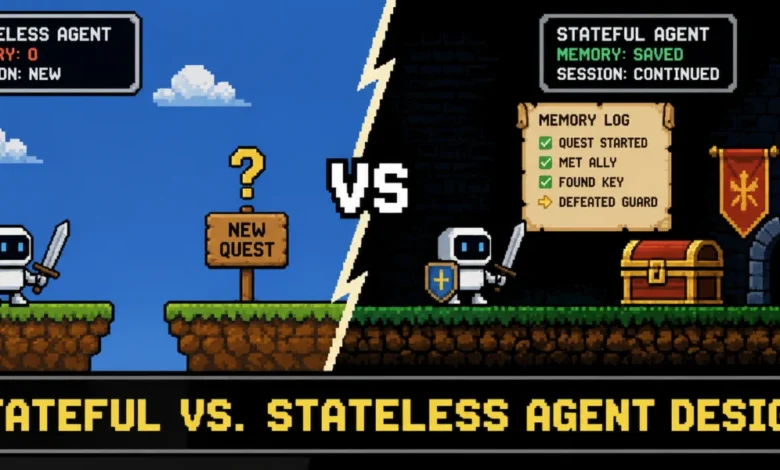
At its core, "state" in the context of an AI agent refers to the information the agent retains about past interactions, its environment, and its own internal workings. This can encompass a wide range of data: the full transcript of a multi-turn conversation, user preferences gleaned over time, results from previous tool calls, intermediate reasoning steps, or even long-term memory derived from user behavior. Without some form of state, an agent operates in a vacuum, treating every incoming request as an entirely new interaction, devoid of historical context. This limitation severely hampers its ability to engage in natural, continuous, or personalized dialogues, which are increasingly expected from modern AI applications. The challenge lies in determining where and how this crucial information is stored, accessed, and managed across potentially thousands or millions of concurrent user sessions.
The Stateless Paradigm: Efficiency in Isolation
The stateless approach dictates that each request made to an AI agent is treated as a completely isolated transaction. The agent processes the current input, performs its designated task—typically involving an LLM inference engine—and returns an output. Crucially, it retains no memory of previous interactions in its local context or internal storage once the execution cycle concludes. Any necessary historical context for subsequent turns must be explicitly provided by the client or frontend with each new request. This "fire and forget" model draws parallels to traditional stateless web servers, which process individual HTTP requests without maintaining session-specific data on the server itself.
Advantages of Stateless Agents:
- Exceptional Horizontal Scalability: This is arguably the most significant advantage. Since no user-specific memory is stored on the backend server, any incoming request can be routed to any available agent instance. This allows for effortless horizontal scaling by simply adding more identical instances behind a load balancer, making stateless architectures ideal for handling massive, fluctuating traffic loads.
- Simplified Backend Logic: The agent’s code is often simpler as it doesn’t need to manage persistent storage, database connections, or complex state serialization/deserialization. This reduces development overhead and potential points of failure related to state management.
- Enhanced Fault Tolerance: If an agent instance fails, no session-specific data is lost because it was never stored locally. Users can simply be redirected to another available instance without interruption, provided the client can resubmit the full context.
- Reduced Resource Contention: Without the need for shared memory or database locks for state, contention issues common in stateful distributed systems are largely avoided, leading to more predictable performance.
Disadvantages of Stateless Agents:
- Context Window Burden and Cost Escalation: For multi-turn conversations, the primary drawback becomes apparent. The client (frontend application) is responsible for collecting the entire conversation history and resending it with every new user prompt. This "snowballing effect" means the context window sent to the Large Language Model (LLM) grows linearly with the conversation length. As LLM API calls are often priced per token, this rapidly drives up operational costs. For instance, an LLM with an 8,000-token context window might quickly reach its limit in a detailed conversation, incurring higher costs or requiring complex context compression strategies.
- Increased Latency for Long Contexts: Larger payloads mean more data transfer and more tokens for the LLM to process, potentially increasing response times, especially for geographically distributed users or highly verbose conversations.
- Client-Side Complexity: The burden of managing and transmitting conversation history shifts entirely to the client. This can complicate frontend development, especially for mobile applications or browser-based interfaces, which must maintain and update the history robustly.
- Limited "Memory" Beyond Current Turn: The agent inherently lacks long-term memory or personalization capabilities that extend beyond the immediate interaction unless the client continuously feeds this information.
Illustrative Example: The "Fire and Forget" Nature
To demonstrate, consider a stateless_agent function that interacts with a Groq language model. The llama-3.1-8b-instant model, known for its efficiency and generous free-tier usage (up to 14,400 requests per day at the time of writing), serves as an excellent model for illustrating these paradigms without incurring significant costs.
import os
from groq import Groq

# Get an API key in https://console.groq.com/keys and set it here
os.environ["GROQ_API_KEY"] = "PASTE_YOUR_GROQ_API_KEY_HERE"

# Initializing the client
client = Groq()

# Using an efficient model from Groq: Llama 3.1 8B Instant
MODEL_ID = "llama-3.1-8b-instant"

def stateless_agent(prompt: str, provided_history: list = None) -> str:
    """
    The agent relies completely on the client to provide context.
    It retains no information from past interactions in local memory.
    """
    # Initializing with a system prompt
    messages = ["role": "system", "content": "You are a helpful, concise assistant."]
    # Appending whatever history the client provided
    if provided_history:
        messages.extend(provided_history)
    # Appending the new prompt
    messages.append("role": "user", "content": prompt)
    # The LLM processes the entire chain of messages
    response = client.chat.completions.create(
        model=MODEL_ID,
        messages=messages,
        max_tokens=100
    )
    return response.choices[0].message.content.strip()

# --- Testing the Stateless Agent ---
print("--- Turn 1 ---")
prompt_1 = "Hi, my name is Alice and I am learning about API infrastructure."
response_1 = stateless_agent(prompt_1)
print(f"Agent: response_1")

print("n--- Turn 2 (Without Client Context) ---")
# The agent fails here because it retained no memory of Turn 1
prompt_2 = "What is my name and what am I learning about?"
response_2 = stateless_agent(prompt_2)
print(f"Agent: response_2")

print("n--- Turn 2 (With Client Context) ---")
# The frontend MUST inject the history into the payload for the agent to succeed
frontend_payload = [
    "role": "user", "content": prompt_1,
    "role": "assistant", "content": response_1
]
response_3 = stateless_agent(prompt_2, provided_history=frontend_payload)
print(f"Agent: response_3")
Output from the stateless agent test clearly illustrates the dependency on the client for context:
--- Turn 1 ---
Agent: Hello Alice, nice to meet you. Learning about API infrastructure can be a fascinating and rewarding topic. What specific aspects of API infrastructure would you like to explore or discuss? Are you looking for information on API management, security, deployment, or something else?

--- Turn 2 (Without Client Context) ---
Agent: Unfortunately, I don't have any information about you, including your name. Our conversation just started, so I'm here to help you with any questions or topics you'd like to learn about. Please feel free to share your name and a topic you're interested in learning about.

--- Turn 2 (With Client Context) ---
Agent: Your name is Alice, and you are learning about API infrastructure.
This output highlights that without the client explicitly re-sending the history, the agent has no recollection of "Alice" or "API infrastructure." While simple to implement, the escalating token usage and client-side management for multi-turn dialogues can become problematic for complex or long-running conversations.
The Stateful Paradigm: Embracing Continuity and Complexity
In contrast, a stateful agent takes on the responsibility of managing its own memory. When a client sends a new user prompt, it typically includes a unique session identifier. The agent uses this ID to retrieve the ongoing conversation history or other relevant context from a persistent storage layer (e.g., a database or caching system). It then appends the new message to this retrieved history, processes the LLM inference, and, crucially, updates the stored context with the agent’s response before sending it back to the client. This approach allows for a much more natural and seamless conversational experience from the user’s perspective.
Advantages of Stateful Agents:
- Seamless User Experience: Clients only send the new prompt and a session ID, making the frontend experience cleaner and the conversation flow more natural, mimicking human interaction.
- Reduced Client-Side Complexity: The burden of context management is shifted from the client to the backend, simplifying frontend development and reducing payload sizes for client-server communication.
- Enabling Complex Workflows: Stateful agents can easily pause execution, wait for external tool responses, integrate with backend systems, or require human approval, all while maintaining context. This is crucial for autonomous agents that perform multi-step tasks.
- Personalization and Long-Term Memory: By storing state persistently, agents can build long-term memory about user preferences, past interactions, or specific user profiles, enabling highly personalized and adaptive experiences over time.
- Efficient Token Usage (Per Turn): While the total number of tokens processed over a long conversation might be similar (as the full context is still sent to the LLM), the stateful approach ensures the client-side payload remains minimal. The cost savings are more about managing the client’s burden and enabling specific backend architectures.
Disadvantages of Stateful Agents:
- Significant Scaling Challenges: This is the primary hurdle. Managing distributed state across multiple agent instances requires a robust and scalable persistent database layer. Strategies like sticky sessions with load balancers (which can create single points of failure) or, more commonly, centralized memory caching solutions (like Redis, Memcached) become necessary to avoid "localized amnesia" where an agent instance might not have access to the most recent state.
- Increased Backend Complexity: The architecture becomes more sophisticated. It requires integrating and managing databases, implementing robust data retrieval and update logic, handling concurrency, and ensuring data consistency across distributed systems.
- Operational Overhead: Managing persistent storage introduces operational complexities, including database backups, replication, security, performance tuning, and monitoring.
- Data Consistency Issues: In highly scaled environments, ensuring all agent instances always access the absolute latest version of a user’s state can be challenging, requiring careful design around eventual consistency or strong consistency models.
- Cost Implications (Infrastructure): While token costs per turn might be more efficient from the client’s perspective, the infrastructure costs associated with a high-performance, highly available, and scalable database or caching layer can be substantial.
- Security and Privacy Concerns: Storing sensitive user conversation history or personal data necessitates stringent security measures, including encryption at rest and in transit, access controls, and compliance with data privacy regulations (e.g., GDPR, CCPA).
Illustrative Example: Agent-Managed State
The following example uses an in-memory SQLite database to simulate a persistent storage layer, showcasing how a stateful_agent manages its own conversation history.
import sqlite3
import json

# Initializing an in-memory SQLite database for notebook testing
conn = sqlite3.connect(':memory:')
cursor = conn.cursor()
cursor.execute('''CREATE TABLE IF NOT EXISTS agent_memory (session_id TEXT PRIMARY KEY, history TEXT)''')
conn.commit()

def stateful_agent(session_id: str, new_prompt: str) -> str:
    """
    The agent manages its own state using a database.
    The client only sends the new prompt and their session ID.
    """
    # 1. Retrieving existing state from the database
    cursor.execute("SELECT history FROM agent_memory WHERE session_id=?", (session_id,))
    row = cursor.fetchone()
    if row:
        conversation_history = json.loads(row[0])
    else:
        # Initializing with system prompt for new sessions
        conversation_history = ["role": "system", "content": "You are a helpful, concise assistant."]

    # 2. Appending the new user prompt
    conversation_history.append("role": "user", "content": new_prompt)

    # 3. Processing the LLM call using the retrieved history
    response = client.chat.completions.create(
        model=MODEL_ID,
        messages=conversation_history,
        max_tokens=100
    ).choices[0].message.content.strip()

    # 4. Updating the state with the assistant's reply
    conversation_history.append("role": "assistant", "content": response)

    # 5. Saving the new state back to the database
    cursor.execute('''
        INSERT INTO agent_memory (session_id, history)
        VALUES (?, ?)
        ON CONFLICT(session_id) DO UPDATE SET history=excluded.history
    ''', (session_id, json.dumps(conversation_history)))
    conn.commit()

    return response

# --- Testing the Stateful Agent ---
print("--- Turn 1 ---")
print(f"Agent: stateful_agent('user_123', 'Hi, I am Bob and I want to scale my AI app.')")

print("n--- Turn 2 ---")
# Notice how the client NO LONGER sends the context payload. Just the session ID.
print(f"Agent: stateful_agent('user_123', 'What was my name again?')")
Output from the stateful agent test demonstrates its ability to recall context:
--- Turn 1 ---
Agent: Hello Bob, scaling an AI app can be a complex process. May I ask:
1. What type of AI technology is your app built on? (e.g., machine learning, natural language processing, computer vision)
2. Are you using any cloud services like AWS, Google Cloud, or Azure?
3. What are your scalability goals (e.g., increase user count, reduce latency, improve response times)?
This information will help me better understand your requirements and provide more effective assistance.

--- Turn 2 ---
Agent: Your name is Bob.
Here, the agent successfully recalled "Bob" without the client resending the entire conversation, illustrating the power of internal state management. This simplicity from the client’s perspective comes at the cost of increased complexity on the backend.
The Strategic Choice: Matching Architecture to Use Case
The decision between a stateless and stateful design is not a matter of one being inherently superior, but rather a strategic alignment with the specific functional requirements, scalability targets, and operational constraints of the AI application. Industry experts and developers frequently emphasize the need for a nuanced approach, acknowledging that different use cases demand different architectural paradigms.
-
Stateless Agents are Preferred for:
- Transactional AI: Single-turn queries, simple command execution, or one-off information retrieval where no memory of past interactions is needed.
- High-Throughput, Low-Latency Single Interactions: Scenarios where the primary goal is to process a large volume of independent requests as quickly as possible.
- Edge Deployments: Where client devices might have limited resources for managing extensive conversation history.
-
Stateful Agents are Essential for:
- Conversational AI: Any multi-turn dialogue system, chatbots, virtual assistants, or agents requiring continuous context.
- Personalized Experiences: Agents that adapt their responses based on user history, preferences, or evolving goals.
- Complex Autonomous Agents: Systems that perform multi-step tasks, integrate with external tools, or require human intervention at various stages, where maintaining context across these steps is critical.
- Asynchronous Workflows: Agents that need to pause, wait for external events, and then resume their processing.
Broader Implications and Future Outlook
The evolving landscape of AI agents, particularly with the advent of more capable LLMs, increasingly pushes the need for robust state management. As agents become more sophisticated, capable of multi-modal interactions and complex reasoning chains, their "memory" will need to store not just conversation history but also plans, observations, tool outputs, and internal reflections.
- Hybrid Approaches: A growing trend is the adoption of hybrid architectures. For example, a system might use a stateless agent for its core LLM interaction but couple it with a dedicated session store (e.g., Redis) or a vector database for managing long-term, semantic memory. This allows for the horizontal scalability of stateless processing while providing the rich context of stateful interactions. Serverless functions often lend themselves well to this, executing stateless code but connecting to external managed state services.
- Evolving Tooling: Frameworks like LangChain and LlamaIndex are continually developing abstractions to simplify state management, offering various memory components that can be plugged into agent designs, whether in-memory, database-backed, or vector-store-backed.
- Data Governance and Ethics: With stateful systems, the implications for data privacy and security are profound. Organizations must implement robust data governance policies, ensure data encryption, manage retention periods, and comply with international regulations to protect sensitive user information stored persistently.
- Economic Trade-offs: The decision also has significant economic ramifications. While stateless agents might incur higher token costs over long conversations, stateful agents introduce infrastructure costs for databases, caching, and potentially more complex DevOps. The optimal balance depends on the expected volume, length of conversations, and the overall budget.
In conclusion, the choice between stateless and stateful agent design is a critical architectural decision that requires careful consideration of an AI application’s specific requirements. While stateless agents offer unparalleled scalability and simplicity for transactional tasks, stateful agents are indispensable for delivering the rich, continuous, and personalized interactions that define the next generation of intelligent systems. As AI agents become more deeply integrated into our digital lives, mastering these architectural trade-offs will be key to building scalable, reliable, and truly intelligent applications.