The Lifecycle of an Embedding in Production
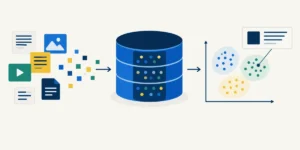
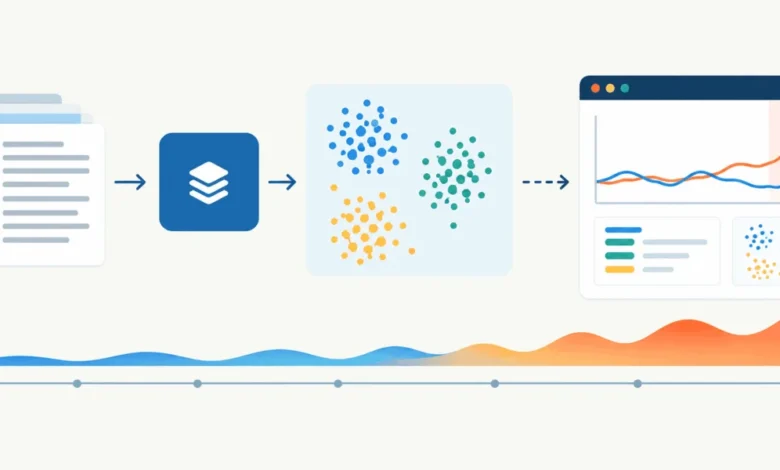
The lifecycle of a production LLM typically involves transforming raw text data into high-dimensional numerical vectors using a pre-trained encoder, such as those provided by the Sentence-Transformers library. These vectors are then indexed in a specialized vector database. During the initial deployment phase, these embeddings are assumed to be representative of the "ground truth" or the baseline data distribution.
However, the real world is rarely static. User behavior, emerging industry trends, and shifts in organizational terminology create a gap between the training distribution and the production reality. For instance, a customer support bot trained on technical troubleshooting manuals may experience a sudden influx of queries regarding a new, unplanned product launch or a cybersecurity incident. Because the underlying embedding model has not been updated to account for this new semantic space, the model perceives these new queries as "drifting" away from its baseline knowledge, often resulting in a drop in semantic similarity scores and poor retrieval performance.
Understanding the Mechanics of Embedding Drift
Embedding drift occurs when the probability distribution of the input embeddings changes over time. In a mathematical sense, if we represent the reference data as a distribution $P(X)$ and the production data as $Q(X)$, embedding drift is the divergence between these two distributions. Because these vectors typically reside in 384, 768, or 1,536-dimensional spaces, traditional univariate drift detection metrics—such as the Kolmogorov-Smirnov test—are computationally impractical and often fail to capture the multi-dimensional relationships inherent in the data.
To effectively manage this, engineers must implement continuous monitoring pipelines. This process involves collecting incoming production embeddings, comparing them against the established baseline, and triggering alerts when a significant statistical departure is identified. This is not merely an academic exercise; for enterprises, failing to detect drift can lead to systemic failures in automated customer service, financial analysis, or legal document retrieval systems, incurring significant operational costs.
Analytical Approaches to Detection
There are three primary strategies for detecting this phenomenon: the domain classifier approach, the centroid distance method, and statistical distribution comparison.
1. The Domain Classifier (Adversarial Approach)
The domain classifier technique is perhaps the most robust method for detecting high-dimensional drift. By training a lightweight, supervised machine learning model—such as a Random Forest or a logistic regression classifier—to distinguish between "reference" data and "production" data, one can effectively quantify the drift. If the classifier achieves high accuracy, it indicates that the two datasets are easily separable, confirming the presence of drift. A ROC-AUC score exceeding a pre-defined threshold (typically 0.65 to 0.70) serves as a reliable trigger for human intervention or automated retraining.
2. Centroid-Based Distance Metrics
The centroid method offers a more computationally efficient alternative. By calculating the mean vector (or "center of mass") of the reference batch and comparing it to the mean vector of the production batch using cosine distance, engineers can identify macro-level shifts in topic or intent. While this approach is faster and easier to implement, it carries the inherent risk of masking nuanced, multi-modal shifts within the data, as it reduces a complex high-dimensional distribution to a single point.
Practical Implementation and Simulation
To demonstrate these concepts, we look at the integration of the Scikit-LLM library, which acts as a wrapper for managing LLM pipelines. When simulating 384-dimensional embeddings, we observe that even subtle changes in the mean of the distribution (shifting from 0.0 to 0.3) result in significant statistical divergence.
import numpy as np
from sklearn.ensemble import RandomForestClassifier
from sklearn.model_selection import train_test_split
from sklearn.metrics import roc_auc_score

# Baseline Data (Reference)
np.random.seed(42)
X_reference = np.random.normal(loc=0.0, scale=1.0, size=(500, 384))

# Production Data (Simulating a topic shift)
X_production = np.random.normal(loc=0.3, scale=1.0, size=(500, 384))

# Labeling and Concatenation
y_reference = np.zeros(500)
y_production = np.ones(500)
X_combined = np.vstack((X_reference, X_production))
y_combined = np.hstack((y_reference, y_production))

# Training the Classifier
X_train, X_test, y_train, y_test = train_test_split(X_combined, y_combined, test_size=0.3)
drift_classifier = RandomForestClassifier(n_estimators=50, max_depth=5).fit(X_train, y_train)

# Evaluation
y_pred_proba = drift_classifier.predict_proba(X_test)[:, 1]
roc_auc = roc_auc_score(y_test, y_pred_proba)
print(f"Domain Classifier ROC-AUC: roc_auc:.3f")
In scenarios using real-world text, such as those processed through all-MiniLM-L6-v2, the results are even more pronounced. Queries concerning standard IT support (e.g., "reset password") versus niche financial queries (e.g., "minting NFTs") occupy distinct regions of the latent space. Monitoring these clusters allows firms to proactively manage their vector databases, updating their indices before users experience a degradation in service.
Broader Implications and Strategic Importance
The implications of embedding drift extend beyond simple technical metrics. From a product management perspective, detecting drift is equivalent to identifying changing user needs. If a company’s RAG system begins to see a spike in "drifted" queries, it serves as a business intelligence signal that the organization’s documentation or service offerings may be misaligned with current market demand.
Furthermore, the rise of "LLMOps"—a subset of MLOps specifically focused on the unique challenges of language models—has cemented embedding monitoring as a foundational pillar of AI governance. Industry experts argue that as models become more autonomous, the human-in-the-loop requirement for reviewing drifted data will become a regulatory and operational necessity.
Moving Forward: Automation and Governance
The future of embedding monitoring lies in automated feedback loops. When the centroid distance or the domain classifier triggers an alert, the most sophisticated pipelines do not merely notify an engineer; they automatically trigger a data-labeling process or pull relevant new documents into a fine-tuning set. By closing the loop between drift detection and model adaptation, organizations can maintain a high-performing AI system that evolves alongside its user base.
In conclusion, while the mathematical foundations of drift detection are well-understood, the implementation in production requires a careful balance between sensitivity and noise reduction. Whether through the rigor of domain classifiers or the efficiency of centroid analysis, the proactive monitoring of embedding space is no longer optional—it is a critical requirement for any enterprise that views its LLM as a core component of its operational infrastructure. By treating embeddings as dynamic data rather than static constants, developers can ensure that their AI systems remain robust, accurate, and relevant in an ever-changing digital landscape.