The Hidden Cost of AI Code Generation: Why Anthropic’s 25x CI Surge Signals a New Era for Software Quality Engineering

Software engineering has spent the better part of three decades trying to remove the barriers to code creation. From the advent of higher-level programming languages and modular frameworks to continuous integration pipelines and cloud-native infrastructure, the overarching objective has consistently been to accelerate how quickly developers can transform ideas into functional code. With the emergence of advanced generative artificial intelligence models, that long-standing optimization effort has achieved an unprecedented inflection point. Recent metrics published by AI research firm Anthropic reveal a fundamental shift in the software development lifecycle: artificial intelligence tools are now responsible for generating roughly 80 percent of the company’s internal codebase.
While the headline-grabbing statistic that Claude writes the vast majority of Anthropic’s code has dominated industry discussions, infrastructure and quality engineering experts are focusing on a different set of figures buried deeper in the organization’s technical disclosures. Over a recent six-month period marked by widespread agentic coding adoption, Anthropic’s internal test suite expanded tenfold, while continuous integration (CI) jobs surged by an extraordinary 25 times. This massive escalation highlights a critical reality of the modern software landscape: when artificial intelligence effectively eliminates the bottleneck of code generation, it does not remove friction from the development lifecycle—it merely relocates it. As development throughput scales exponentially, the primary constraint in software engineering has shifted definitively from production to verification.
The Mechanics of the Upstream Expansion
To understand the current strain on software delivery pipelines, industry analysts point to the fundamental mathematics of modern development workflows. Historically, a mid-level software engineer might author and submit a handful of meaningful code modifications per development sprint. With the integration of autonomous coding agents capable of planning, writing, and executing complex routines, individual developer output has multiplied dramatically.
However, raising the volume of code production immediately impacts every downstream process. When a developer—assisted by an AI agent—increases their output from a few pull requests per sprint to dozens, the volume of code paths, execution dependencies, security reviews, and deployment procedures scales in parallel. Every pull request requires validation; every code change demands test execution; every failed check requires investigation. Without a corresponding expansion in verification capacity, the delivery pipeline inevitably encounters severe congestion. Anthropic’s 25-fold increase in CI jobs is the direct manifestation of this structural pressure from the inside.
The traditional assumption that faster code creation naturally results in a faster, more efficient release lifecycle is proving to be a misconception. Instead, AI-driven development creates an upstream deluge of code that can quickly overwhelm legacy testing infrastructures. Organizations that scale their code generation capabilities without concurrently upgrading their quality engineering frameworks risk creating an expensive form of automation theater—generating larger volumes of code and running more frequent tests, while actually experiencing a net reduction in confidence per deployed release.

The Limitations of "Run All Tests" and the Rise of Deterministic Analysis
As CI pipelines buckle under the weight of AI-generated code, legacy testing methodologies are reaching their functional limits. The traditional directive to execute the entire regression test suite upon every code modification is rapidly becoming economically and computationally unviable. Running comprehensive regression tests for every minor, agent-generated code adjustment wastes valuable compute resources and stretches the feedback loops that autonomous agents require to evaluate and correct their own work.
Conversely, relying on large language models themselves to dynamically determine which tests should be executed introduces an unacceptable level of operational risk. Asking an AI model to guess which tests are relevant to a specific change is an unreliable verification strategy. To address this challenge, engineering organizations are turning to deterministic solutions.
Anthropic’s technical disclosures highlight the deployment of a deterministic test impact analysis service. Rather than relying on heuristics or probabilistic guesses, this system selects and executes relevant tests based strictly on package relevance and historical execution performance. This deterministic layer acts as a critical anchor, ensuring that high-stakes validation decisions remain grounded in reproducible logic while autonomous agents handle the iterative generation work.
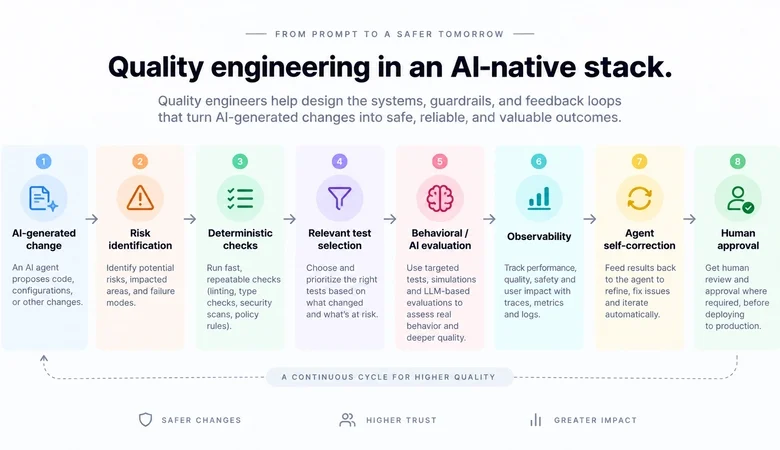
Furthermore, the role of the test suite itself has evolved. In traditional human-centric development, failing tests serve primarily as a gatekeeper at the end of the implementation phase. In an agentic workflow, however, the test suite functions as the primary navigational feedback loop for the autonomous agent. When an agent submits code, the deterministic testing layer executes relevant checks and returns structured failure or success data. The agent reads this feedback, self-corrects its logic, and re-submits the code in a continuous, automated iteration loop. Consequently, test execution latency is no longer merely a matter of developer convenience; it is a primary determinant of overall system throughput.
Redefining the Role of Quality Engineering
The rapid proliferation of AI-assisted development is fundamentally transforming the responsibilities of Quality Engineering (QE) and Quality Assurance (QA) departments. Historically, QA organizations measured their efficacy through manual test execution metrics and the accumulation of large libraries of automated testing scripts. In an environment where AI models can independently generate thousands of unit tests and implementation scripts in a matter of minutes, traditional volume-based metrics have lost their predictive value.

An AI agent can easily produce dozens of redundant tests covering trivial variations of a single behavior while simultaneously overlooking subtle, high-impact failure modes that present genuine operational risks in production. Consequently, quality engineering is moving away from the manual execution of test cases and toward higher-level architectural governance.
Modern quality engineering teams are increasingly tasked with designing the systemic environments in which AI agents operate. This involves establishing rigorous risk-identification frameworks, defining deterministic check criteria, configuring behavioral evaluation parameters, and determining precisely which system actions require automated verification versus mandatory human oversight. Rather than acting as a final checkpoint stationed at the end of the development assembly line, quality engineering is becoming an embedded infrastructural layer that ensures autonomous workflows remain trustworthy, transparent, and aligned with organizational risk tolerances.
Implications and the Path Forward
The broader implications of Anthropic’s infrastructure data extend across the entire software industry. As foundational AI models become more capable and cost-effective, code is transitioning from a scarce resource to an abundant commodity. However, abundant code inherently expands the software surface area, requiring significantly more review, validation, and trust.
Industry observers note that the most critical strategic takeaway from the current wave of agentic coding is not the 80 percent generation figure, but rather the 25x infrastructure multiplier that accompanied it. Organizations that fail to anticipate this shift risk falling into a severe operational trap: accelerating upstream development throughput without simultaneously hardening and modernizing downstream verification capabilities.
To avoid this imbalance, technology leaders are increasingly advised to stress-test their continuous integration architectures, review queues, and deployment controls against projected output multiples. Ensuring that verification systems can scale in lockstep with generative capabilities will determine which organizations successfully harness the productivity gains of artificial intelligence and which simply drown in an ocean of unverified code.