Autonomous Data Products for the Autonomous Era: Rethinking Data Architecture for GenAI

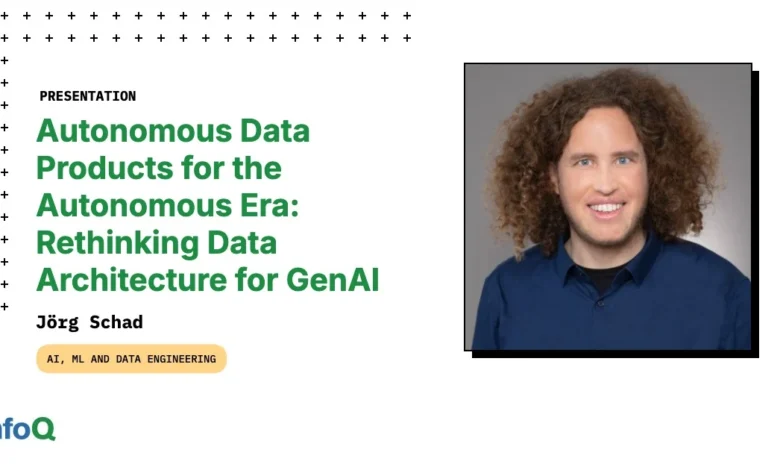
The rapid proliferation of generative artificial intelligence (GenAI) is exposing critical vulnerabilities in traditional enterprise data architectures, leading to widespread project failures not due to flawed models, but rather an underestimation of the operational complexities surrounding data access and management. This was the central theme explored by Jorg Schad, VP of Engineering at Nextdata, during a recent presentation on InfoQ, a leading platform for enterprise software development insights. Schad emphasized that the journey from GenAI prototype to production is fraught with challenges, primarily stemming from the inability of existing data systems to provide scalable, specific, and secure data access at the speed demanded by autonomous AI agents.
The GenAI Data Challenge: A Bumpy Road to Production
For many organizations, the allure of GenAI has led to a surge in experimental projects. Consultants frequently demonstrate impressive prototypes using small, meticulously curated datasets. However, the transition from these controlled environments to real-world production scenarios, where GenAI models need to connect with vast, heterogeneous, and often messy enterprise data, routinely encounters significant roadblocks. Schad noted that this "bumpy road from prototype to prod" is a consistent failure mode, and with GenAI, the speed and scale of data consumption by autonomous agents amplify these existing issues.
The core problems identified can be categorized into four pillars:
- Standardization: Enterprises often grapple with a fragmented landscape where individual teams adopt disparate tools and approaches (e.g., LangChain vs. custom solutions) for data access and ML systems, hindering scalability.
- Speed of Access: Autonomous agents require rapid, on-demand access to data, a stark contrast to the often manual, multi-step processes required in current architectures.
- Specificity: Providing the right amount of context to GenAI models is crucial. Overloading models with irrelevant data, a phenomenon Schad termed "context rot," demonstrably degrades performance and increases the likelihood of hallucinations. Research by various AI labs has consistently shown that as the input context length increases beyond an optimal threshold, the accuracy and relevance of LLM outputs tend to decline, making precise data exposure paramount.
- Safety: The autonomous nature of GenAI agents introduces unprecedented safety concerns. Uncontrolled access could lead to data corruption (e.g., a coding agent wiping databases) or, more critically, the exposure of sensitive Personally Identifiable Information (PII) or confidential business data to unauthorized users or external models.
The "Data 2.0" Problem: A Fragmented Landscape
Schad characterized the current state of enterprise data architectures as a "data management hairball." From an organizational perspective, numerous stakeholders—platform engineers, data product owners, ingestion teams, data architects, data stewards, data engineers, data governance, and end-consumers (including AI agents)—are involved. Each persona interacts with a fragmented system, where data and metadata are scattered across different tools and responsibilities, leading to slow coordination and bottlenecks.
Architecturally, this fragmentation manifests as a complex tangle of specialized tools for cataloging, governance, quality, lineage, and ETL/ELT pipelines. Enterprises invest heavily in solutions like Monte Carlo, Soda, or Great Expectations for data quality, alongside various pipeline orchestration tools, but the onus is on individual teams to weave these disparate components into a cohesive, yet often unwieldy, architecture. While foundational infrastructure like multi-cloud storage, compute, and security are generally mature, the challenge lies in unifying these layers and making data accessible to a rapidly expanding ecosystem of applications, particularly GenAI.
Schad drew a compelling parallel to the evolution of computing infrastructure, specifically the impact of Docker and Kubernetes. Just as these technologies standardized container images, runtimes, networking, and storage layers, enabling scalable microservices, a similar "hourglass of standardization" is needed in the data world. This middle layer would abstract away underlying complexities, allowing diverse data sources at the bottom and a multitude of consumption applications (including GenAI) at the top to interact seamlessly.
The inherent complexity of data is escalating across multiple dimensions: geographical distribution (cloud regions, on-premises), varied formats and access modes (RAG, MCP, vector embeddings, SQL, Power BI), diverse processing engines (Spark, Polars, Snowflake, Iceberg), and a growing array of applications. Critically, the human element—the different skills and personas interacting with these platforms—adds another layer of intricate coordination. This multi-dimensional complexity, if not managed proactively, becomes a significant impediment to autonomous data consumption by AI agents.
Introducing Autonomous Data Products: A Paradigm Shift
To address these challenges, Nextdata champions the concept of "Autonomous Data Products." Building upon the principles of Data Mesh, where data products are central units encapsulating data and metadata, autonomous data products introduce a crucial distinction: they are running processes with their own lifecycle management and runtime controllers (or "kernels").
An autonomous data product’s lifecycle consists of four key phases:
- Sensing Inputs: It monitors upstream data changes or dependencies on other data products, acting as an intelligent watcher.
- Running Transformation: Based on sensed inputs and configured policies, it triggers transformations (e.g., a Spark job, a Databricks SQL script) in the underlying compute layer. The data product is a logical abstraction, not a replacement, for these compute engines.
- Checking Outputs (Pre-Consumption): Crucially, outputs are not immediately exposed. The data product first runs comprehensive data quality checks and validates against predefined data contracts. This proactive validation ensures that any data consumed downstream is reliable and adheres to quality standards, a significant improvement over traditional post-facto alerting.
- Promoting Output: Only after successful validation are the outputs promoted and made accessible to downstream consumers, internal or external.
This encapsulated approach offers several benefits:
- Proactive Quality: Data quality issues are caught before data is consumed by agents or humans, preventing flawed data from propagating through the system.
- Standardized APIs: Each data product exposes standard APIs for observability and discovery, providing a single source of truth for its contents, metadata, and underlying logic.
- Multi-Modal Access: A single semantic data model can be exposed in various physical formats required by different consumers—SQL for data analysts, file-based access for ML engineers, vector embeddings for RAG-based GenAI applications, and Machine Comprehension Protocol (MCP) endpoints for autonomous agents. This eliminates the need for redundant, out-of-sync pipelines.
- API-Driven Interaction: Data products are entirely API-driven, allowing for easy sharing, access control, and programmatic interaction.
Data 3.0: The Vision for Scalable AI
The autonomous data product paradigm underpins a broader vision for "Data 3.0," shifting away from centralized, storage-oriented architectures towards a semantic, domain-first approach.
- Domain-Centric GenAI: Instead of starting with storage technology decisions (Snowflake vs. Databricks), Data 3.0 prioritizes defining the data assets needed by specific business domains. This empowers domain teams, who possess deep business context, to manage their data products independently, reducing reliance on central bottlenecks.
- Context-Aware Ground Truths: By exposing only specific, relevant slices of data to autonomous consumers, Data 3.0 combats "context rot," ensuring GenAI models receive precise information, thereby improving performance and reducing hallucinations. This granular control means an entire data warehouse isn’t exposed, but rather targeted, validated datasets.
- Modality Shift and Reuse: A key advantage is the ability to generate multiple output modalities (SQL tables, vector embeddings, document files, MCP endpoints) from a single semantic data product. This ensures all representations are always in sync, preventing discrepancies that plague systems with separate, parallel pipelines. If a new business requirement emerges for a different output format, the existing data product is simply extended, not duplicated.
- Self-Orchestration: Each data product manages its own lifecycle, sensing inputs and deciding when to run based on defined policies. This "orchestration shift" decentralizes pipeline management from a central team to the data product owner, aligning compute resources with actual business value. For instance, a report accessed monthly doesn’t need hourly Spark job runs.
- Inbuilt Lineage and Reasoning: Lineage, a critical component for data governance and debugging, is natively built into the data product abstraction. This provides an end-to-end audit trail, crucial for justifying model decisions and ensuring compliance.
- Proactive Governance and Data Quality: Unlike traditional systems where data quality alerts often occur after data has been consumed, autonomous data products enforce data contracts and policies before exposure. This "shift-left" in governance is paramount for autonomous agents, which lack human intuition to detect erroneous or sensitive data.
Addressing Safety and Governance in the Autonomous Era
The inherent risks of autonomous agents interacting with sensitive data necessitate robust safety mechanisms. Autonomous data products address this through centrally defined "policies" and a contract repository. For example, a global policy stating "no PII can be exposed to LLMs" can be enforced across the entire data mesh. Any data product seeking deployment must adhere to these contracts (e.g., implementing a predefined PII check if it has an MCP or embedding output). This enforcement is automated at deployment time and continuously checked during runtime, akin to Kubernetes Admission Controllers. This approach ensures scalability by offloading governance review from human teams, who would otherwise become severe bottlenecks, to an automated, policy-driven system. Data governance teams and CISOs can gain confidence that sensitive information is protected without stifling developer velocity.
Agent Lifecycle and Progressive Tool Discovery
The architectural shift also redefines how GenAI agents discover and interact with data. Autonomous data products standardize the creation of MCP (Machine Comprehension Protocol) tools and output ports. This standardization is crucial for interoperability. Furthermore, the concept of "progressive tool discovery" optimizes agent interaction. Instead of presenting an agent with a massive, undifferentiated list of all available tools (which contributes to context rot), the system employs an MCP gateway. An initial query to this gateway returns a minimal set of tools, typically including a discover_tools function. When an agent expresses a specific task, calling discover_tools with context, the system dynamically provides a highly specific, filtered set of tools relevant to that task (e.g., get_customer_feedback). This dynamic filtering, combined with centralized access control through the gateway, ensures agents receive only the necessary information, enhancing performance and maintaining security.
Nextdata’s Implementation: A Real-World Example
Nextdata’s platform provides a concrete implementation of these principles. The demo showcased a user interface visualizing different business domains, each containing various subdomains and individual data products. The interface clearly displays lineage, showing how data products interact.
Key features highlighted during the demo included:
- Data Product Overview: A quick description, update status, owner, and associated storage/compute services. Users can even inspect the underlying code.
- Trust Summary: Metrics on access frequency and data quality check pass rates, providing an immediate sense of reliability.
- Data Models: Details on the semantic data models offered, including centrally defined topics.
- API Functions: Explicitly defined questions or actions the data product can answer or perform, embedded directly with its implementation.
- Output Ports: Visualization of various output formats (Snowflake, Iceberg/S3, Pinecone vector embeddings) from a single data product, with options to request access based on permissions.
- Data Contracts: Clear display of data quality rules (e.g., using Soda) and their recent pass/fail status, ensuring adherence to promises.
- Policy Checks: Confirmation that the data product satisfies global organizational policies, such as data completeness or PII non-exposure rules.
The demonstration extended to an LLM (Claude Desktop) interacting with the mesh. The LLM could query metadata (e.g., "What data products are available in the demo mesh?", "What domains are available?") and actual data, with the system dynamically providing relevant tools via progressive discovery. This illustrated how autonomous agents can seamlessly and safely interact with a structured data environment, receiving only the information they are authorized and need to access.
Broader Implications and Industry Outlook
The shift towards autonomous data products and Data 3.0 represents a fundamental re-architecture of enterprise data strategy. It moves organizations beyond the limitations of monolithic data lakes and warehouses, offering a scalable blueprint for leveraging GenAI effectively. For CTOs and executive leadership, this vision offers the promise of accelerated GenAI initiatives, transforming the "dream of a fleet of agents" into a tangible reality. Data scientists and engineers can anticipate reduced friction in accessing high-quality, relevant data, allowing them to focus on model development rather than data wrangling. Data governance teams, traditionally seen as bottlenecks, transition into enablers, proactively embedding compliance and safety into the data ecosystem.
This paradigm aligns with evolving industry trends that emphasize decentralization, domain ownership, and API-first approaches. By encapsulating data, standardizing access, enabling multimodal consumption, and embedding proactive governance, autonomous data products offer a robust foundation for enterprises to harness the full potential of GenAI in a secure, efficient, and scalable manner. The key insight remains: domain-centric GenAI, with careful attention to data specificity and safety, is paramount for building truly scalable and resilient data architectures in the autonomous era.