The modern software development lifecycle is increasingly defined by the tension between rapid feature delivery and the long-term maintainability of complex systems. As organizations scale, the accumulation of technical debt and the degradation of code quality often become silent bottlenecks that impede innovation. To address these perennial challenges, the team behind Qodana—JetBrains’ code quality platform—recently convened to provide authoritative guidance on the technical standards that define high-performing engineering organizations.
The Anatomy of Technical Debt and Code Quality
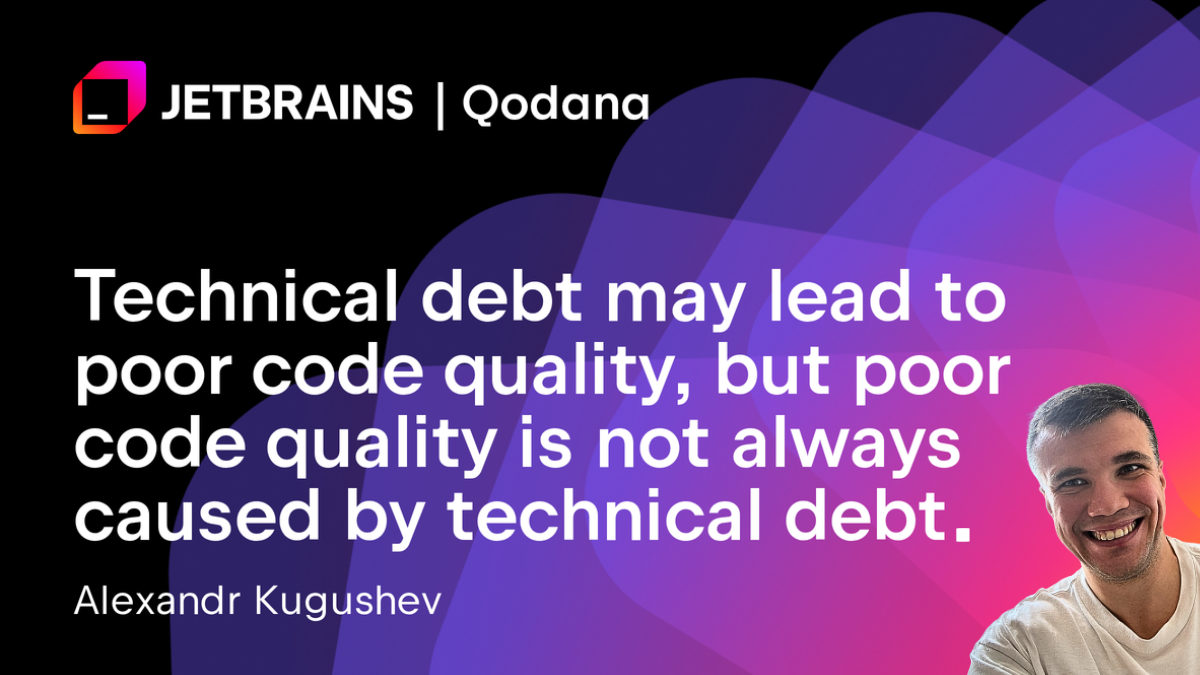
A fundamental misconception often plagues engineering discussions: the conflation of technical debt with poor code quality. While both negatively impact development velocity, their origins and remediation strategies are distinct. According to Alexandr Kugushev, a software engineer with the Qodana team, technical debt is essentially a strategic, albeit risky, trade-off. It is an intentional choice—such as hardcoding values to meet a Proof of Concept (POC) deadline—designed to prioritize speed over structural perfection, with the implicit understanding that the debt will be repaid later.
In contrast, poor code quality is frequently a byproduct of a knowledge gap or a failure to adhere to best practices. If a developer uses hardcoded values simply because they are unaware of configuration management patterns, the result is not a calculated risk but a systemic deficiency. While technical debt can eventually manifest as poor quality if left unmanaged, the inverse is not necessarily true. This distinction is critical for engineering managers: technical debt requires a repayment plan, while poor code quality requires education, mentorship, and architectural oversight.
Strategies for Cognitive Complexity Management
One of the most persistent hurdles in maintaining large-scale codebases is cognitive complexity—the measure of how difficult a piece of code is to understand and maintain. Deeply nested loops, a common symptom of high cognitive load, are notorious for increasing the probability of bugs during future refactoring.
Anastasia Lavrenko of the Qodana team suggests a multi-layered approach to simplifying logic. The most effective strategy is the aggressive elimination of nesting through structural changes. Developers are encouraged to move away from nested loops by decomposing monolithic blocks into smaller, single-purpose functions. Furthermore, modern programming paradigms—such as the use of map, filter, and reduce functions—can replace imperative loops with declarative logic, significantly improving readability. By flattening data structures before processing them, engineers can transform complex, spaghetti-like control flows into clear, linear pipelines.
The Evolution of Testing Standards
The role of unit testing in maintaining software integrity has shifted from a "best practice" to a mandatory standard in enterprise environments. Arman Ayvazyan, a member of the Qodana development team, emphasizes that unit tests serve as the primary defensive line against regression. By isolating individual units of behavior, tests allow for a rapid feedback loop. This speed is essential: the closer a test detects a defect to the point of introduction, the cheaper and easier it is to remediate.
However, the industry has also begun to adopt more sophisticated validation metrics, such as mutation testing. Unlike traditional code coverage, which merely measures the percentage of lines executed, mutation testing evaluates the efficacy of the tests themselves. By intentionally introducing small "mutations" or errors into the production code, developers can verify if their test suite is robust enough to catch the discrepancy. If the tests pass despite a mutation, the test suite is inadequate. While there is no universal benchmark, industry experts suggest that a mutation score between 40% and 60% provides a strong foundation for ensuring that tests are actually performing their intended function.

Measuring Quality Through Longitudinal Data
Determining whether a team’s code quality is improving is often difficult due to the qualitative nature of "good" code. Alex Costa, a senior engineer at JetBrains, advocates for a data-driven approach that looks beyond localized static analysis. Static analysis tools are excellent for identifying individual issues, but they must be viewed as indicators within a larger trend line.
A holistic view of quality improvement should include metrics such as:
- Regression Trends: The volume and frequency of new issues introduced per deployment cycle.
- Mean Time to Recovery (MTTR): A reduction in the time required to address production issues, suggesting that the code is easier to diagnose and fix.
- Severity Distribution: A shift in the ratio of high-severity (Sev 1) issues to lower-priority warnings.
By mapping these metrics over several quarters, leadership can gain an empirical understanding of whether their investment in testing infrastructure, code reviews, and automated analysis is yielding tangible improvements in software reliability.
Navigating the Challenges of Automated Scanning
A common pain point for DevOps teams integrating automated security and quality tools is the proliferation of "false positives." These occur when a tool flags code that is technically compliant with logic but violates an automated rule. Anna Zhukhova, a lead on the Qodana team, clarifies that the goal of static analysis is not simply to flag vulnerabilities, but to identify bugs, dead code, and dangerous patterns.
To minimize friction, teams must provide the analysis engine with context. If an organization chooses to deviate from industry standards for specific technical requirements, or if they are constrained by legacy dependencies, they must utilize suppression mechanisms. Most modern CI/CD pipelines allow for repository-wide exclusions or granular, line-level suppressions using tags such as // NOLINT. By curating these exceptions, teams can ensure that automated pipelines remain helpful assistants rather than sources of bureaucratic noise.
The Role of Continuous Integration in Scalable Quality
The broader implications of these practices point toward a paradigm shift: code quality is no longer a post-development chore but a continuous, integrated activity. The integration of platforms like Qodana into CI/CD pipelines allows for the democratization of high-standard engineering. By bringing JetBrains’ deep static analysis inspections into the development workflow, teams can catch structural defects before they are merged into the main branch.
This chronological shift—moving from retrospective code reviews to proactive, automated gating—drastically lowers the cost of software maintenance. In an era where the speed of deployment is a primary competitive advantage, the ability to maintain a clean, performant, and secure codebase is a critical differentiator.
Looking Forward
As software systems grow in scale and interconnectedness, the reliance on automated governance will only increase. The guidance provided by the Qodana team underscores a vital truth: technology is only as effective as the processes surrounding it. Whether it is the intentional management of technical debt, the adoption of rigorous mutation testing, or the careful calibration of automated scanning, the objective remains the same: to create a development culture where quality is a default, not an afterthought.
For engineering teams looking to refine their workflows, the focus for the coming year should be on transparency. By making the metrics of code health visible to all stakeholders—from individual contributors to project managers—organizations can foster an environment of continuous improvement. As the industry continues to evolve, the tools that provide the fastest, most actionable feedback will remain the most valuable assets in an engineer’s toolkit.
As teams move forward, the emphasis on "meaningful testing" and "conscious compromise" will likely become the standard by which high-functioning software organizations are measured. The transition from reactive debugging to proactive quality assurance is not merely a change in tools, but a fundamental change in mindset, essential for the next generation of resilient software development.