The Strategic Role of Knowledge Layers in Public Sector AI Deployment and Operational Workforce Intelligence

As public sector organizations across the globe finalize their fiscal strategies, a significant portion of capital has been earmarked for the integration of artificial intelligence into core operations. From defense and emergency services to healthcare and critical infrastructure, the pressure to deploy AI-driven solutions is no longer a future consideration but a current mandate. Governments are increasingly looking toward AI to bridge the gap created by aging workforces, budget constraints, and the need for rapid, high-consequence decision-making. However, as pilot programs transition into full-scale deployments, a critical architectural flaw is emerging: the inability of standard AI models to reason across fragmented and siloed workforce data.
In high-stakes environments where the speed of an answer must be matched by its accuracy, current AI applications often struggle. When applied directly to disconnected data sets, large language models (LLMs) and predictive algorithms tend to produce well-articulated but fundamentally incomplete answers. In sectors like combat medicine or disaster response, an incomplete answer delivered at high speed is not merely a technical error; it is a significant operational risk. The solution, according to emerging data strategies within the United States Department of Defense (DoD) and other leading agencies, lies not in the sophistication of the AI model itself, but in the structural architecture of the data it consumes.
The Hierarchy of AI Adoption: Data as the Foundation
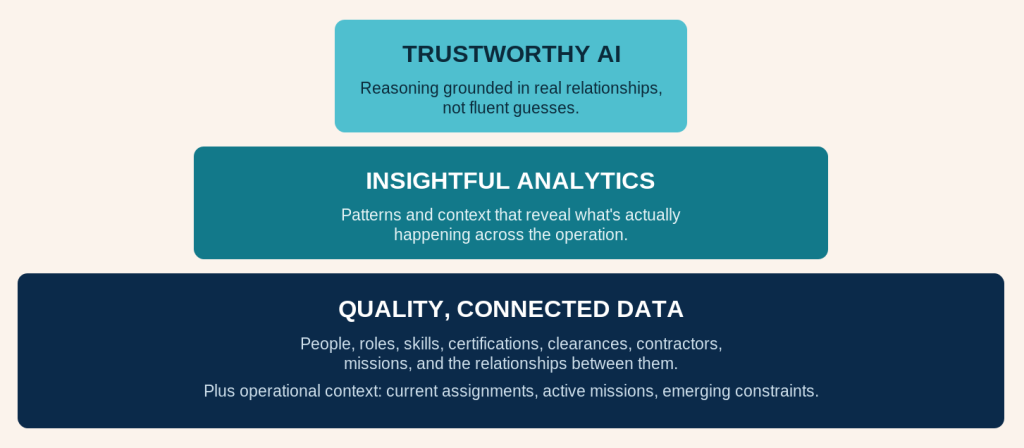
The United States Department of Defense’s Data, Analytics, and AI Adoption Strategy provides a clear roadmap for this technological evolution. The strategy outlines a rigid hierarchy of needs that must be satisfied to achieve operational excellence. At the base of this pyramid sits quality data; building upon that foundation are insightful analytics; and only at the apex sits responsible, autonomous AI.
The strategy is explicit: all analytic and AI capabilities require trusted, high-quality data. A defining characteristic of "trusted" data in this context is its connectivity. For AI to be effective, it must be able to exploit complementary data elements through their innate relationships. This requirement shifts the focus from traditional record-keeping—where data is stored in isolated tables—to a relational model where the connections between data points are treated as first-class assets.
The Evolution of Workforce Intelligence: A Chronology
The journey toward modern workforce intelligence has moved through several distinct phases over the last two decades. Initially, the focus was on digitization—moving paper records into digital databases. This was followed by the era of "Business Intelligence," where organizations attempted to create dashboards and reports from these databases.
By the early 2020s, the focus shifted toward "Data Lakes," which sought to aggregate disparate data into a single repository. However, while data lakes solved the problem of storage, they failed to solve the problem of context. Records remained siloed within the lake, lacking the relational metadata necessary for an AI to understand how a specific person’s certification might impact a mission’s viability three counties away.
We have now entered the "Knowledge Layer" era. This phase is defined by the creation of an Enterprise Knowledge Graph (EKG)—a dynamic, interconnected map of an organization’s entire operational reality. Unlike traditional databases, a knowledge layer does not just store facts; it stores the relationships between those facts, allowing AI to perform multi-hop reasoning across previously disconnected systems.
Defining the Workforce Knowledge Layer
A workforce knowledge layer is designed to bridge the gap between static human resources (HR) records and dynamic operational needs. It connects persistent facts—such as personnel files, roles, skills, and certifications—into a continuously maintained graph. This graph includes:
- Persistent Entities: People, roles, specific skill sets, professional certifications, security clearances, and external contractors.
- Operational Context: Current assignments, active missions, emerging constraints, and recent administrative decisions.
- Relationships: The links between these entities, such as which contractor supports which mission, or which specific certification is required for a privileged system access.
Without this layer, every new AI application must attempt to build its own understanding of the workforce from scratch. This leads to "hallucinations" where the AI makes assumptions about data it cannot see, resulting in inconsistent reasoning and duplicated logic across different departments.
Operational Scenarios: The Power of Multi-Hop Traversal
The necessity of a knowledge layer becomes most apparent when organizations face "compound questions"—queries that require following a chain of relationships across multiple entities.
Emergency Surge and Capability Gaps
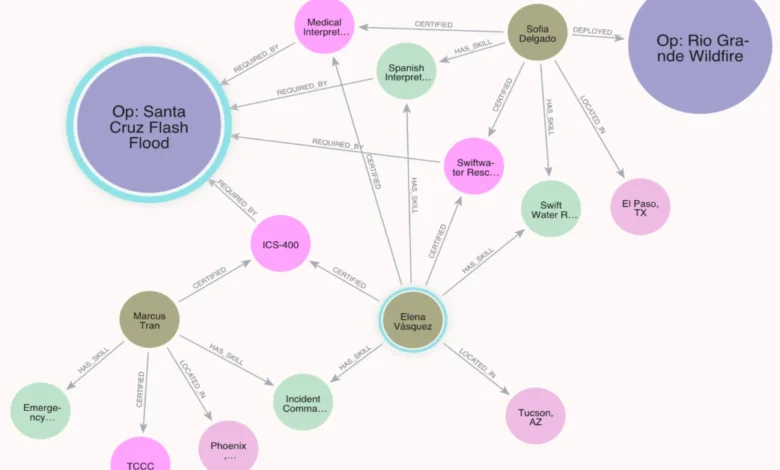
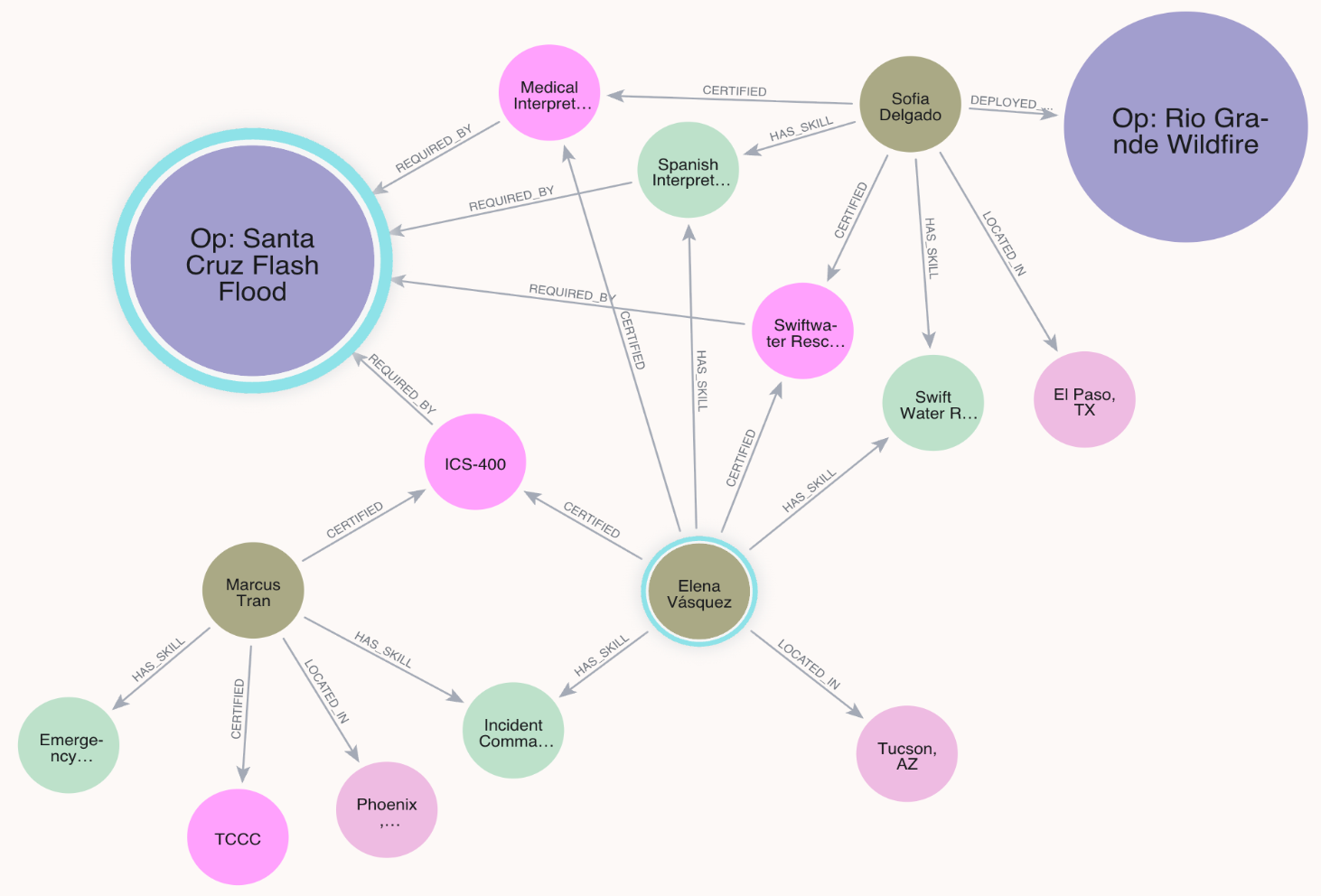
Consider a scenario involving a natural disaster, such as a flash flood requiring an immediate response. An AI tasked with identifying a response team must look for individuals who possess specific certifications (such as Swiftwater Rescue or Medical Interpreter status) and language skills (Spanish fluency).
In a traditional system, the AI might identify two qualified candidates: "Elena" and "Sofia." However, a knowledge layer reveals a deeper layer of truth. Sofia is currently the only medical interpreter assigned to an active wildfire response nearby. Removing her would create a critical capability gap in an ongoing mission. Elena, conversely, is part of a team with redundant coverage.
A standard database might show both as "available" or "qualified," but only a relational graph can show the downstream impact of moving them. This ability to see the "ripple effect" of a decision is vital for surge operations.
Contractor Dependency and Supply Chain Risk
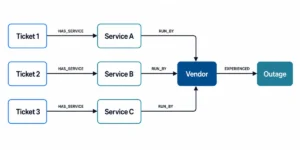
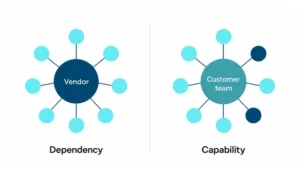
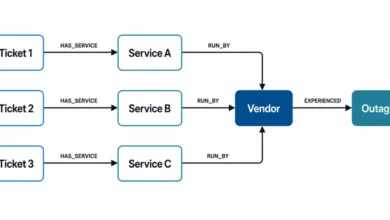
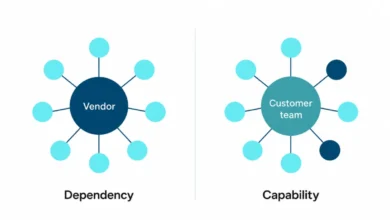
Public sector reliance on third-party contractors has reached historic highs. When a contractor exits a program or a parent company undergoes a merger, the operational impact can be opaque. A knowledge layer allows leaders to map exactly which programs a contractor supports, which internal roles depend on their expertise, and where no internal backup exists.
Furthermore, it can trace ownership chains—identifying if a subcontractor is owned by a parent company that poses a geopolitical or regulatory risk. This type of multi-hop traversal across people, organizations, and ownership structures is nearly impossible to perform efficiently in record-based systems.
Cybersecurity and the Insider Threat
The alignment of access, clearance, and operational responsibility is a constant challenge for security leaders. According to the Cybersecurity Insiders 2025 Insider Risk Report, 93% of security leaders consider insider threats to be as difficult or more difficult to detect than external attacks.
The report suggests that the signals for insider threats are almost always relational rather than record-based. An individual’s risk profile changes based on their position within the operational network—who they are connected to, which systems they can reach, and which missions they influence. A knowledge layer makes these invisible networks visible, allowing for real-time auditing of whether a person’s privileged access still aligns with their current mission requirements.
Supporting Data: The Cost of Fragmented Architecture
Research into AI implementation suggests that organizations that fail to address data architecture early in the process face significantly higher costs. Industry data indicates that:
- Data Preparation Time: Data scientists spend up to 80% of their time cleaning and organizing data rather than building models. A knowledge layer automates much of this contextualization.
- Auditability: In the public sector, the "black box" nature of AI is a major hurdle. Knowledge graphs provide a "reasoning path," allowing auditors to see exactly which relationships the AI traversed to reach a conclusion.
- Operational Efficiency: Organizations using graph-based intelligence report a 10x to 100x increase in query performance for complex, relational questions compared to traditional relational databases.
Broader Impact and Policy Implications
The decision to build a knowledge layer before or after AI deployment will likely define the success of digital transformation in the public sector for the next decade. If organizations apply AI to fragmented systems, they are essentially automating a broken architecture. Rebuilding that foundation after deployment is not only more expensive but can lead to a loss of public trust if the AI provides faulty or biased guidance during its initial run.
Moreover, the human element remains central. AI is not intended to replace the judgment of an emergency coordinator or a combat medic; it is intended to augment it. By providing a "connected intelligence" framework, leaders can answer compound questions quickly enough for the answers to actually matter in a crisis.
As the workforce continues to face structural challenges—including the "Silver Tsunami" of retiring specialists and diminishing pipelines for niche roles—the ability to maximize existing talent through connected data becomes a matter of national security.
Conclusion: Connected or Exposed
The data required to solve the most pressing workforce challenges in the public sector already exists. It is stored in HR systems, mission logs, certification databases, and procurement records. The missing link is the architecture that connects these disparate points of data into a coherent whole.
Platforms like Neo4j’s Graph Intelligence Platform are increasingly being recognized as the standard for this "knowledge layer" architecture. By turning fragmented records into traversable relationships, these platforms provide the "ground truth" that AI needs to be both effective and responsible.
In the final analysis, the organizations that thrive in the age of AI will not necessarily be those with the largest budgets or the most complex models. They will be the ones with the strongest knowledge foundations. In a world of increasing complexity, the choice for public sector leaders is clear: they can be connected and proactive, or they can remain fragmented and exposed, discovering critical dependencies only after a crisis has already begun.
Related posts: