Unlocking Frictionless Publishing: How Docsify-This Revolutionizes Markdown Content Sharing Without Complex Build Processes

The modern digital publishing landscape has long required content creators, educators, and developers to navigate complex website setups, static site generators, and intricate build pipelines just to share formatted documentation online. For years, publishing Markdown files meant configuring Node.js environments, managing dependencies, setting up continuous integration workflows, and deploying to specialized hosting services. However, the emergence of innovative open-source utilities is fundamentally shifting this paradigm. Among the most promising developments in this space is Docsify-This, an open-source project built upon the popular Docsify.js framework that allows users to instantly transform publicly available Markdown files into responsive, standalone web pages without any traditional website infrastructure or build processes.
Understanding the Mechanics of Docsify-This
At its core, Docsify-This addresses a persistent friction point in digital content management: the difficulty of publishing and reusing lightweight text markup across disparate platforms without duplicating effort. By leveraging URL parameters and the robust Docsify.js rendering engine, the platform ingests raw Markdown files hosted on public repositories—primarily Codeberg and GitHub—and dynamically renders them into polished, highly readable web pages in real time.
This architectural approach separates content creation from deployment. Authors write and maintain their documentation in plain text Markdown, utilizing version control systems to track changes, while Docsify-This handles the presentation layer dynamically. Furthermore, because the project is fully open-source, organizations and individuals can deploy their own independent instances of Docsify-This on custom domains. This decentralized capability shields users from vendor lock-in, ensuring long-term data sovereignty and operational continuity—a critical consideration for educational institutions and enterprise environments navigating strict compliance and data governance standards.

The Evolution of Lightweight Publishing and Background Context
To understand the significance of tools like Docsify-This, one must examine the trajectory of web publishing over the past two decades. In the early days of the web, content creation required direct HTML authoring, which gradually gave way to heavy Content Management Systems (CMS) like WordPress, Drupal, and proprietary enterprise platforms. While powerful, these systems often introduced unnecessary complexity, security vulnerabilities, and database overhead for simple documentation, blogging, and course material delivery.
The subsequent rise of Markdown in the mid-2000s offered a cleaner, human-readable alternative for text formatting. Developers and technical writers quickly embraced Markdown for its simplicity and portability. Yet, presenting Markdown files to non-technical audiences traditionally required compiling them into static HTML sites using tools like Jekyll, Hugo, or Sphinx. While effective, these static site generators still demanded technical proficiency in command-line interfaces, configuration files, and hosting management.
Docsify.js emerged as a client-side solution that rendered Markdown on the fly in the browser, eliminating the need for pre-generating HTML files. Building upon this foundation, Docsify-This extended the concept further by removing the requirement to host a dedicated Docsify site altogether. By abstracting the rendering process into a centralized or self-hosted service driven entirely by URL parameters, the project democratized access to advanced web publishing for educators, researchers, and project maintainers who lack dedicated web development support.
Core Features and User Workflow
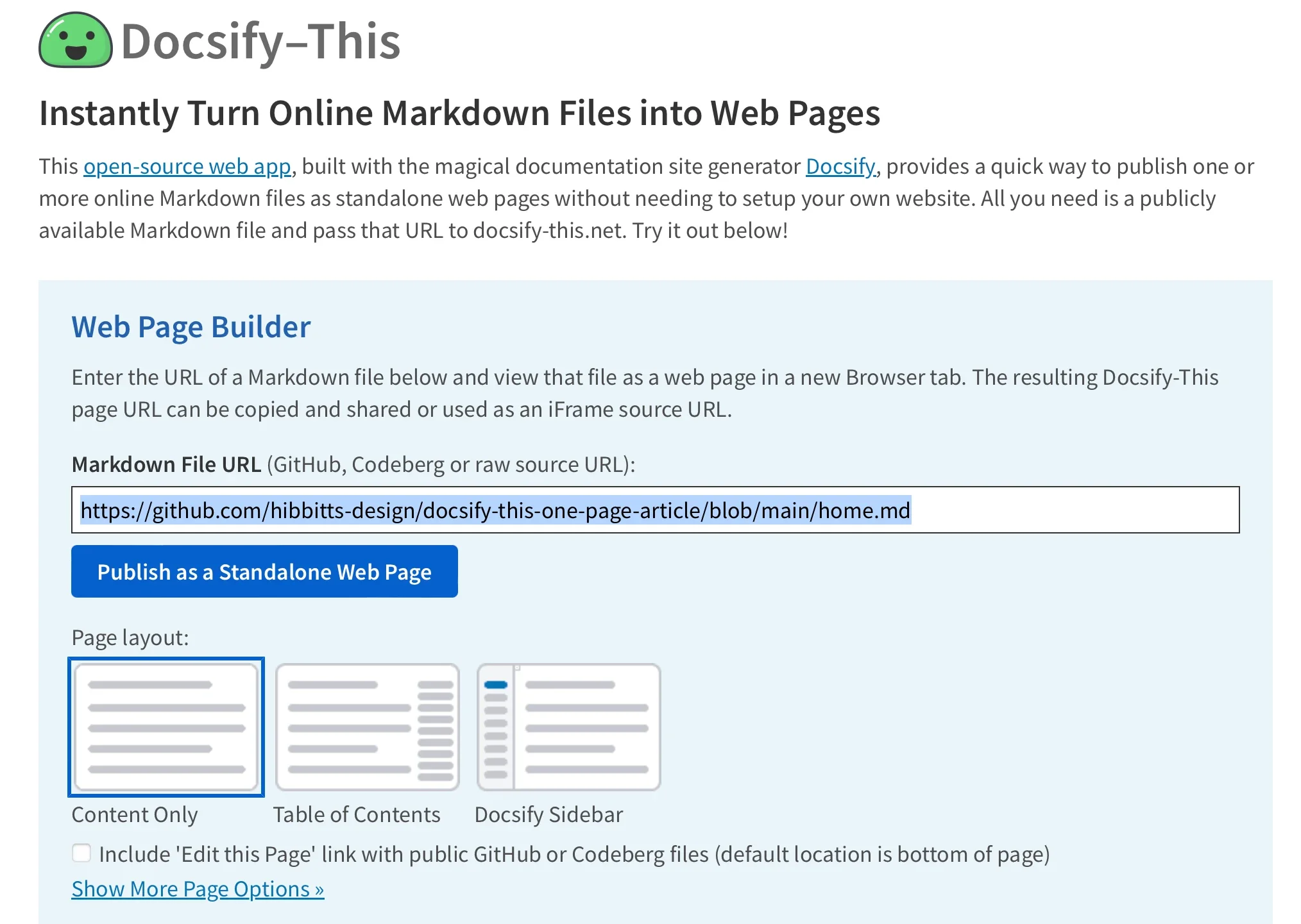
The platform provides a dual approach to content management: a user-friendly point-and-click Web Page Builder interface and direct URL parameter manipulation. Through the web interface hosted at docsify-this.net or on a private instance, users paste the raw URL of a Markdown file stored in a public Git repository. Upon clicking the publication button, the system generates a unique, shareable URL encapsulating the base path and target file.
Beyond single-page publishing, content creators can link multiple Markdown files together to form cohesive multi-page websites or digital handbooks. By modifying the "homepage" URL parameter, administrators can seamlessly direct readers to different documents within the same repository without altering the underlying infrastructure.
A notable feature for collaborative projects is the automatic integration of an "Edit this Page" link. When enabled for repositories hosted on GitHub or Codeberg, readers can click directly through to the source file in the repository, encouraging community contributions, peer reviews, and collaborative authoring workflows reminiscent of wiki-based platforms.
Customization, Visual Styling, and Platform Integration
One of the historical limitations of embedding external content into Learning Management Systems (LMS) or third-party CMS platforms has been visual inconsistency. Embedded content frequently clashes with the typography, color schemes, and layout constraints of the host platform, resulting in a disjointed user experience.
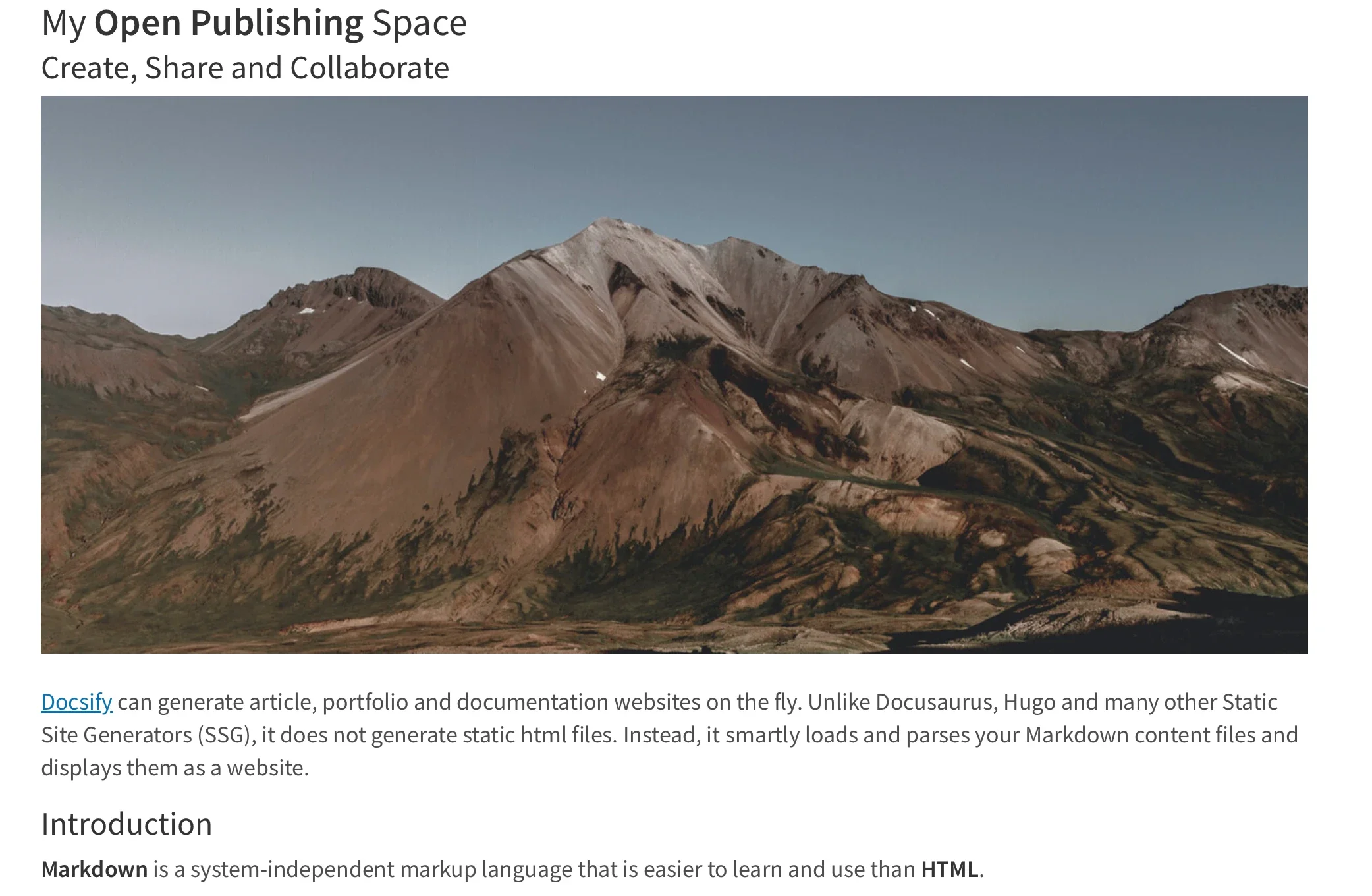
Docsify-This solves this challenge through extensive visual customization via URL parameters and specialized CSS classes. Administrators can dynamically pass common CSS attributes—such as font-family, font-size, link-color, and line-height—directly through the web page URL. This capability ensures that an embedded document seamlessly matches the visual identity of its destination platform.
Furthermore, the project supports a specialized set of Markdown CSS classes that enable rich UI elements to be generated directly from plain text syntax. For instance, appending specific class tags to standard Markdown links instantly transforms plain text hyperlinks into styled interactive buttons. For advanced users, custom CSS stylesheets can be embedded directly within individual Markdown files, allowing for the creation of bespoke components, layout grids, and visual containers without modifying the global application code.
Integration with Learning Management Systems and Educational Workflow
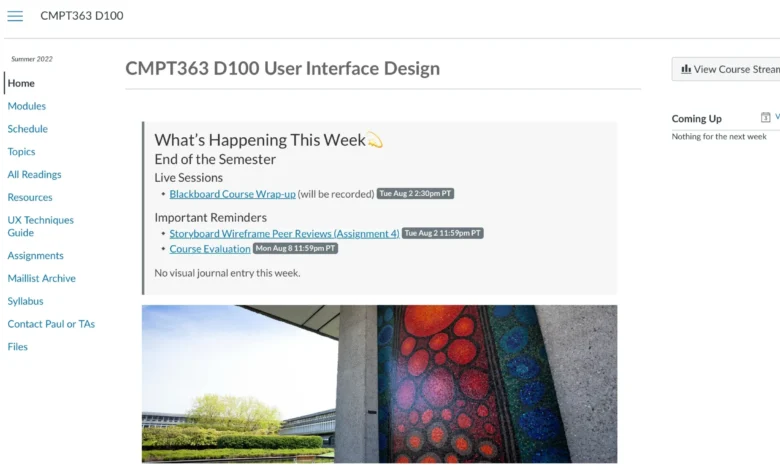
The flexibility of Docsify-This has found a particularly receptive audience within higher education and corporate training sectors. Educators frequently struggle to update course materials distributed across rigid Learning Management Systems like Canvas, Moodle, or Blackboard. Traditional LMS interfaces can be cumbersome for iterative text editing, often requiring multi-step file uploads and tedious formatting adjustments for every minor syllabus update.
By utilizing Docsify-This, instructors can maintain their course notes, syllabi, and resource guides in a single, version-controlled GitHub or Codeberg repository. Whenever an update is made to the Markdown source file, the changes are instantly reflected across all embedded instances of the document.

Educational institutions integrate these dynamic pages in two primary ways: via responsive iFrames or through external URL navigation tools. Using lightweight iFrame HTML snippets, instructors can embed fully formatted, responsive modules directly into course pages. Alternatively, platforms like Canvas and Moodle support external tool integrations and redirect links, allowing an entire Docsify-This repository to be mounted directly into the course navigation menu. This workflow grants students immediate access to up-to-date learning materials while preserving the familiar navigation structure of their primary educational portal.
The Role of Version Control and Collaborative Ecosystems
The integration of Docsify-This with Git-based version control platforms aligns publishing workflows with modern software engineering best practices. Storing documentation in Git repositories provides robust audit trails, branching capabilities, rollback options, and transparent history tracking.
To lower the barrier to entry for non-technical contributors, a wide array of user-friendly Git management tools are available. Graphical interfaces such as GitHub Desktop, Git-Cola, and SparkleShare allow users to manage repositories visually without interacting with command-line prompts. Additionally, modern code editors and text environments—including Visual Studio Code and Pulsar Edit—feature native Git integrations that streamline the editing, committing, and pushing of Markdown updates.
This ecosystem ensures that subject matter experts, instructional designers, and project managers can collaborate on shared documentation with the same reliability and precision traditionally reserved for software development teams.

Implications and Future Outlook for Lightweight Publishing
The growing adoption of tools like Docsify-This highlights a broader industry shift toward decoupled architectures, minimalism, and content portability. As organizations increasingly prioritize interoperability and frictionless publishing, heavy, monolithic web architectures are frequently being reevaluated in favor of lightweight, modular alternatives.
From an analytical perspective, the implications of this publishing model are twofold. First, it significantly reduces the technical debt and maintenance overhead associated with digital publishing. Organizations no longer need to allocate dedicated engineering resources solely to manage software updates, security patches, and database migrations for static informational websites. Second, it enhances content longevity and reuse. Because Markdown is a plain-text format independent of any proprietary database or application framework, content remains perpetually accessible, archivable, and easily translatable to future publishing technologies.
As open-source utilities continue to mature, platforms that bridge the gap between raw developer tools and accessible end-user interfaces will likely play an increasingly central role in digital communication. By lowering the technical barriers to professional-grade web publishing, Docsify-This exemplifies how minimalist design principles can solve complex, systemic challenges in education, enterprise documentation, and open-source collaboration.
Related posts: