Data-Driven Decision Making with AWS AppConfig Experimentation: Bridging the Gap Between Intuition and Production Evidence

In the modern digital landscape, the difference between a successful product launch and a costly technical regression often hinges on the ability to validate hypotheses against real-world user behavior. For years, software engineering teams have relied on a combination of development-environment testing and, eventually, "all-or-nothing" production deployments. While development testing confirms functionality, it fails to account for the chaotic variability of production traffic. Conversely, full-scale releases expose entire user bases to the risk of broken checkout flows, latency spikes, or performance degradation. AWS AppConfig experimentation, a capability of AWS Systems Manager, is designed to resolve this tension by enabling controlled A/B testing within production environments, allowing organizations to move away from gut-feeling decision-making and toward evidence-based engineering.
The core premise of AWS AppConfig experimentation is that testing should be both safe and data-driven. By leveraging existing feature flag infrastructure, teams can define a hypothesis, segment a specific audience, and serve different "treatments" to users. This process is managed through the AWS AppConfig Agent, which handles delivery, while leaving the complex task of data analysis to the organization’s preferred analytics platform. This architectural choice ensures that companies maintain full sovereignty over their metrics and data, rather than being locked into a proprietary experimentation silo.
The Evolution of Deployment Safety
Historically, the software development lifecycle was bifurcated into distinct phases: development, testing, and production. However, as microservices architectures and cloud-native applications have become the standard, the complexity of production environments has grown exponentially. According to recent industry benchmarks from the DevOps Research and Assessment (DORA) group, high-performing organizations are those that can deploy frequently and recover rapidly from failures. Experimentation serves as a critical tool in this evolution.
Before the introduction of integrated experimentation tools, engineers often had to build bespoke A/B testing frameworks, which were difficult to maintain and frequently prone to bugs. AWS AppConfig experimentation simplifies this by providing a control plane that integrates directly with existing AWS workflows. The system works by assigning users to either a "control" group or a "treatment" group, ensuring consistent experiences through the use of an Entity-ID. This consistency is vital for maintaining the integrity of data; if a user were to flip-flop between experiences, the resulting metrics would be statistically unreliable.
Architecting for Real-Time Validation
The technical architecture of AWS AppConfig experimentation is designed to be lightweight and scalable. At its heart, the system utilizes a three-pronged runtime approach: delivery, measurement, and safety.
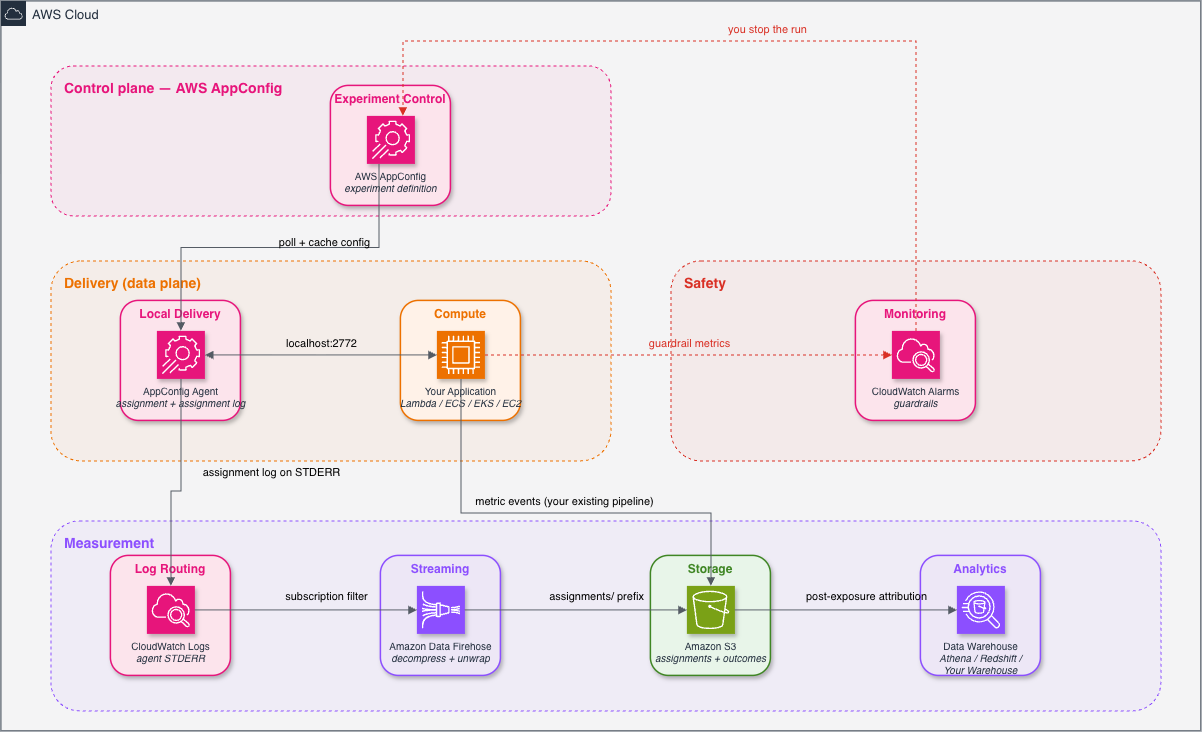
- Delivery: The AWS AppConfig Agent acts as a sidecar or extension, delivering the correct flag value to the application at the edge.
- Measurement: The agent automatically logs treatment assignments. These logs are then ingested via Amazon CloudWatch and processed through Amazon Data Firehose before being stored in Amazon S3.
- Safety: By setting gradual exposure, teams can limit the "blast radius" of a potential failure.
This pipeline is not just theoretical; it is a robust method for managing risk. By using Amazon Athena or other data warehousing tools, organizations can perform post-exposure attribution. This ensures that outcomes—such as "add to cart" clicks or successful checkouts—are only attributed to a specific treatment if the event occurred after the user was assigned that treatment. This temporal precision is the foundation of scientific rigor in software development.
Case Study: Frontend Optimization and Conversion
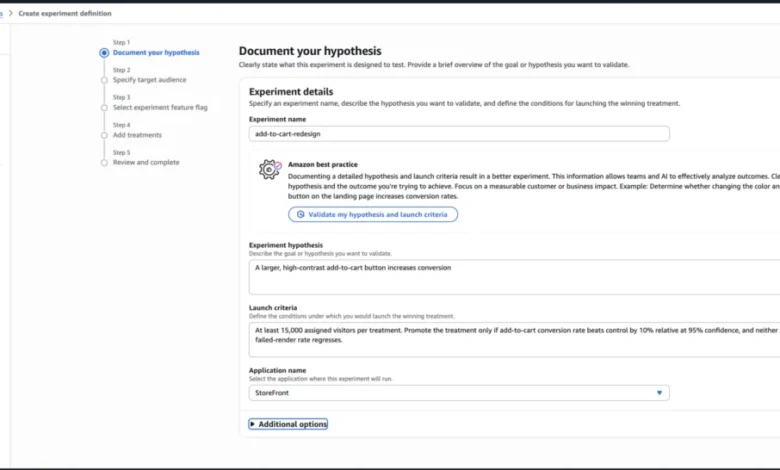
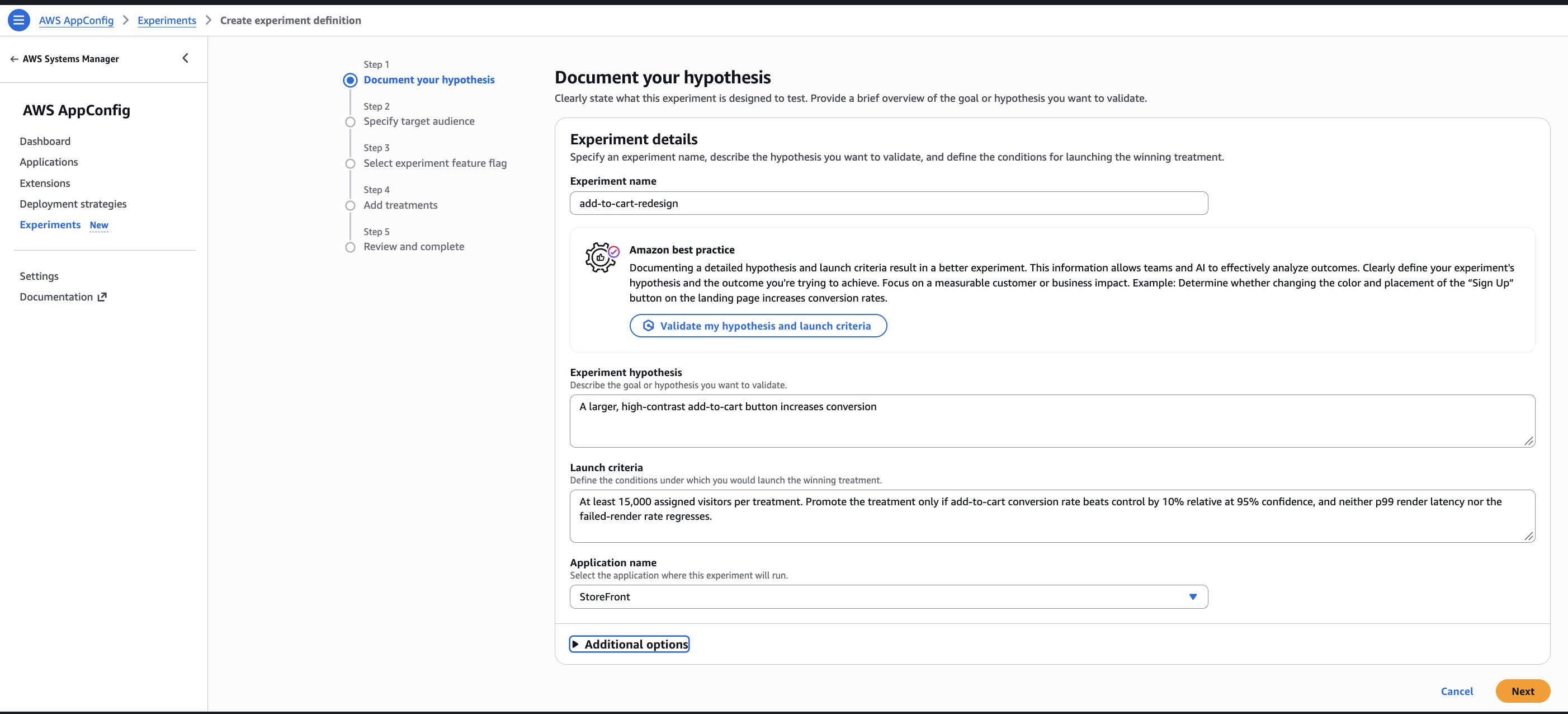
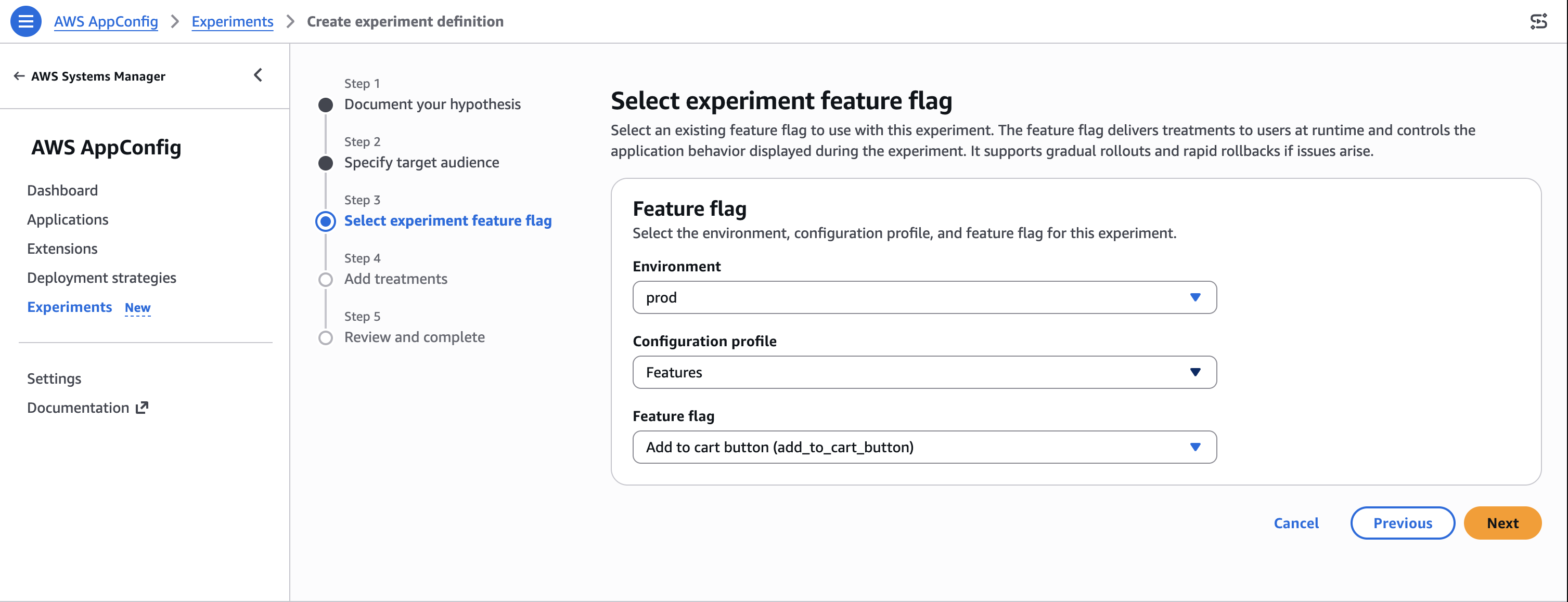
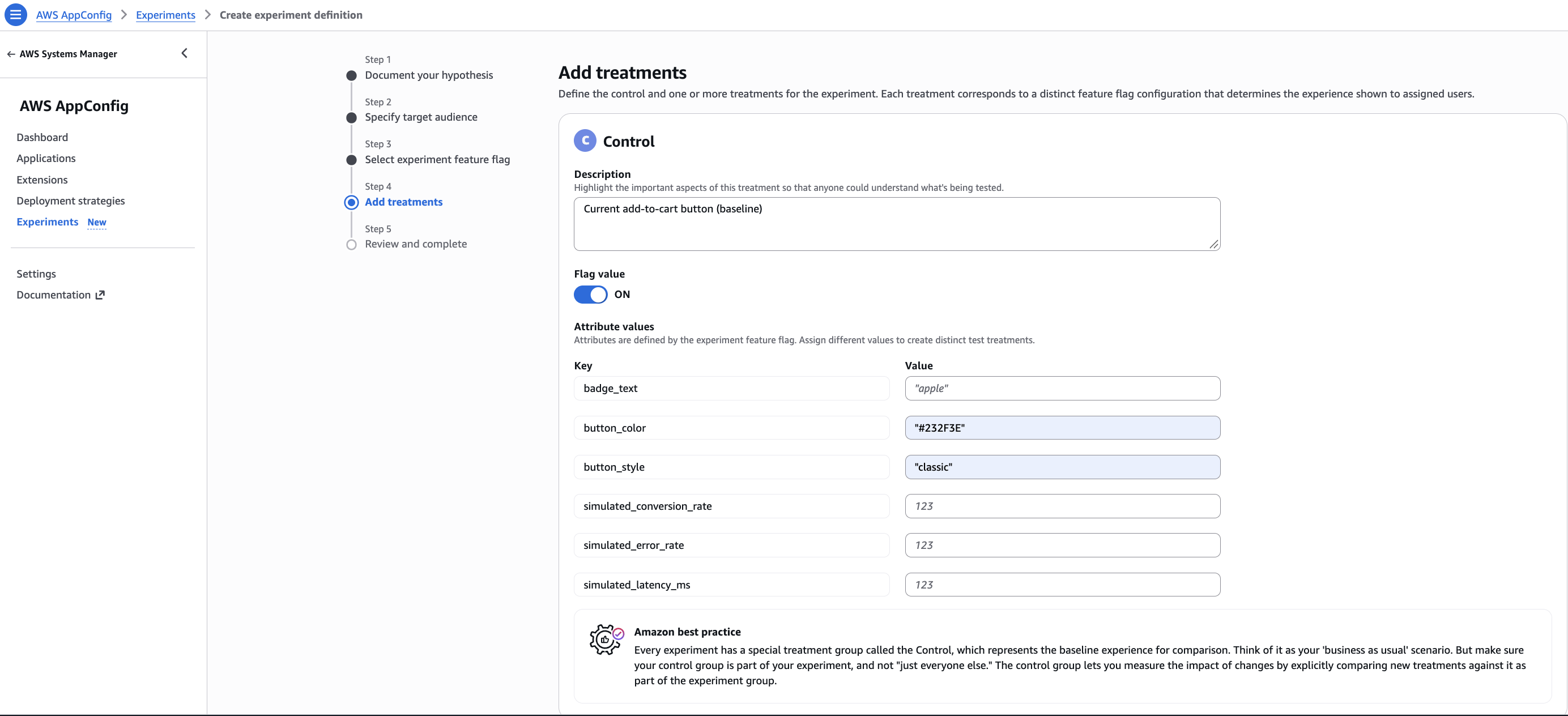
Consider a common retail scenario: a product team believes that a redesigned "Add to Cart" button, featuring a high-contrast color, will increase conversion rates. Previously, this change might have been deployed globally based on the loudest voice in the boardroom. With AWS AppConfig, the team can define an experiment in the console, set the audience to 5% of web traffic, and monitor the conversion rate in real-time.
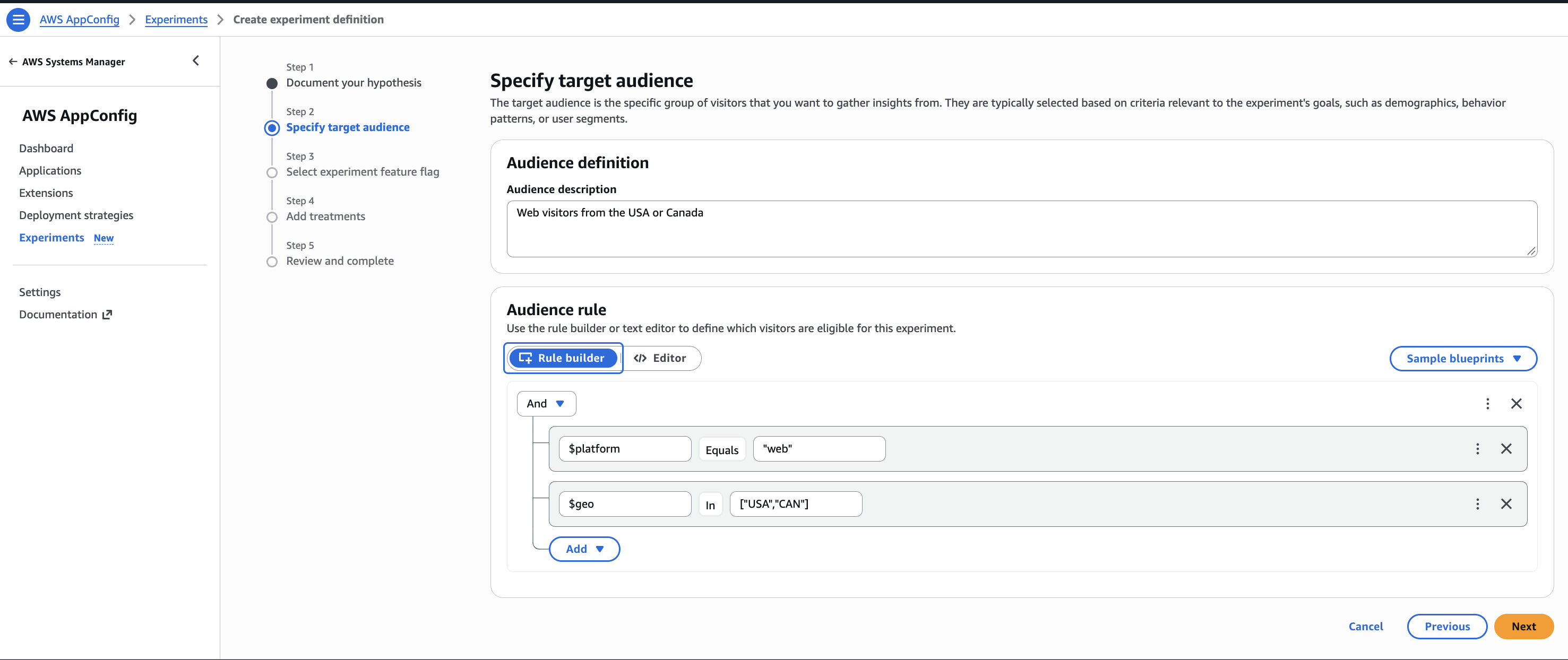
The setup involves defining an audience rule, such as selecting users only from specific geographic regions (e.g., USA and Canada) and on the web platform. The system then automatically manages the traffic split. If the new button causes a regression in latency or an increase in 500-level errors, the team can rely on pre-configured Amazon CloudWatch alarms to trigger a rollback. This automated safety net is a significant advancement over manual monitoring, where a regression might go unnoticed for hours.
Case Study: Backend Efficiency and Cache TTL
The utility of experimentation is not limited to the frontend. Backend teams often grapple with cache Time-to-Live (TTL) settings. A longer cache TTL can significantly reduce backend database load, but it risks serving stale data. Through AWS AppConfig, a backend service can treat the cache duration as a variable controlled by a feature flag.
By using the Amazon ECS Task ID as the Entity-ID, the team can ensure that each service instance receives a consistent TTL configuration. This allows for instance-level segmentation, which is far more precise than a broad application-wide change. The ability to test this in production ensures that the team can find the optimal balance between database performance and data freshness without manual coordination across a distributed cluster.
Operational Safety and Guardrails
The most critical aspect of any production experiment is the definition of "guardrails." AWS AppConfig experimentation emphasizes that an experiment is, by definition, a production change. Therefore, it mandates a safety-first approach.
Before any traffic is exposed to a new treatment, teams are encouraged to use a "0% exposure" window. During this phase, administrators can use treatment overrides to pin specific test accounts to a variant. This allows developers to verify that the application renders correctly and that the logging pipeline is successfully capturing assignment events in the data warehouse. Once this is confirmed, the ramp-up process begins.
Furthermore, the integration with Amazon CloudWatch alarms provides a layer of automated protection. If an experiment begins to degrade performance metrics, the alarms trigger the necessary alerts. While AWS AppConfig handles the deployment of the configuration, the organization remains responsible for the monitoring logic. This separation of concerns is a hallmark of the AWS philosophy: providing the tools for control while leaving the specific policy and threshold definitions in the hands of the end-user.
Statistical Rigor and Data Analysis
A common pitfall in software experimentation is the misinterpretation of results. AWS AppConfig provides the aggregate traffic metrics, but the final determination of "success" remains a human-led, data-backed analytical process.
To ensure statistical validity, teams should perform a power analysis to determine the required sample size before beginning the experiment. Once the data has been collected, comparing the conversion rates between the control and the treatment must be done using standard statistical tests, such as a two-proportion z-test. By following these rigorous protocols, organizations can avoid the "false positive" traps that often plague informal testing.
The post-exposure attribution query—joining assignment logs with conversion events—is the definitive method for calculating lift. By filtering out all events that occurred prior to the assignment timestamp, the resulting analysis represents a true causal relationship between the treatment and the observed user behavior.
Broader Implications and Future Directions
The shift toward controlled experimentation marks a maturity in how enterprises manage software delivery. It moves the industry away from the concept of "the deployment" as a singular, risky event and toward a model of continuous, safe, and incremental improvement.
From an economic perspective, the cost of these experiments is linked directly to the duration of the run. This encourages operational hygiene: experiments should have a start and an end. The practice of "orphaned experiments"—runs that are forgotten and left to consume resources—is mitigated by clear documentation and lifecycle management policies.
As organizations continue to adopt AI and machine learning, the role of configuration-driven experiments will only expand. Testing system prompts, model parameters, or RAG (Retrieval-Augmented Generation) retrieval strategies will follow the exact same patterns as the button-redesign experiments described here. By treating model parameters as configurable feature flags, teams can optimize AI-driven experiences with the same level of safety and scientific rigor currently applied to frontend and backend code.
In conclusion, AWS AppConfig experimentation provides a cohesive framework for those seeking to bridge the gap between intuition and empirical evidence. By leveraging existing infrastructure, maintaining control over data, and prioritizing safety through gradual exposure and alarm-based rollbacks, organizations can foster a culture of rapid, data-informed innovation. The tools are now in place; the challenge for the modern engineering organization is to adopt the discipline required to use them effectively.
Related posts: