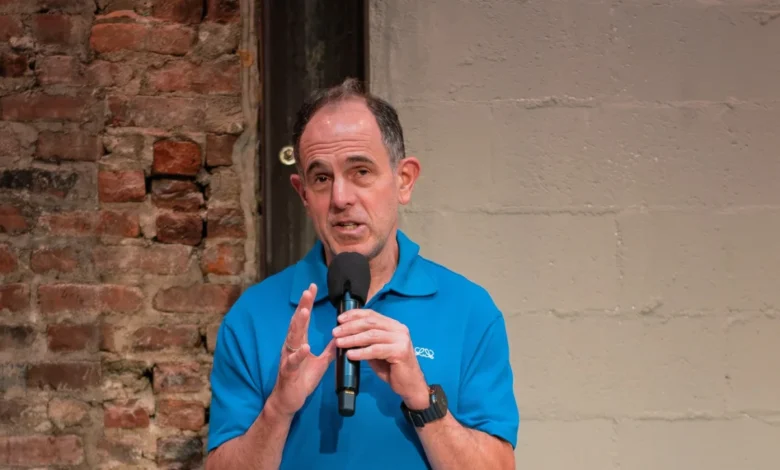
After thirteen years of deep-rooted operations centered exclusively in the affluent corridors of Menlo Park, California, Khosla Ventures is signaling a definitive shift in the geography of venture capital. Keith Rabois, a prominent partner at the firm, confirmed on Thursday night at TechCrunch’s StrictlyVC event in New York’s West Village that the powerhouse venture firm is establishing its first physical office outside of the Sand Hill Road ecosystem. The new workspace, located on 14th Street in Manhattan, is slated to open its doors this fall, marking a significant departure from the firm’s traditional "West Coast-only" operational model.
The decision is striking in its departure from Khosla’s internal culture. As Rabois noted during the event, the firm does not even maintain a dedicated office in San Francisco, choosing instead to focus its entire infrastructure in Menlo Park. This expansion to the East Coast is not merely a satellite office; it represents a strategic pivot toward integrating the firm more closely with the evolving tech and financial landscape of New York City.
A Strategic Pivot in Operations
The logistics of the expansion are currently underway. Rabois, who spoke candidly about the realities of commercial construction, hinted at the uncertainties of the project’s timeline. “It’s allegedly being built out now,” Rabois remarked to the audience. “We’ll see. This fall opening date is very vague in my mind.” Despite these reservations regarding the construction timeline, the firm’s commitment to the location remains firm.
The facility is designed to serve a dual purpose. While it will provide a base of operations for a select team of Khosla investors, its most innovative feature is an “executive briefing center.” This space is engineered to bridge the gap between emerging startups and established legacy corporations. The firm intends to rotate 10 to 12 of its portfolio companies through the space weekly, facilitating direct, high-level meetings with Fortune 500 decision-makers. According to Rabois, this creates a high-velocity environment that benefits the startups by accelerating access to pilot programs and enterprise-level customers.
Contextualizing the East Coast Migration
The timing of the expansion aligns with personal changes for Rabois, who recently relocated to the East Coast to be closer to his family, including his husband, Jacob Helberg, who serves as the Under Secretary of State for Economic Growth, Energy, and the Environment. However, while personal convenience may have served as a catalyst, the move reflects a broader macroeconomic trend: the shifting gravity of the American technology sector.
For decades, the Silicon Valley "moat" was defined by an unrivaled concentration of capital, technical talent, and networking opportunities. That monopoly, however, has begun to fracture. Recent data from the commercial real estate services firm CBRE indicates that New York has officially surpassed the San Francisco Bay Area in total tech talent headcount for the first time in the 13-year history of their tracking. This shift has been propelled largely by the aggressive hiring of AI-focused talent by New York’s financial institutions, which have been capitalizing on the talent churn caused by downsizing at major West Coast tech firms.
The Talent Paradox: Junior vs. Senior
When asked about the quality and density of talent in New York compared to the Bay Area, Rabois offered a nuanced assessment that differentiated between career stages. Regarding junior-level talent—specifically individual contributors and recent graduates—Rabois expressed high confidence in the New York market. He cited the fintech firm Ramp, a company he has backed extensively, as a prime example of how a startup can successfully build a "critical density" of high-performing young talent in New York.
“Individual contributor level, right out of school, absolutely,” Rabois stated. “We’ve been tapping into right-out-of-school graduates and been able to create a critical density of talent from the intern class that is extraordinary.”
However, the narrative shifts significantly when the conversation turns to senior technical architecture and executive management. Rabois identified a distinct "pain point" for companies requiring seasoned leadership. The challenge is not necessarily a lack of qualified individuals, but rather the geographic and lifestyle constraints of the New York metropolitan area.
“Senior engineers, architect-level—no, I think that’s a challenge,” Rabois explained. “Fortunately, maybe in the modern age, you need less of these people per company than you have historically.”
The executive-level recruitment issue is even more pronounced. For startups that prioritize an in-office culture, the commute from suburban areas to the city core creates a barrier to entry. “If you have an in-office culture, most of the more senior people that live and reside in the New York area live outside the city, and the commute in and out of the city for an office environment can be very painful,” Rabois noted. He argued that for senior executives with families, the cost of living and the quality of life in central Manhattan often preclude the five-day-a-week in-office model.
Institutional Strategy: Building from the Ground Up
This geographic friction has led to a specific hiring philosophy at firms like Ramp. Rather than attempting to compete for the limited pool of senior executives who are willing to navigate the complexities of a daily New York commute, the strategy has been to prioritize internal promotion and ground-up development.
“We don’t hire senior people. We just build from the bottom up,” Rabois said. “That can work. But if you need a CFO, a SVP of sales, someone who’s got a lot of gravitas and experience, it’s really hard to have them in the office five days a week.” This structural limitation continues to be a hurdle for the traditional venture-backed model that demands high-touch, in-person management.
Broader Implications for the Venture Capital Landscape
The entry of Khosla Ventures into the New York market follows a period of gradual, yet consistent, expansion by other major venture capital firms. While Sequoia Capital and Andreessen Horowitz have maintained presences in New York for years, their operations have historically been viewed as outposts rather than headquarters. The Khosla move suggests a transition toward a "bi-coastal" model becoming the industry standard for top-tier firms.
The reaction to the CBRE report, which suggests New York has overtaken the Bay Area in tech talent, remains polarized. At the StrictlyVC event, many attendees expressed skepticism, suggesting that raw headcount data might not capture the specific nature of the "innovation density" that still defines the Silicon Valley ecosystem. The sentiment among many investors is that while New York is rapidly gaining in administrative and financial-tech talent, the "build-from-zero" culture that powers high-growth venture capital still finds its most fertile ground in Northern California.
Conclusion: The Future of Venture Geography
As Khosla Ventures prepares to open its 14th Street office, the move serves as a bellwether for the venture capital industry. The firm is essentially betting that the future of enterprise tech is not found in a single geography, but in the intersection of finance, policy, and startups—an intersection where New York is currently asserting dominance.
Whether this physical expansion will lead to a broader exodus from the Bay Area remains to be seen. For now, firms are adopting a hybrid approach: maintaining the deep technical roots of the West Coast while positioning themselves closer to the capital and customer base that defines the East Coast. For Khosla, the "executive briefing center" is the centerpiece of this strategy, an attempt to replicate the success of the Silicon Valley network within the urban density of Manhattan. As the industry watches the construction on 14th Street, it is clear that the traditional, monolithic geography of the venture capital world is a thing of the past.
Related posts: