Mastering Terminal Presentations: A Comprehensive Guide to the Open-Source Spiel Python Framework

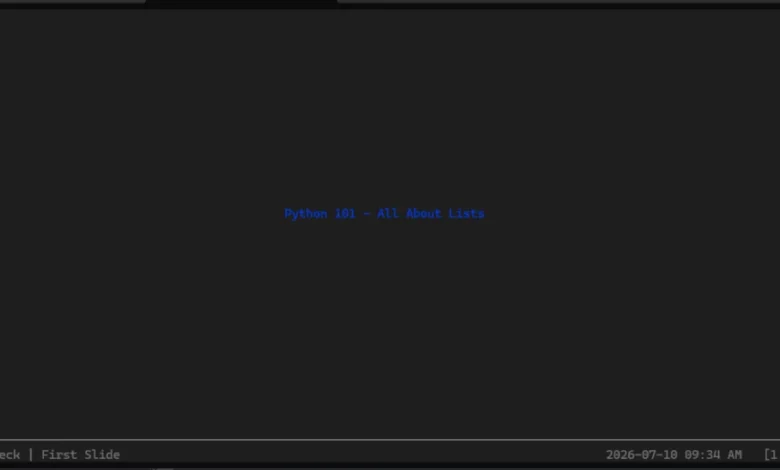
The modern landscape of software development and technical presentations often relies on heavy, graphical applications such as Microsoft PowerPoint, Apple Keynote, or web-based alternatives like Google Slides. However, a niche yet innovative segment of the developer community continually explores minimalist paradigms that keep engineers entirely within their preferred command-line environment. Addressing this specific workflow preference, open-source developer Josh Karpel introduced Spiel, a Python-based framework designed to render fully interactive, beautifully styled presentations directly inside a terminal window.
Although the project’s official GitHub repository is currently archived—largely due to underlying dependencies on legacy iterations of Textual that prevent seamless upward compatibility—Spiel remains a fascinating case study in creative command-line interface (CLI) design. By leveraging the rendering prowess of the popular Rich package, Spiel bridges the gap between raw text interfaces and polished visual storytelling. This report examines the technical architecture of Spiel, provides a comprehensive installation and implementation guide, explores the broader implications of terminal-based tooling, and contextualizes its place within the wider Python ecosystem.
Background Context and the Evolution of Terminal Tooling
For decades, the computer terminal has served as the primary nexus for systems administration, software compilation, and source code management. While graphical user interfaces (GUIs) eventually came to dominate consumer computing, developers have continually sought ways to bring rich media, color, and structured layouts into the terminal. Tools like tmux, htop, vim, and neofetch transformed the character-cell interface from a monochrome text prompt into a vibrant, information-dense workspace.
In recent years, the Python ecosystem has witnessed a renaissance in terminal user interface (TUI) design, heavily catalyzed by packages such as Will McGugan’s Rich and Textual. Rich brought syntax-highlighted code blocks, Markdown rendering, custom tables, and progress bars directly to standard output, while Textual enabled full-featured, event-driven TUI applications. Spiel emerged during this wave of innovation as an experimental medium for technical speakers, developers, and educators who wished to deliver presentations without ever leaving their terminal sessions. By packaging slides as Python functions decorated with routing logic, Spiel allowed technical documentation and presentation slides to live in the exact same repository as the source code they describe.
Technical Architecture and Dependency Ecosystem
At its core, Spiel relies on the architectural primitives provided by Rich to layout, style, and print renderable objects to the screen frame-by-frame. When a user launches a presentation via Spiel, the framework initializes a command-line controller that listens for keyboard inputs—specifically directional arrow keys for navigation and control signals for termination.
Despite its elegant design, the project’s current archival status on GitHub highlights a persistent challenge in modern software engineering: dependency drift. Spiel was built upon an early architecture of Textual. As Textual underwent rapid, major version iterations—transitioning into a fully fledged asynchronous TUI framework with reactive attributes—older integrations became incompatible. Because the repository is archived, the core codebase has been frozen in time, meaning that developers wishing to experiment with Spiel must operate within a carefully managed virtual environment pinned to compatible legacy dependencies.
Installation and Setup Procedures
While containerization offers a frictionless method for evaluating software without altering local machine states, establishing a dedicated Python virtual environment remains the best practice for developers looking to inspect or build upon Spiel’s codebase.
Evaluating via Containerization
For users who wish to test the framework instantly without installing package dependencies locally, Spiel provides a pre-built Docker container image hosted via the GitHub Container Registry. By executing a single command, Docker fetches the isolated environment and launches the default demo:
docker run -it --rm ghcr.io/joshkarpel/spielThis command pulls the image, allocates an interactive pseudo-TTY, connects standard input, and automatically removes the container upon termination, ensuring zero local clutter.
Local Installation via Pip
For developers intending to author custom slide decks, local installation is straightforward. It is highly recommended to isolate the installation inside a Python virtual environment to avoid polluting global system packages or triggering dependency conflicts with newer Rich or Textual installations.
# Create a virtual environment
python3 -m venv spiel-env

# Activate the virtual environment
# On macOS and Linux:
source spiel-env/bin/activate
# On Windows:
# spiel-envScriptsactivate

# Install the package via pip
pip install spiel
Once the installation completes, verification can be performed by executing the built-in demonstration deck included with the package:
spiel demo presentUpon successful execution, a fully interactive terminal presentation launches, allowing users to verify that keyboard bindings and color rendering function correctly within their specific terminal emulator (such as Alacritty, Kitty, iTerm2, or Windows Terminal).
Authoring Presentations: From Basic Decks to Advanced Layouts
Spiel provides two primary programmatic mechanisms for defining slides: utilizing decorator patterns on standard Python functions or instantiating explicit Slide objects and adding them to a Deck collection.
The Decorator Approach
For simple, linear presentations, the decorator pattern offers an intuitive syntax reminiscent of web microframeworks like Flask. Each slide is defined as a Python function returning a Rich-compatible renderable type (such as strings, Text objects, Panels, or Tables), decorated with routing metadata:
from rich.console import RenderableType
from spiel import Deck, present

deck = Deck(name="Introduction to Terminal Presentations")

@deck.slide(title="Welcome Slide")
def slide_one() -> RenderableType:
    return "Welcome to presentations inside your terminal!"

if __name__ == "__main__":
    present(__file__)
The Advanced Component Approach
For more complex layouts involving customized styling, alignment, and dynamic data injection, developers can utilize Spiel’s object-oriented components alongside Rich’s styling primitives. The following complete example demonstrates how to build modular slide factories using Align, Text, and Style:
from rich.align import Align
from rich.console import RenderableType
from rich.style import Style
from rich.text import Text
from spiel import Deck, Slide, present

def make_styled_slide(
    title_prefix: str,
    slide_text: Text,
) -> Slide:
    """Factory function to generate standardized, center-aligned slides."""
    def render_content() -> RenderableType:
        return Align(slide_text, align="center", vertical="middle")

    return Slide(title=f"title_prefix Presentation Slide", content=render_content)

# Initialize the presentation deck
presentation_deck = Deck("Python Architecture Overview")

# Construct individual slides using helper factories
first_slide = make_styled_slide(
    title_prefix="Opening",
    text=Text("Python 101: Deep Dive Into Lists and Iterables", style=Style(color="blue", bold=True))
)

second_slide = make_styled_slide(
    title_prefix="Core Concepts",
    text=Text("A Python list is a mutable, ordered sequence of arbitrary objects.", style=Style(color="red"))
)

# Register slides with the deck
presentation_deck.add_slides(first_slide, second_slide)

if __name__ == "__main__":
    present(__file__)
When this script is executed via Python in the terminal, Spiel renders the presentation interface. Navigation is handled seamlessly: users advance to the subsequent slide using the right or down arrow keys, return to previous slides using the left or up arrow keys, and safely exit the application at any moment by pressing Ctrl + C.
Broader Industry Implications and Future Outlook
The existence and reception of tools like Spiel highlight several noteworthy trends in software engineering and developer tooling:
- Context Switching Reduction: For engineers conducting technical workshops, internal tech talks, or code walkthroughs, remaining within the terminal eliminates the cognitive friction associated with minimizing IDEs, opening external presentation software, and managing dual-monitor display configurations.
- Infrastructure as Documentation: Because presentations written in Spiel are pure Python scripts, they can be version-controlled in Git, subjected to automated linting, and updated via standard pull requests alongside the codebase they reference.
- The Fragility of Open-Source Dependencies: Spiel’s archived status serves as a reminder of the vulnerabilities inherent in fast-moving open-source ecosystems. When upstream dependencies undergo breaking architectural changes—such as the evolution of Textual—smaller satellite projects can easily become orphaned if maintainers lack the bandwidth to refactor core rendering pipelines.
Conclusion
While Spiel currently occupies a niche space as an archived open-source experiment, its design philosophy offers a compelling glimpse into the future of developer-centric communication tools. By fusing the aesthetic power of Rich with programmatic slide generation, it proves that effective presentations do not require heavy graphical suites. Whether developers choose to adopt Spiel within pinned virtual environments for their next internal lightning talk, or simply use its architecture as inspiration for building custom terminal utilities, the project remains a brilliant exercise in command-line creativity.