Laya and the Rise of Non-Autoregressive Decision Engines: Why the AI Industry is Re-Evaluating LLM Classification Costs

The modern artificial intelligence landscape has spent the past several years aggressively leaning into generative capabilities, leveraging massive frontier models for virtually every task, including straightforward text classification, content moderation, and queue routing. However, this "LLM-as-a-judge" paradigm has introduced severe economic and operational friction for enterprise engineering teams. Serializing text into a prompt, dispatching it to a resource-intensive frontier model, waiting for token generation, and parsing the resulting prose via complex regular expressions has proven to be an expensive, latent, and non-deterministic bottleneck.
This systemic frustration has fueled the explosive, unprecedented rise of Laya, an open-source, non-autoregressive decision engine developed under the Apache-2.0 license by NandhaKishorM. Within just nine days of its initial public release in September 2026, the GitHub repository captured more than 26,000 stars and thousands of forks, reflecting an industry-wide exhaustion with deploying deliberative language models for high-frequency, low-complexity classification tasks.
The Core Architecture: System 1 Thinking for Enterprise AI
To understand the sudden market enthusiasm for Laya, one must examine its core architectural premise, which mirrors Daniel Kahneman’s concept of "System 1" human cognition: fast, automatic, intuitive, and subconscious judgment, as opposed to the slow, deliberate computation of "System 2."
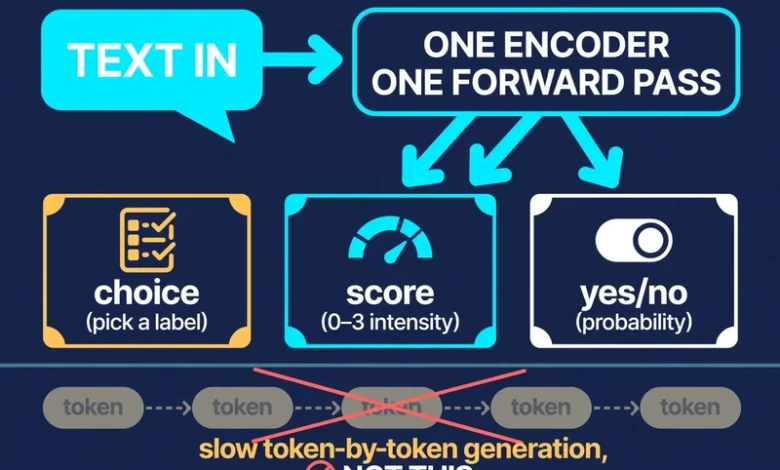
Traditional large language models operate autoregressively, predicting the next token sequentially. When an enterprise system asks a frontier model whether a customer support ticket expresses frustration, demands a refund, or requires escalation, the model generates conversational prose token by token, which developers must subsequently translate into structured JSON. Laya bypasses this cycle entirely.
By employing a non-autoregressive architecture built upon transformer encoders—specifically leveraging variants like ModernBERT-large—Laya processes an input text and a set of typed questions simultaneously through a single forward pass. The engine handles multiple decision typologies natively: choice for multi-label classifications, score for measuring intensity across defined numerical scales, and noul (yes/no) for probability-based binary assessments.

Because the model does not generate conversational text, its inference returns output_tokens: 0, eliminating both the compute overhead and the financial cost associated with token-based generation. On a standard NVIDIA T4 GPU, the engine boasts speeds of approximately 33 milliseconds per question, dropping to just 7.2 milliseconds per question when processing batched inputs. Even on standard CPU infrastructure, the architecture offers a dramatic efficiency leap over traditional autoregressive alternatives.
Chronology and Deployment Milestones
The rapid trajectory of the project highlights the agility of modern open-source AI tooling development:
- September 18, 2026: Laya is officially published to GitHub and Hugging Face under the repository
convaiinnovations/laya, introducing its foundational English (421M parameter) and multilingual (322M parameter) checkpoints. - September 20–24, 2026: Word spreads rapidly across developer communities and AI engineering forums, driving an unprecedented surge of approximately 3,000 GitHub stars per day as engineers test its drop-in CLI and Python router components.
- September 27, 2026: The repository records 26,639 stars and 2,326 forks. Real-world evaluations confirm the stability of version 0.3.21, showcasing its cross-lingual routing capabilities, built-in enterprise presets (such as triage, email moderation, and guardrails), and schema-driven Python application programming interfaces.
Technical Deep Dive: Installation and Production Integration
For engineering organizations looking to integrate non-autoregressive decision routing into existing pipelines, the installation process emphasizes resource-conscious deployment. Developers typically initialize the environment by ensuring PyTorch is installed via its CPU index to prevent the accidental download of multi-gigabyte CUDA dependencies, followed by pinning the stable release:
pip install torch --index-url https://download.pytorch.org/whl/cpu
pip install "laya==0.3.21"
Once installed, Laya provides a Command Line Interface (CLI) that automatically detects script profiles and language structures to route queries to the appropriate checkpoint. For instance, evaluating an incoming support ticket using the built-in multilingual preset demonstrates the engine’s capability to return multi-dimensional, typed metrics instantly:
laya "My payment failed twice" --preset triage --model multilingual --device cpuThe output yields a structured breakdown containing explicit confidence metrics for intents, urgency levels, frustration scales, and churn risk parameters—all derived from a single computational pass without generating a single output token.
In programmatic production environments, engineers interact with the Router class to manage automated workflows. A critical feature of Laya’s enterprise readiness is its opt-in confidence thresholding (min_confidence). When an input text yields ambiguous results—such as a misclassified feature request evaluated below acceptable certainty parameters—Laya flags the specific field as low_confidence or returns None via its schema-driven API.

This design pattern introduces a reliable safety mechanism: rather than propagating erroneous classifications into downstream databases or automated refund systems, the engine routes uncertain data points to human review queues or escalates them to larger frontier models.
Industry Implications and the Calibration Caveat
Despite the overwhelming enthusiasm from the developer community, independent evaluations and the project’s own documentation emphasize crucial operational caveats. Most notably, the initial open-source checkpoints are significantly over-confident out of the box, producing probability distributions that appear sharper than empirical accuracy warrants. Furthermore, the multilingual checkpoint ships without pre-fitted temperature scaling.
Industry analysts and machine learning engineers stress that organizations deploying Laya in production must perform rigorous temperature calibration against proprietary held-out datasets before establishing hard automated thresholds. While default confidence gates (such as min_confidence=0.90) serve as effective baseline filters, treating raw probabilities as absolute mathematical certainty without local validation introduces operational risks.
Broader Economic and Architectural Impact
The emergence of Laya signals a broader architectural shift within AI engineering. For years, the industry operated under the assumption that scaling up frontier models was the universal solution for both complex reasoning and routine classification. Laya challenges this mono-model approach by proving that narrow, structured classification tasks are better suited to dedicated, lightweight encoder models.
By offloading 95% of routine routing, sentiment analysis, moderation checks, and intent classification to non-autoregressive engines running locally or on inexpensive edge hardware, companies can drastically reduce their API expenditure with frontier model providers while simultaneously improving system latency. As enterprises mature in their AI deployment strategies, the division of labor between heavy reasoning engines and lightning-fast, typed decision engines like Laya is expected to become a standard architectural blueprint across customer support, content moderation, and workflow automation.