Netflix Overhauls Conductor Workflow Orchestration Engine to Power Next-Era Scale and Mitigate Performance Bottlenecks

In an effort to future-proof its sprawling technical infrastructure against a projected fivefold increase in workload demand, streaming pioneer Netflix has significantly overhauled its internal Conductor workflow orchestration engine. The newly detailed architectural transformation, designated as Conductor 4.0, marks a major milestone in the evolution of the company’s distributed systems engineering, addressing critical memory constraints, latency spikes, and locking contention that emerged as the platform scaled to unprecedented volumes.
Today, Conductor serves as the silent engine room for a vast array of Netflix business domains, orchestrating complex distributed workflows across Content and Studio Engineering, global advertising platforms, and burgeoning gaming initiatives. The scale of the system is immense: Conductor currently supports approximately 200,000 distinct workflow definitions spread across 150 unique enterprise applications, executing an astonishing 420 million workflows every single month. However, this massive operational footprint pushed previous iterations of the software to their absolute limits, compelling engineers to fundamentally rethink how workflow states are managed, loaded, and processed.
The Evolution of Netflix Conductor: A Chronological Journey
To understand the necessity of the 4.0 redesign, one must examine the historical architecture of Conductor and the steady accumulation of engineering hurdles over the years. Conductor’s evolution has been characterized by a continuous series of migrations and decentralizations aimed at removing monolithic bottlenecks.
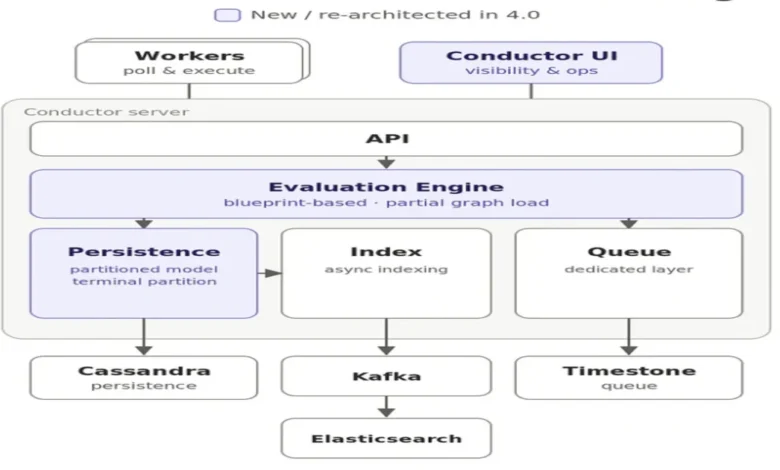
In its early iterations, Conductor relied heavily on Dynomite for execution data storage. As data volumes soared, the engineering team migrated execution data to Cassandra to improve durability and scale. Simultaneously, large task inputs and outputs—which threatened to bloat database memory—were systematically offloaded to Amazon S3 object storage. To streamline queue management, the platform replaced DynoQueues with Timestone, a specialized queuing technology designed to handle high-throughput scheduling. Furthermore, Apache Kafka was introduced to decouple event indexing from the core execution path, allowing Elasticsearch and Apache Iceberg to handle downstream search indexing and long-term analytical storage without interfering with active workflow processing.
Despite these aggressive architectural upgrades, a fundamental operational bottleneck remained deeply embedded in the execution engine: complete workflow evaluation.
Unpacking the Performance Bottlenecks

In versions prior to Conductor 4.0, the orchestration engine was architected to load the entire running workflow state directly into memory whenever an evaluation was triggered. While this approach sufficed for smaller, straightforward processes, it proved unsustainable as application requirements grew more complex.
Public community discussions on GitHub vividly documented the scaling friction experienced by both internal teams and external adopters. Back in 2022, a registered Conductor user reported that running between 25,000 and 30,000 concurrent workflows caused HTTP task queues to back up severely. Aravind Ramkumar, a core Conductor maintainer at Netflix, addressed the issue at the time, cautioning that merely increasing worker polling counts would not alleviate the problem and could instead trigger catastrophic system overloads, recommending horizontal scaling of workers instead.
Further insights into memory pressure surfaced in other 2022 GitHub discussions. One user highlighted a staggering scenario where a single workflow grew to 1.7 MB in size, encompassing nearly 5,000 individual task entries. Storing this massive workflow definition consumed close to two minutes of processing time, while repeatedly pulling and parsing the entire definition from the database directly degraded overall execution latency. In a separate instance, an organization running roughly 55,745 workflows and 310,000 tasks observed Java Virtual Machine (JVM) heap usage ballooning to 5 GB. Ramkumar publicly acknowledged these architectural constraints during community troubleshooting, confirming that separating workflow metadata from task execution payloads was a top priority on the platform roadmap.
The Architectural Breakthrough of Conductor 4.0
Conductor 4.0 directly resolves these historical memory and latency issues through a radical decoupling strategy. Rather than hauling entire workflow definitions and all associated task states into memory simultaneously, the new design completely separates workflow metadata from task and user data, storing individual tasks independently.
Under the hood, the Conductor evaluator now utilizes a lightweight workflow blueprint. When a decision point is reached, the engine loads only the specific task data required for the immediate next step, leaving historical and unrelated task data untouched in storage. This targeted approach has paid immediate dividends: Netflix reports that the maximum supported workflow size has leaped dramatically from approximately 2,500 tasks to an impressive 30,000 tasks. Concurrently, the p99 workflow evaluation latency has dropped by approximately 40%, ensuring remarkably predictable performance even under heavy loads.
In addition to resolving memory bloat, the 4.0 release eliminates locking mechanisms from task state coordination. Legacy versions of the engine frequently suffered from lock contention when multiple workers attempted to update task states simultaneously. During peak operational periods, failed lock acquisition attempts routinely spiked to roughly 2,700 per interval.
To eradicate this friction, Conductor 4.0 stores pending and terminal task states separately, deferring reconciliation to the application layer where terminal states are explicitly programmed to take precedence. Furthermore, workflow evaluations have been removed entirely from the synchronous request-response path. Instead, updates are routed directly into exclusive Timestone queues for sequential asynchronous processing. As a direct result of this shift, failed lock acquisition attempts have dropped to essentially zero, neutralizing a notorious source of system thrashing.
/filters:no_upscale()/news/2026/09/netflix-conductor-4-workflow/en/resources/1Screenshot%202026-08-26%20at%206.01.24 PM-1787938227450.png)
New Developer Capabilities and Ecosystem Expansion
Beyond raw performance optimizations, Conductor 4.0 introduces a suite of developer-centric features designed to streamline building and scaling distributed applications. The platform now incorporates native concurrency controls, dynamic worker allocation capabilities, and a robust type-safe Java Workflow SDK.
Within Netflix, these new developer primitives have already proven their value. The Netflix Ads organization, for instance, has successfully leveraged the updated toolchain to manage complex creative ingestion pipelines and sensitive Data Clean Room workflows. Because Conductor relies on task-based orchestration—pairing declarative workflow definitions with a powerful, decoupled execution engine—it remains uniquely suited for long-running, stateful distributed systems that span multiple microservices and cloud regions.
Broader Industry Implications and Open Source Realities
Looking forward, Netflix anticipates that its internal workflow demands could surge by as much as fivefold. This anticipated exponential growth is driven by the company’s ongoing diversification into high-throughput, real-time domains such as live streaming content delivery, interactive gaming infrastructure, and podcast production pipelines. Without the architectural headroom provided by Conductor 4.0, scaling into these resource-intensive verticals would have introduced severe operational bottlenecks.
However, the ongoing evolution of Conductor highlights a broader shift in how major technology enterprises manage prominent open-source assets. In December 2023, Netflix officially discontinued direct maintenance of its public Conductor OSS repository on GitHub, citing a strategic shift toward focusing entirely on its internal, heavily customized Conductor fork. While community-contributed modules and extensions continue to live on in a separate Conductor community repository, the core architectural innovations—such as those unveiled in version 4.0—primarily reflect the specialized scaling requirements of Netflix’s hyper-scale production environment.
For enterprise architects and systems engineers designing large-scale distributed applications, the Netflix Conductor 4.0 redesign offers a masterclass in modern workflow orchestration. By ruthlessly decoupling metadata from task payloads, eliminating synchronous locking contention, and embracing asynchronous state reconciliation, Netflix has demonstrated how mission-critical orchestration engines must evolve to survive the punishing demands of next-generation digital infrastructure.
Related posts: