Jetpack Compose November 2026 Stable Release Delivers Major Graphics Performance and Adaptive UI Enhancements


The Android development ecosystem reached a significant milestone this November with the stable release of Jetpack Compose version 1.13. This update, which arrives as part of the November 2026 Bill of Materials (BOM) 2026.11.01, represents a concerted effort by the Android engineering team to prioritize visual fidelity, runtime performance, and architectural modernization. By requiring developers to transition to Kotlin 2.2 and compileSdk 37.1, the release sets a new technical baseline that facilitates deeper integration with modern Android platform capabilities, particularly in the realms of graphics rendering and state management.

Chronology and Development Trajectory
The progression toward version 1.13 has been marked by a deliberate shift away from legacy UI patterns. Throughout the first three quarters of 2026, the Jetpack Compose team focused on "graduating" experimental APIs to stable status. The April 2026 release introduced early versions of FlexBox and Grid layouts, which have now been fully finalized. This trajectory reflects a broader organizational strategy at Google to consolidate the UI toolkit’s surface area, reducing the number of experimental annotations—which dropped by 52% in this release—and streamlining the developer experience for long-term project sustainability.
The deprecation of Material 2, which officially loses active maintenance status alongside this release, marks the end of a six-year transition period. As Material 3 becomes the de facto standard for Android development, the shift in version 1.13 is not merely aesthetic but structural, forcing a move toward more performant, state-driven components.

Graphics and Visual Fidelity Advancements
The headline feature of the 1.13 release is the introduction of advanced graphics primitives that were previously restricted to low-level access or third-party wrappers. The new PolygonShape and MorphPolygonShape allow for complex geometric transitions, such as animating a circle into a star with custom corner rounding, without the overhead of heavy path calculations. By moving these capabilities into the core androidx.compose.foundation module, Google is enabling developers to create "premium" UI interactions—such as morphing FABs (Floating Action Buttons) or dynamic icon states—that were previously considered too costly for standard production apps.
Furthermore, the implementation of progressive blur marks a major improvement for UI depth perception. The Modifier.blur function, powered by BlurRadiusSpec, allows for dynamic, runtime-calculated blur maps. This enables developers to create sophisticated glass-morphism effects that react to user input, such as radial spotlights that follow a user’s finger or headers that seamlessly blend into the background as a user scrolls. Performance benchmarks suggest that these operations are now highly optimized, leveraging hardware acceleration to maintain high frame rates even on mid-range devices.

Performance Benchmarking and Static Analysis
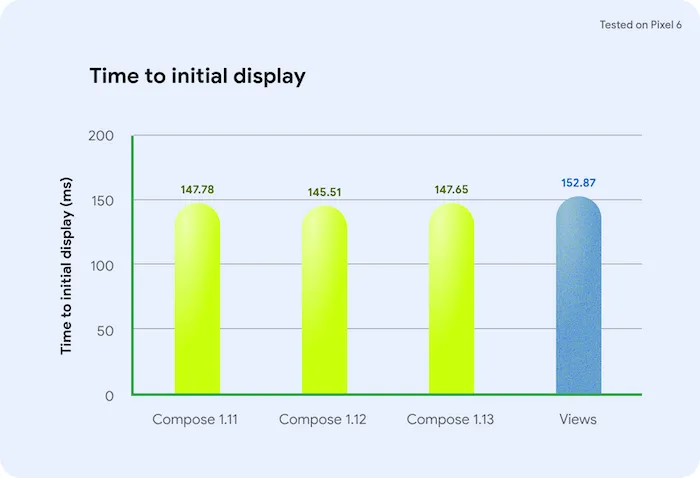
One of the most critical aspects of the 1.13 release is the continued focus on performance metrics. Android engineering teams have consistently highlighted the "Hero Benchmarks," which track cold startup times and scroll fluidity. According to official data from the 2026 Android Dev Summit, Compose 1.13 achieves a 0% jank rate on Pixel 6 hardware, maintaining a frame duration of 3.51 ms. While traditional Android Views still hold a slight edge in Time to Full Display (TTFD) due to the underlying architecture of GPU shader compilation, the gap has narrowed significantly to within a few milliseconds.
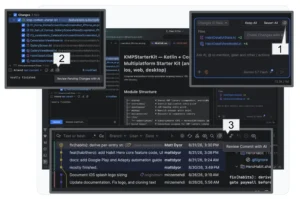
To assist developers in maintaining these performance standards, the team has introduced a new suite of "static analysis skills." Accessible via the Android CLI, these tools allow developers to run automated audits on their codebase. The analysis covers seven key areas, including state stability and Modifier.Node migrations, providing immediate feedback on potential bottlenecks before they reach production. This proactive approach to performance monitoring is a clear signal that Google expects Compose to be the default choice for high-performance, large-scale applications.
State Management and the BasicTextField Migration
The industry-wide move toward state-based text field handling is perhaps the most significant "breaking" change for existing codebases. The deprecation of the traditional value-based BasicTextField and TextField components in favor of the new TextFieldState API is intended to resolve long-standing issues with synchronization, cursor positioning, and undo/redo history.
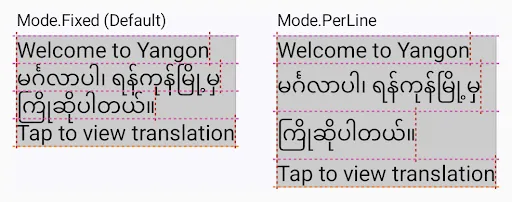
By utilizing TextFieldState, developers gain access to a more granular, synchronous model for text input. This system handles complex scenarios like multi-language text entry and formatted input much more efficiently than its predecessor. For enterprises maintaining large apps, this migration will require significant refactoring, but the trade-off is a measurable increase in stability. The removal of experimental annotations from undo/redo history and change-tracking buffers indicates that this API is now considered robust enough for mission-critical banking and productivity applications.

Adaptive UI and Foldable Support
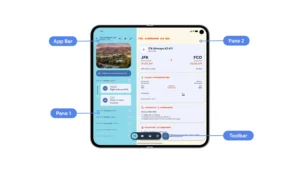
The 1.13 release also addresses the increasing fragmentation of Android hardware form factors. Through the updated "Adaptive Skill" and the stabilization of the FlexBox and Grid layouts, Google is pushing for "design once, adapt everywhere" methodologies. The new maxItemsInEachLine configuration for FlexBox allows for highly responsive designs that gracefully handle screen rotations or transitions from phone to tablet to desktop modes.
This support is reinforced by the LazyLayoutCacheWindow stabilization, which improves the performance of lazy lists and grids by pre-fetching off-screen content. The case study involving Instagram Direct’s migration to this system suggests that developers can expect a reduction in "blank space" during rapid scrolling, as the system now manages off-screen compositions with much greater intelligence.
The A2UI Renderer and Future-Proofing
A novel addition in this release is the Jetpack Compose A2UI (Agent-to-UI) renderer. This feature addresses the burgeoning field of AI-generated user interfaces. By implementing the open A2UI protocol, developers can now render UIs defined by LLMs directly as native Compose components. This eliminates the need for arbitrary code execution, which has been a primary security concern in previous attempts at dynamic UI generation. By treating UI as data that maps to specific, pre-defined components, the A2UI renderer ensures that AI-driven features remain secure, performant, and consistent with a brand’s design language.
Implications for the Android Ecosystem
The release of Jetpack Compose 1.13 signifies that the framework has moved past its "early adoption" phase and into a period of refinement and performance optimization. The deprecation of ConstraintLayout and MotionLayout—two staples of the older UI generation—further emphasizes that the Android team is confident in the capability of the new, modern layout primitives.
For developers, the implications are clear: the focus is shifting from "how to build" to "how to build efficiently." The combination of automated static analysis, stricter state management, and powerful graphics primitives provides a toolkit that is increasingly difficult to replicate with traditional XML-based View systems. As the industry continues to move toward modularized architectures, the 1.13 release acts as a consolidation point, ensuring that codebases built on Compose are not only faster and more visually appealing but also more maintainable in the long term.
Summary of Key Changes:
- Graphics: Introduction of
PolygonShapeandMorphPolygonShapefor complex geometric animation; implementation of high-performance progressive blur. - Performance: 0% jank rate on Pixel 6; introduction of automated performance static analysis tools.
- Text: Formal transition to
TextFieldStateandBasicTextFieldfor state-based input, providing better performance and native support for undo/redo. - Layouts:
FlexBoxandGridgraduated to stable;ConstraintLayoutandMotionLayoutofficially deprecated. - Animation: Addition of
CapturedAnimatedVisibilityto prevent flicker and state-loss issues during exit animations. - Web Integration: New
androidx.webalpha library to improve reliability of WebView content within Compose hierarchies.
As the development community begins to integrate these tools, the focus will likely turn toward the upcoming 1.14 cycle, where further refinements to the styling engine and the maturation of the A2UI protocol are expected. For now, the stability and depth of version 1.13 establish a high bar for the Android UI toolkit, reflecting a matured platform that is well-positioned for the next era of mobile and multi-device development.