Accelerating Java Application Migration to AWS Graviton with AWS Transform Continuous Modernization

As of October 29, 2026, organizations operating large-scale Java estates have a new, automated pathway for transitioning their infrastructure to AWS Graviton-based instances. AWS Transform continuous modernization, a service designed to streamline technical debt reduction, has officially introduced support for Graviton readiness assessment and automated remediation for Java applications. This development arrives at a critical juncture in cloud computing, as enterprise architects increasingly seek the superior price-performance ratios offered by Arm-based silicon, such as the AWS Graviton series, over traditional x86-based alternatives.
The migration of complex Java applications to Arm64 architectures has historically been a labor-intensive endeavor. While the Java Virtual Machine (JVM) is inherently cross-platform, the challenge rarely lies within the Java source code itself. Instead, it resides in the deep-rooted dependencies—native libraries, JNI (Java Native Interface) bridges, and binary artifacts—that often lack native support for the Arm64 instruction set. Manually auditing thousands of repositories to identify these architecture-specific bottlenecks is not only slow and repetitive but also highly susceptible to human error. By integrating automated discovery and remediation into the development lifecycle, AWS is signaling a shift toward treating infrastructure migration as a scalable, code-driven operation rather than an ad-hoc manual project.
Chronology and Operational Framework
The rollout of these features follows a strategic timeline aimed at reducing the friction of cloud-native adoption. Since early 2026, AWS has been refining its automated transformation capabilities to address the specific needs of legacy system modernization. The current solution operates through a two-pronged mechanism: the Graviton readiness assessment and the Java-x86-to-Graviton remediation skill.
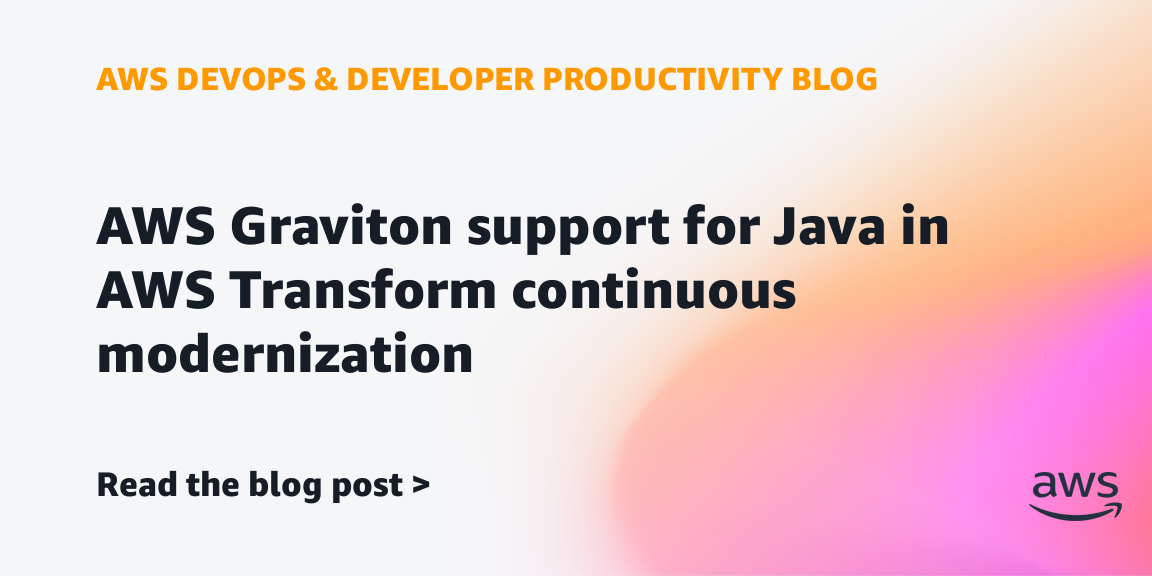
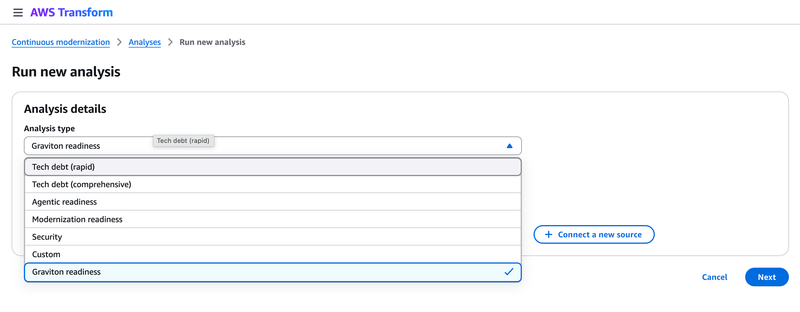
The assessment component functions as a read-only diagnostic tool. It performs a deep scan of a repository, parsing transitive dependency trees and inspecting the binary contents of JAR files to identify incompatibility with the Arm64 architecture. By detecting native library mismatches before any code is altered, the tool allows teams to triage their portfolio and prioritize applications with the highest readiness scores.
Once the analysis is complete, the remediation skill acts as the execution engine. It automates the resolution of identified issues by updating native library references, upgrading incompatible dependencies, configuring Dockerfiles for multi-architecture builds, and applying optimized Graviton JVM flags. This process results in a pull request, allowing developers to review, validate, and merge the necessary changes within their existing CI/CD pipelines.
Technical Implications and Data Performance
The economic incentive for this transition is grounded in the architectural efficiency of Graviton. In standard benchmarking, Graviton instances often demonstrate a significant reduction in cost per unit of compute compared to their x86 counterparts. However, realizing these gains requires more than a simple re-deployment; it requires the optimization of the application’s underlying binary stack.
For instance, the TASSEL genetics toolkit—a project comprising approximately 245,000 lines of code—serves as a primary case study for these automated improvements. During testing on a c7g.2xlarge instance, the application’s matrix algebra operations were analyzed. The transition from a pure-Java path to a native BLAS (Basic Linear Algebra Subprograms) library optimized for Arm64 resulted in a performance increase of roughly five times the throughput. By enabling the application to leverage the native instructions of the Graviton processor, the remediation process transformed a potential compatibility bottleneck into a significant performance advantage.
Strategic Impact on Enterprise Architecture
The broader implication of this release is the formalization of "continuous modernization" as a standard operational practice. By allowing analysis to run on a recurring schedule, AWS Transform ensures that technical debt—specifically regarding architectural compatibility—does not accumulate as dependencies evolve. This is particularly vital for organizations that maintain thousands of repositories, where manual oversight of dependency versions is physically impossible.
Industry analysts suggest that this shift towards automated migration tools is a necessary evolution in cloud management. As the industry trends toward heterogeneous computing, the ability to rapidly shift workloads between instruction sets will become a key competitive differentiator. For many enterprises, the barrier to moving to more efficient, cost-effective hardware has been the "migration tax"—the time and engineering hours required to refactor legacy dependencies. By commoditizing this refactoring process, AWS is effectively lowering the cost of innovation, allowing teams to focus on application logic rather than architectural plumbing.
Implementation and Governance
The platform provides flexibility in how these operations are conducted, supporting both local execution and AWS-managed infrastructure. For teams concerned with data sovereignty or specialized build environments, the ability to run the remediation locally ensures that code changes are validated within the developer’s own Arm64 pipeline before being pushed to production. This creates a secure, controlled environment where the output of the automated tool is treated as a starting point for human-led quality assurance.
Governance is maintained through detailed reporting. Every finding produced by the readiness assessment includes specific file references, severity levels, and the exact transformation logic required for remediation. This transparency is crucial for regulated industries that require full visibility into the changes made to their software supply chain. Furthermore, the ability to define execution roles for managed schedules ensures that automated tasks operate within the established security perimeter of the customer’s AWS account.
Future-Proofing the Software Estate
Looking ahead, the integration of these tools into the AWS ecosystem suggests a future where hardware-level portability is managed by software services. As more developers adopt multi-architecture build strategies, the distinction between x86 and Arm64 codebases will likely fade, replaced by containerized, architecture-agnostic deployments.
The current offering from AWS Transform serves as a bridge for this transition. It provides an immediate solution for the massive volume of Java applications currently locked into x86-only native dependencies. By providing a clear roadmap—from discovery and analysis to automated remediation and final deployment—AWS is empowering organizations to move beyond the limitations of legacy architectural constraints.
As teams begin to integrate these tools into their portfolios, the primary focus will likely shift from "can we migrate" to "how quickly can we optimize." With the heavy lifting of dependency analysis and binary reconciliation handled by automated services, the engineering focus returns to the primary objective of any software organization: delivering high-performance, cost-effective applications that can scale seamlessly across the modern cloud landscape. The tools are now available for teams to begin auditing their environments, and the economic benefits of such a migration are, based on initial test data, substantial and immediate.