AWS CloudFormation Enhances Infrastructure as Code Validation with Automatic Pre-Deployment Checks and New Capabilities


AWS CloudFormation, a cornerstone service for modeling and provisioning cloud infrastructure as code (IaC), has significantly advanced its validation capabilities with the introduction of automatic pre-deployment checks for all CreateStack and UpdateStack operations. This critical enhancement means that developers and automation tools will now receive immediate feedback on potential template errors, dramatically accelerating development velocity and bolstering deployment reliability without requiring any additional configuration. Previously, pre-deployment validation was available primarily during change set creation, offering a crucial but less ubiquitous safety net. The new, always-on validation extends this safeguard across all primary deployment paths, including direct stack creations, updates, CI/CD pipelines, and even AI-driven infrastructure agents.
The landscape of cloud infrastructure management has undergone a profound transformation with the widespread adoption of Infrastructure as Code. IaC methodologies, championed by services like AWS CloudFormation and tools such as the AWS Cloud Development Kit (CDK), enable organizations to define their cloud resources using declarative templates in JSON or YAML. This approach brings immense benefits, including version control, repeatability, consistency, and audibility of infrastructure deployments. However, even with the precision offered by IaC, errors can still manifest. These can range from simple syntax mistakes in property definitions to more complex logical flaws, resource name conflicts with existing infrastructure, or inadvertently exceeding service quotas. Historically, such errors might only become apparent minutes into a deployment, necessitating time-consuming rollbacks, debugging, and redeployment cycles. This iterative process, while necessary, incurs significant costs in developer time, compute resources, and potential operational downtime.
Recognizing the need for a more proactive approach, AWS CloudFormation introduced pre-deployment validation during change set creation, a "shift-left" strategy aimed at catching errors as early as possible in the development lifecycle. This initial implementation proved invaluable, identifying issues such as incorrect property syntax, conflicts with existing resource names, and constraints like S3 bucket emptiness before any resources were provisioned. This marked a significant step forward in reducing deployment failures and improving developer experience.
Building on this foundation, today’s announcement represents a substantial expansion of this shift-left strategy. The integration of automatic pre-deployment validation into every CreateStack and UpdateStack operation means that regardless of the deployment mechanism—be it a manual CLI command, an automated CI/CD pipeline, or an intelligent AI agent—validation checks will run inherently. This pervasive application of validation eliminates the need for developers to remember to explicitly create a change set for checks, streamlining workflows and ensuring a consistent level of quality control across all deployments. The implication for developer productivity is considerable: what once might have been a multi-minute wait for a stack to fail and roll back, now becomes a near-instantaneous notification of an error, allowing for immediate correction and iteration.
In addition to broadening the scope of automatic validation, AWS is introducing three crucial new validation checks designed to catch an even wider array of potential deployment issues. These include:
- Service Quotas Limit Exceeded: This check proactively identifies if a proposed deployment would cause an AWS account to exceed a service quota for a particular resource. For instance, attempting to create more EC2 instances, VPCs, or S3 buckets than permitted by the account’s limits would trigger a warning. This is vital for preventing unexpected deployment failures and ensuring the stability of larger-scale operations.
- AWS Config Recorder Conflicts: AWS Config recorders are essential for monitoring and recording changes to AWS resource configurations, crucial for governance, compliance, and security auditing. Conflicts with existing AWS Config recorders during a CloudFormation deployment could disrupt these vital monitoring capabilities. This new check helps prevent such conflicts, maintaining the integrity of an organization’s compliance posture.
- ECR Repository Delete Readiness: The Amazon Elastic Container Registry (ECR) stores container images. Attempting to delete an ECR repository that is not empty can lead to errors. This validation ensures that a repository targeted for deletion in a template is indeed ready to be removed, preventing deployment hiccups related to image data retention.
These new checks primarily operate in a "WARN" mode during change set creation, meaning they will flag potential issues without immediately halting the deployment process. This allows developers to review the warnings, assess the impact, and take corrective action—such as requesting a quota increase or manually clearing an ECR repository—before proceeding with the execution of the change set. This nuanced approach balances proactive error detection with operational flexibility.
For developers working with the AWS Cloud Development Kit (CDK), the new cdk validate command offers a unified and highly intuitive validation experience. The CDK, which allows developers to define cloud infrastructure using familiar programming languages like TypeScript, Python, Java, and C#, has gained significant traction for its programmatic approach to IaC. The cdk validate command synthesizes the CDK application into CloudFormation templates, creates a change set to invoke the server-side pre-deployment validation, and then correlates the results back to the original CDK source code. This construct-level source tracing is a game-changer, pinpointing the exact line of code in the CDK application that needs modification, rather than just a CloudFormation logical resource ID. This dramatically reduces the cognitive load and time spent debugging, empowering developers to fix issues with unparalleled precision.
While pre-deployment validation is enabled by default for all stack operations, AWS acknowledges scenarios where granular control is necessary. For such cases, a new DisableValidation parameter has been introduced. This parameter allows developers to explicitly skip validation for a specific CreateStack or UpdateStack operation. This might be useful in highly specialized edge cases, such as deploying experimental or non-critical resources where the overhead of validation is deemed unnecessary, or when a known, transient validation warning needs to be bypassed. However, AWS strongly advises caution when using this parameter, emphasizing the trade-off between deployment speed and early error detection. Disabling validation means foregoing the immediate feedback loop, potentially leading to errors that only manifest during resource provisioning, culminating in longer rollback times and increased debugging efforts.
The implications of these advancements extend significantly to automated workflows and the burgeoning field of AI agents for infrastructure management. In complex CI/CD pipelines, where speed and reliability are paramount, immediate error feedback is invaluable. An automated pipeline can now detect template errors in seconds and either halt the process gracefully or, with sophisticated logic, even attempt self-correction. For AI agents designed to provision and manage cloud infrastructure, this structured, machine-readable validation feedback is a critical enabler. Instead of an AI agent initiating a deployment, waiting minutes for it to fail, and then having to parse verbose logs for debugging, it now receives concise, actionable error messages almost instantly. This allows the agent to parse the error, modify the template (or the underlying CDK code), and retry the operation with remarkable efficiency. The AWS Agent Toolkit, specifically the CloudFormation agent skill, leverages these capabilities, providing AI agents with the ability to create stacks, validate templates, and iterate on errors using this pre-deployment validation feedback. This transforms what were once multi-minute debugging cycles into near-instantaneous iteration loops, pushing the boundaries of autonomous cloud operations.
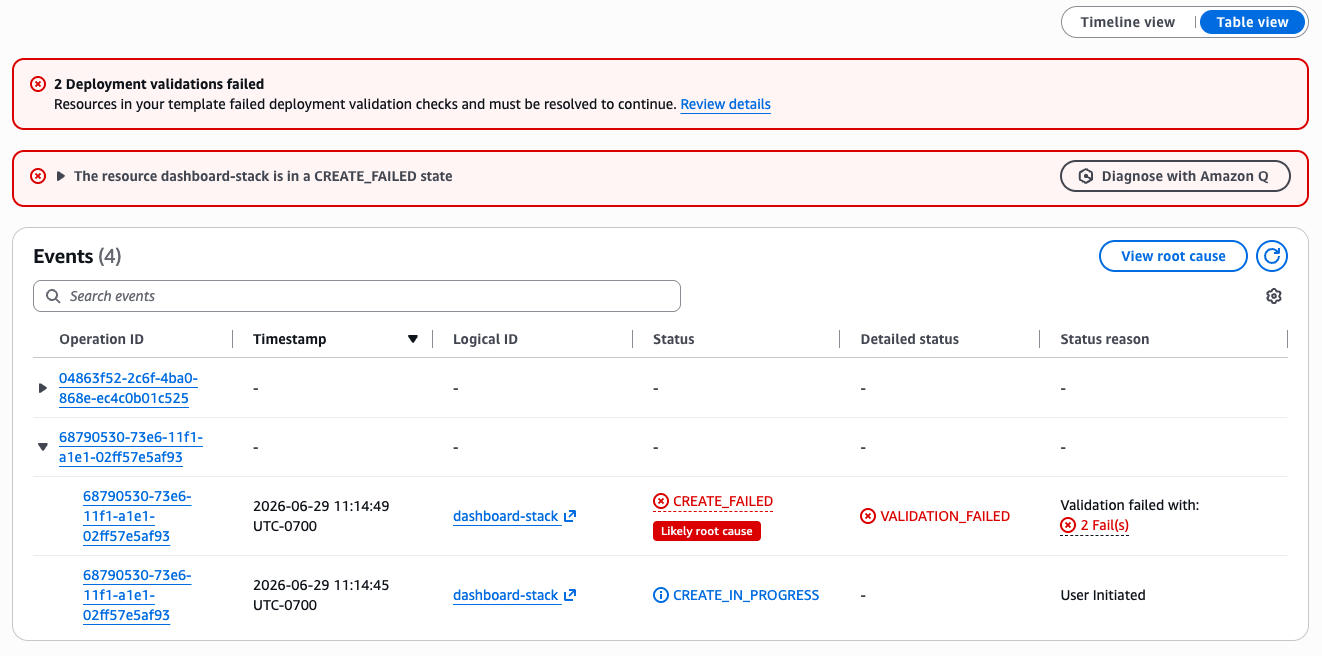
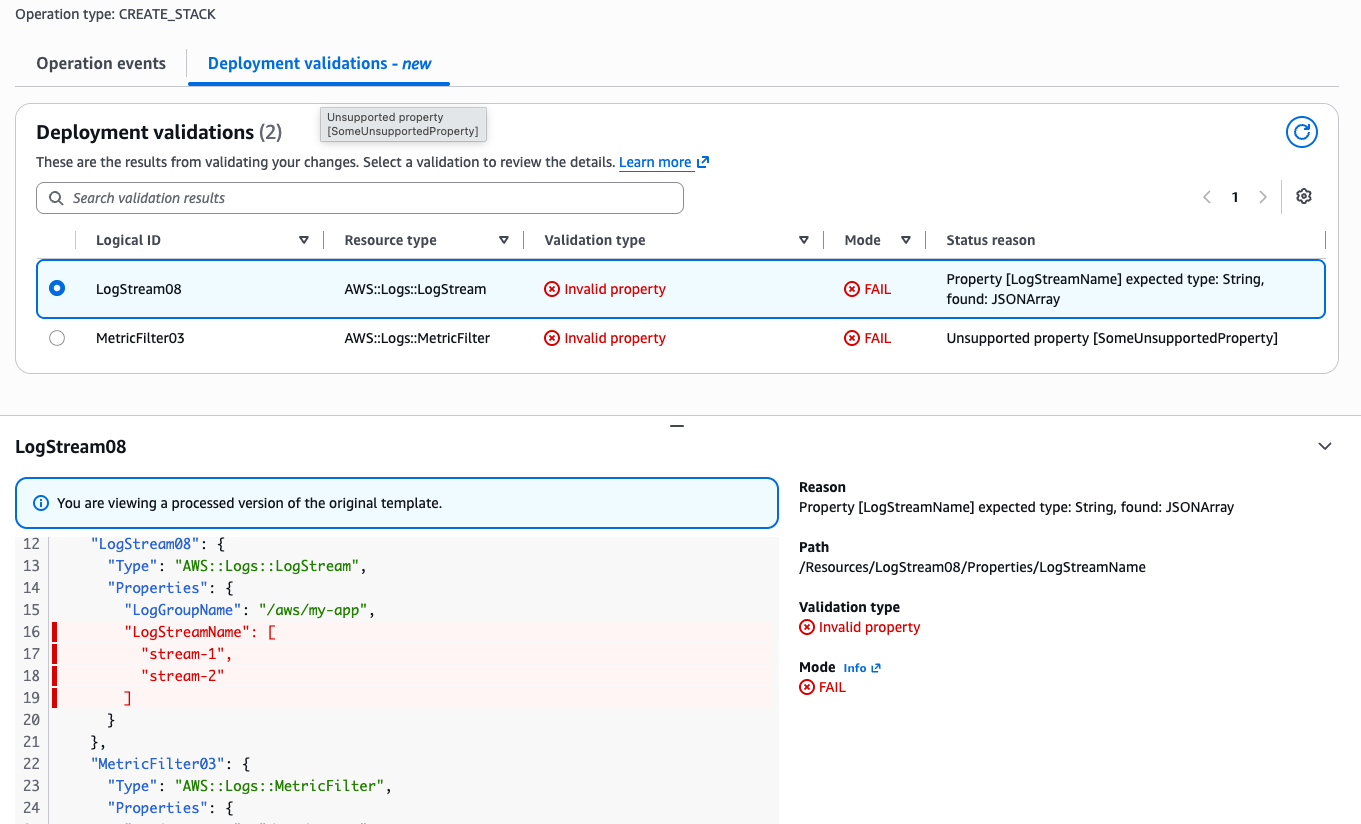
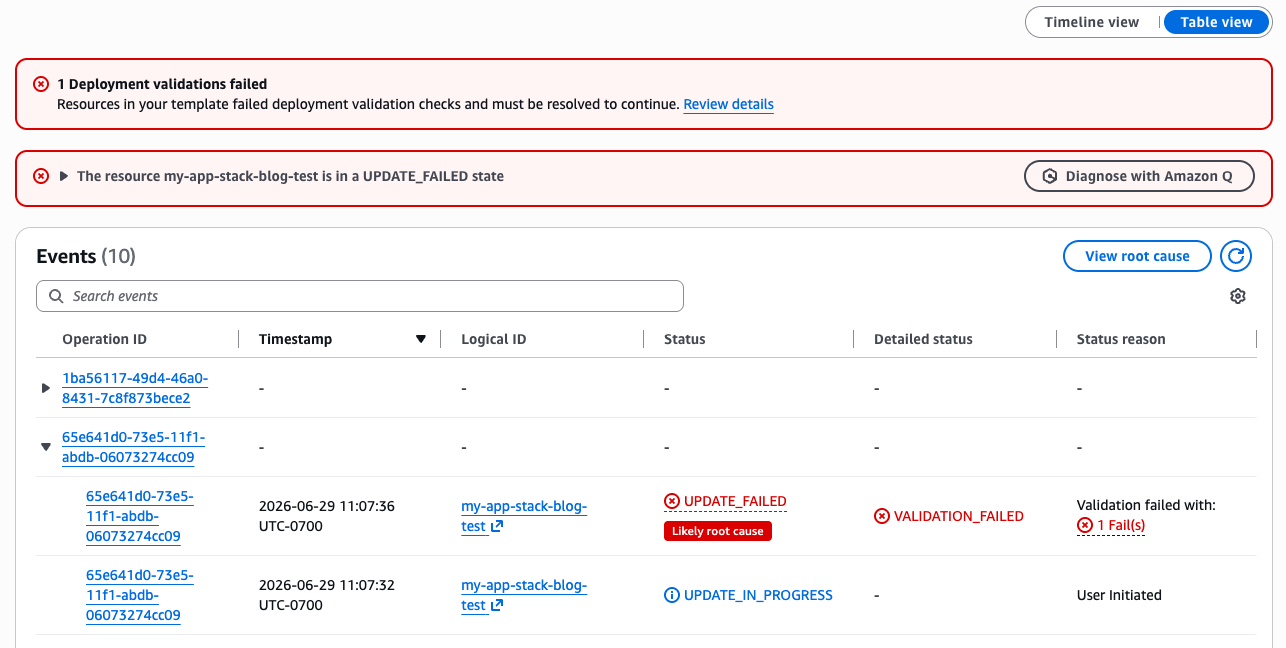
To illustrate these capabilities in practice, consider a scenario where a developer attempts to create a new CloudFormation stack with a template containing a simple property type mismatch—for example, providing an array where a string is expected for a LogStreamName. Previously, this might have led to a stack creation failure after several minutes. With the new automatic validation, the CreateStack operation would fail almost immediately, returning a detailed VALIDATION_ERROR event via the describe-events API or clearly visible in the CloudFormation console. The error message would explicitly state, "Property [LogStreamName] expected type: String, found: JSONArray," alongside the logical resource ID and path, allowing for swift identification and correction. Similarly, an UpdateStack operation attempting to add an S3 bucket with a name that already exists in the account would trigger a NAME_CONFLICT_VALIDATION error, preventing the update and providing a clear message that the resource identifier already exists. These real-time, precise diagnostics are transformative for day-to-day cloud engineering.
For developers and organizations looking to integrate these enhanced validation capabilities into their workflows, several best practices emerge. Firstly, consistently leveraging change sets for planned deployments, even for minor updates, remains a robust strategy, especially now with the new warning-mode validations providing additional pre-execution insights. Secondly, for CDK users, making cdk validate an integral part of their local development and CI/CD pipelines will unlock significant productivity gains due to its construct-level tracing. Thirdly, understanding and configuring the necessary IAM permissions for the advanced validation checks (Service Quotas, Config Recorder, ECR Repository) is crucial to fully benefit from their proactive warnings. While basic property and name conflict checks require no additional permissions beyond the stack operation itself, the new checks rely on specific servicequotas:ListServiceQuotas, config:DescribeConfigurationRecorders, and ecr:GetLifecyclePolicy permissions, among others. If these permissions are not granted, the corresponding checks are gracefully skipped without blocking the operation, highlighting the importance of proper IAM setup for comprehensive coverage.
In conclusion, the automatic pre-deployment validation for all AWS CloudFormation CreateStack and UpdateStack operations marks a significant milestone in AWS’s commitment to "shift-left" validation. By catching common deployment errors in seconds—before any resources are provisioned—this capability dramatically reduces the frequency of unnecessary rollback cycles and substantially accelerates development workflows for cloud engineers. Combined with the power of the cdk validate command, offering a unified validation experience with precise construct-level tracing, and the strategic control provided by the DisableValidation parameter, development teams are now equipped with a comprehensive toolkit to optimize the balance between validation coverage and deployment speed. The benefits extend across the entire spectrum of cloud operations, from individual developers to large enterprises, fostering greater reliability, efficiency, and cost-effectiveness. This enhancement is universally available in all AWS Regions where CloudFormation is supported, requiring no configuration or opt-in, making its advantages immediately accessible to millions of AWS users worldwide. For further detailed information, users are encouraged to consult the official AWS CloudFormation Validate stack deployments User Guide.
Related posts: