React Native 0.85 Officially Released With a New Animation Backend and Major Developer Tooling Updates

The core development team behind React Native has officially announced the rollout of version 0.85, marking a significant milestone for cross-platform mobile application development. The latest stable release introduces a completely redesigned Shared Animation Backend built in partnership with Software Mansion, native Transport Layer Security (TLS) support for the Metro development server, and a series of critical under-the-hood performance optimizations. As version 0.85 takes the mantle of the primary stable release, older iterations such as version 0.82.x have officially transitioned into unsupported status in accordance with the framework’s rolling support lifecycle.
The development lifecycle for React Native 0.85 involved substantial community collaboration, culminating in over 604 distinct code commits contributed by 58 developers worldwide. This release focuses heavily on bridging the performance gap between native and cross-platform animations while simultaneously streamlining the core package architecture to reduce bloat. Developers looking to adopt the new version can initialize projects using the updated CLI or prepare for upcoming SDK integrations, such as Expo SDK 56, which is slated to incorporate the 0.85 release natively.
The New Shared Animation Backend: Unlocking Native Performance
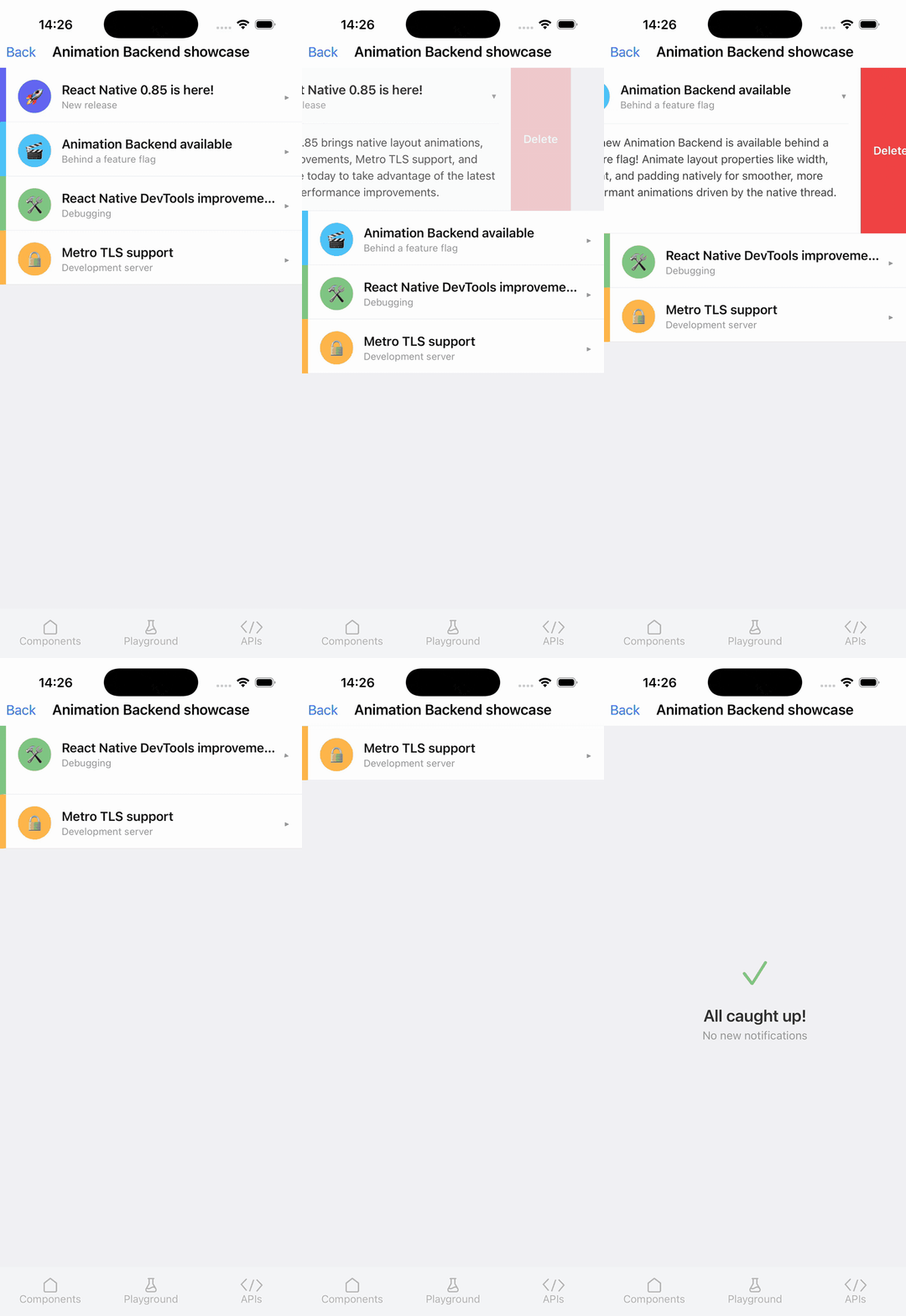
Perhaps the most anticipated addition in React Native 0.85 is the introduction of the Shared Animation Backend. Developed in close technical collaboration with Software Mansion—a recognized leader in React Native ecosystem tooling—this new internal engine fundamentally alters how animations are executed under the hood for both the traditional Animated library and Reanimated.
Historically, managing animation frames and reconciliation processes across the JavaScript-to-native bridge introduced performance bottlenecks, occasionally leading to dropped frames during complex transitions. By migrating the core animation update logic directly into the React Native core, the framework empowers Reanimated to achieve performance benchmarks that were previously unattainable. Furthermore, this architectural shift ensures that update reconciliation processes undergo rigorous native testing, guaranteeing long-term stability across future framework updates.
A major practical benefit of this backend overhaul applies to the traditional Animated library. Developers can now animate layout properties—such as width, height, and positional flexbox metrics—directly using the native driver. Previously, animating layout properties required running calculations on the JavaScript thread, which frequently caused layout thrashing and UI stutter. With the experimental integration arriving in version 0.85.1, engineers can execute fluid layout transitions without leaving the native thread.
To utilize this feature in an experimental capacity, teams can enable the feature flag within their configuration channels. Software Mansion engineers and core contributors have provided robust documentation and example implementations within the react-native/packages/rn-tester/js/examples/AnimationBackend/ directory on GitHub, offering a clear blueprint for migrating legacy layout animations to the new backend architecture.
Enhanced Development Workflow: Metro TLS and DevTools Improvements
Beyond runtime performance, React Native 0.85 delivers notable upgrades to the local developer experience, addressing long-standing requests regarding secure local environments and debugging transparency.
The Metro development server has received native support for Transport Layer Security (TLS). Developers can now configure Metro to accept a complete TLS configuration object—including Certificate Authority (CA), certificate, and private key files—within the metro.config.js file. This capability enables fully encrypted HTTPS and WebSocket Secure (WSS) connections during local development. For mobile engineers building applications that interact with strict backend APIs enforcing secure connections, this update eliminates the friction of bypassing local SSL verification. Communities have widely recommended tools like mkcert to seamlessly generate locally-trusted certificates without triggering browser or operating system security warnings.
Concurrently, the React Native DevTools suite has received interface and performance enhancements. On macOS environments, DevTools now natively leverages native operating system tabs, aligning the debugging interface more closely with native platform aesthetics and improving window management for multi-screen development setups.

Architectural Cleanup: Jest Preset Migration and Breaking Changes
To maintain a lean core package and encourage modularity, the React Native maintainers have executed several breaking changes and deprecations in version 0.85.
The most prominent package-level change is the extraction of React Native’s default Jest testing preset. Previously bundled directly within the main react-native package, the testing preset has been moved to a dedicated, standalone package titled @react-native/jest-preset. Projects upgrading to version 0.85 must update their testing configurations by modifying the preset reference in their jest.config.js files. While this requires a minor manual intervention, it significantly reduces the installation footprint of the core framework and allows testing configurations to evolve independently of the main release cycle.
In alignment with broader industry standards and the Node.js release lifecycle, React Native 0.85 has officially dropped support for end-of-life (EOL) Node.js versions, specifically requiring Node versions at or above v20.19.4. Development teams running legacy server environments must upgrade their runtime environments prior to attempting migration.
Additionally, codebase cleanups have resulted in the removal of the deprecated StyleSheet.absoluteFillObject API. Developers are instructed to transition their style definitions to the modern StyleSheet.absoluteFill property or explicitly declare absolute positioning parameters. These deprecations reflect an ongoing effort by the core team to reduce redundant API surfaces and streamline the framework’s internal type definitions.
Industry Implications and the Broader Ecosystem Impact
The release of React Native 0.85 arrives at a time when enterprises increasingly demand near-native fidelity from cross-platform frameworks. By delegating complex layout animations to the native thread via the Shared Animation Backend, React Native narrows the performance gap traditionally separating it from fully native Swift and Kotlin applications.
Analyst observations suggest that the architectural decoupling of tools like the Jest preset and the tightening of Node.js version requirements point to a maturing ecosystem. By shifting maintenance burdens away from the monolithic core package, the framework enables faster iteration cycles for auxiliary tooling. Furthermore, the inclusion of Metro TLS support underscores an increasing emphasis on enterprise-grade security standards throughout the entire software development lifecycle, ensuring that developers can test secure networking features locally before deploying to production environments.
Upgrading to React Native 0.85
With version 0.85 now established as the current stable release, developers managing existing applications are encouraged to utilize the official React Native Upgrade Helper to identify specific code differences and dependency adjustments required for a smooth transition. Teams starting new projects can initialize their codebases utilizing the updated command-line interface:
npx @react-native-community/cli@latest init MyProject --version latest
For teams utilizing the Expo ecosystem, planning is already underway to incorporate React Native 0.85 into the upcoming Expo SDK 56 release, ensuring that managed workflow users will soon benefit from the new animation backend, Metro TLS capabilities, and underlying performance enhancements without requiring manual bare-workflow configuration.