Sandboxing AI Agent Code Execution in Python: Containers, MicroVMs and Beyond

In the rapidly evolving landscape of artificial intelligence, autonomous agents capable of writing and executing code have transitioned from experimental curiosities to essential enterprise tools. However, this capability introduces a significant security paradox: an agent’s utility is inextricably linked to its ability to manipulate its environment, yet that same capacity creates a massive attack surface. If an AI agent generates malicious or flawed code, the host system—and potentially the entire network—becomes vulnerable to data exfiltration, resource exhaustion, and privilege escalation. To mitigate these risks, developers must implement robust isolation layers. By comparing three distinct sandboxing architectures—limited subprocesses, hardened Docker containers, and Firecracker microVMs—engineers can balance the critical trade-offs between security, performance, and operational complexity.
The Security Architecture of Agentic Execution
The fundamental challenge in AI agent security is the "boundary problem." When an agent is given the authority to execute code, the host environment must decide how much visibility and access that code possesses. If a boundary is too porous, a "jailbreak" or code-injection attack can lead to a full system compromise. Conversely, if the boundary is too rigid, the agent may be unable to perform legitimate tasks.
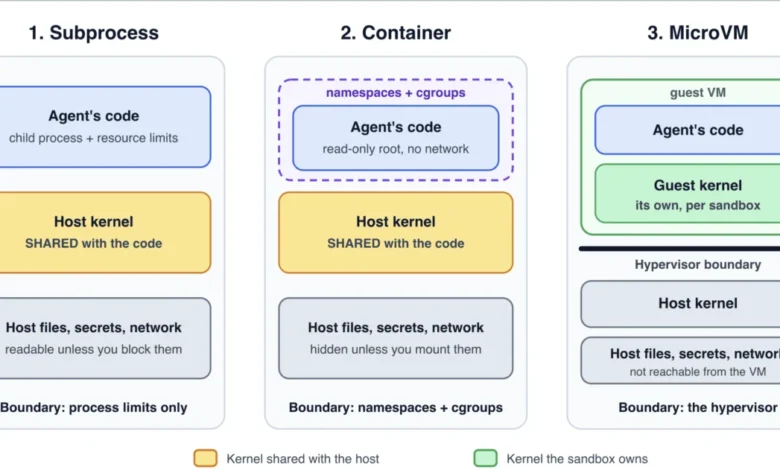
Isolation strategies generally fall into three tiers. The first, and least secure, is the local subprocess. By utilizing Linux features like namespaces and control groups (cgroups), a developer can place a child process in a restricted sandbox. While this approach offers minimal latency, it shares the host’s kernel, leaving it susceptible to kernel-level vulnerabilities. The second tier, containerization via platforms like Docker, adds a layer of abstraction. By defining network policies, read-only filesystems, and strict resource constraints, containers provide a significantly hardened environment. However, as evidenced by the series of runc vulnerabilities identified in late 2025, container breakouts remain a persistent threat because the host kernel is still shared.
The third and most robust tier is the microVM. Technologies like AWS Firecracker enable the creation of lightweight virtual machines that boot in milliseconds. Each microVM features its own dedicated kernel, effectively creating a hardware-level boundary between the agent’s execution environment and the host system. This ensures that even a successful exploit within the sandbox cannot propagate to the underlying host or other active sessions.
A Chronology of Sandboxing Evolution
The history of sandboxing for AI agents is brief but intense, reflecting the acceleration of LLM capabilities. In early 2024, most agents were run in permissive environments, often leading to accidental resource depletion. By 2025, the focus shifted toward "Security by Design." The November 2025 runc breakout vulnerabilities served as a major industry wake-up call, demonstrating that container-based isolation was insufficient for high-stakes environments.
Following these events, the industry saw a surge in the adoption of hypervisor-based isolation. In April 2026, Docker responded to this shift by introducing native support for microVM-based sandboxes, signaling a paradigm shift toward virtualized isolation. Shortly thereafter, cloud providers like AWS began integrating Firecracker technology into their serverless offerings, allowing for secure, stateful, and highly transient code execution environments. This transition marks the end of the "wild west" era of agentic code execution, replacing it with standardized, hardened infrastructure.
Comparative Analysis: Safety vs. Latency
To understand the practical implications of these tiers, developers often run "hostile" testing suites. A standard test involves six vectors: a CPU-intensive infinite loop, a large memory allocation (e.g., 512 MB), a process fork flood, disk space exhaustion, unauthorized file access, and attempts to probe internal network services.
Empirical testing reveals that while a limited subprocess is exceptionally fast—often executing within single-digit milliseconds—it fails to prevent most sophisticated attacks. Specifically, subprocesses often struggle to block fork bombs and lack the capability to completely hide host files. Docker containers, when configured with no-new-privileges and cap-drop ALL, successfully block these vectors. However, the latency overhead for spawning a container is significantly higher, often ranging from 100ms to several hundred milliseconds depending on image caching.
MicroVMs provide the highest level of safety. Because they operate on a hardware boundary, they effectively neutralize all six common attack vectors. The latency trade-off, while once significant, has been minimized by modern hypervisor optimizations. While the startup time for a microVM is inherently higher than that of a subprocess, it remains well within the acceptable threshold for most agentic workflows, often hovering around the 150ms mark.
Strategic Recommendations for Enterprise Deployment
For organizations integrating AI agents into production environments, the selection of a sandboxing tier should be determined by the "trust model" of the input code.
- Subprocesses: Reserved exclusively for local development and trusted scripts. If the code is authored by the developer and not the AI, the risk profile is manageable.
- Hardened Containers: Appropriate for low-risk, internal-only applications where the developer retains control over the host infrastructure. It is essential to ensure that runtime environments like
runcare kept current and that security patches are applied immediately. - MicroVMs: The current industry standard for any agentic system that interacts with external APIs, processes user-generated content, or manages sensitive data. MicroVMs offer the most resilient defense against zero-day exploits and malicious code injections.
The Broader Impact on AI Infrastructure
The move toward microVM-based sandboxing is not merely a technical preference; it is a fundamental shift in how we conceive of AI safety. By abstracting the environment away from the host, developers are creating a "disposable infrastructure" model. In this model, an agent is given a clean, blank slate for every single turn of its execution. Once the task is complete, the entire environment is destroyed, ensuring that no state—malicious or otherwise—persists.
This approach aligns with the principle of "least privilege" in cybersecurity. Instead of building a complex security policy for a long-running container, infrastructure engineers can simply define the environment once and instantiate it for every request. As AI models become more adept at writing complex code, the need for these boundaries will only increase. We are entering a phase where the security of an agent is defined by its infrastructure rather than its code.
Conclusion
The evolution of sandboxing for AI agents highlights a critical realization: the safety of an autonomous agent is only as strong as its weakest point of contact with the host machine. While subprocesses and containers have served their purpose, the industry is clearly pivoting toward microVMs as the primary boundary for untrusted code execution. By leveraging technologies that provide hardware-level isolation, developers can foster innovation while maintaining a robust security posture. Moving forward, the goal for AI platform architects will be to minimize the "latency tax" of these secure boundaries, ensuring that safety does not come at the cost of user experience. As the field matures, the standard will inevitably be a zero-trust architecture where every line of code generated by an AI is treated as a potential vulnerability, executed in a fleeting, isolated, and highly ephemeral environment.