Closing the Loop: Automating Incident Response with AWS DevOps Agent and Amazon OpenSearch Service

The fundamental challenge in modern site reliability engineering is not the collection of telemetry, but the time-consuming bridge between detection and resolution. In most enterprise observability stacks, Amazon OpenSearch Service effectively aggregates structured logs and distributed traces, utilizing sophisticated alerting monitors to signal system degradation. However, the operational reality for many engineering teams remains tethered to manual intervention. When a critical alert arrives at 2:00 AM, an engineer must manually navigate OpenSearch Dashboards, construct complex Domain-Specific Language (DSL) queries, correlate disparate trace IDs, and pivot to AWS CloudTrail to reconstruct the sequence of events. This manual investigative loop—which can consume anywhere from several minutes for minor incidents to hours during cascading microservice failures—represents a significant bottleneck in achieving true system resilience.
A new architectural integration now addresses this inefficiency by connecting the AWS DevOps Agent directly to the indices that trigger alerts. By leveraging the Model Context Protocol (MCP), organizations can transform their existing observability infrastructure into an autonomous investigative engine. Instead of paging a human, the system triggers an AI agent to perform the initial triage: querying logs and traces, correlating them with infrastructure metadata from AWS CloudTrail and Amazon CloudWatch, and producing a comprehensive root cause analysis.
The Evolution of Automated Observability
The integration of AI-driven investigation into the OpenSearch ecosystem marks a significant shift in how cloud-native applications manage downtime. Historically, automation has been limited to reactive scripting—such as auto-scaling groups or basic service restarts. These measures often treat the symptom rather than the root cause. By utilizing MCP, the AWS DevOps Agent acts as an intelligent layer that understands the context of the telemetry it queries.
This capability is made possible through three primary deployment pathways, designed to accommodate varying regional availability and operational constraints. Organizations may choose to self-manage the MCP server on Amazon Elastic Container Service (Amazon ECS) behind a Network Load Balancer (NLB), utilize the managed Amazon Bedrock AgentCore for a streamlined deployment, or, for domains running OpenSearch version 3.3 and higher, leverage a built-in MCP endpoint. This flexibility ensures that the "closed-loop" architecture—where detection, investigation, and analysis occur within the same domain—is accessible regardless of the specific AWS environment.
Architectural Framework and Implementation
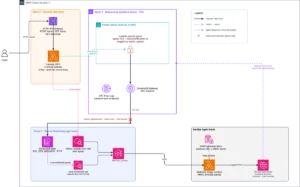
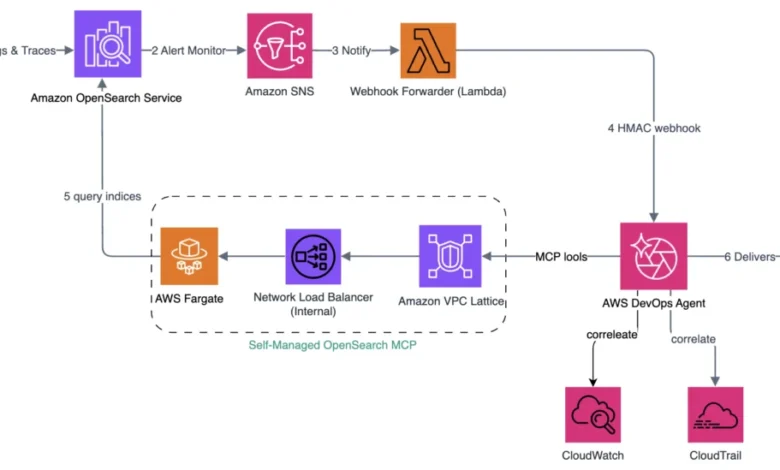
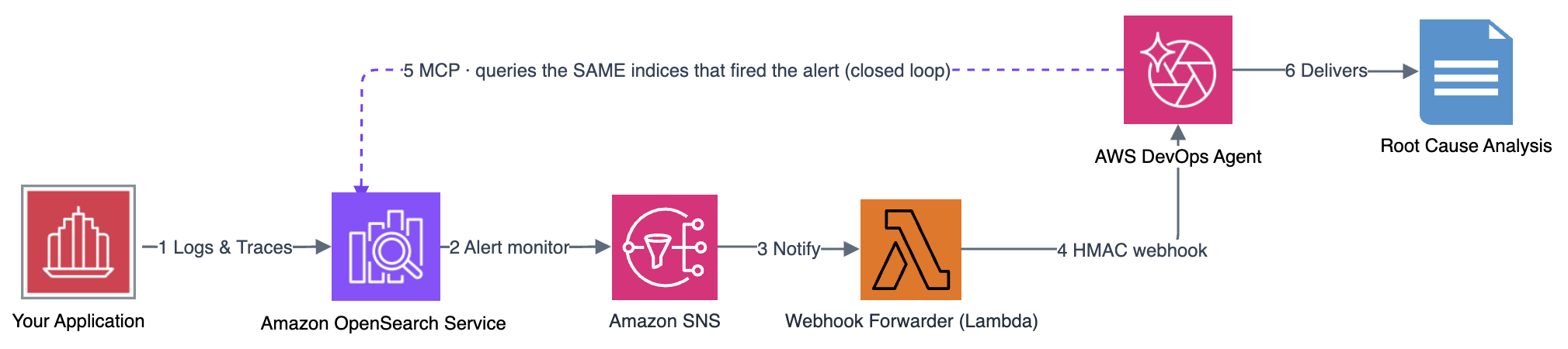
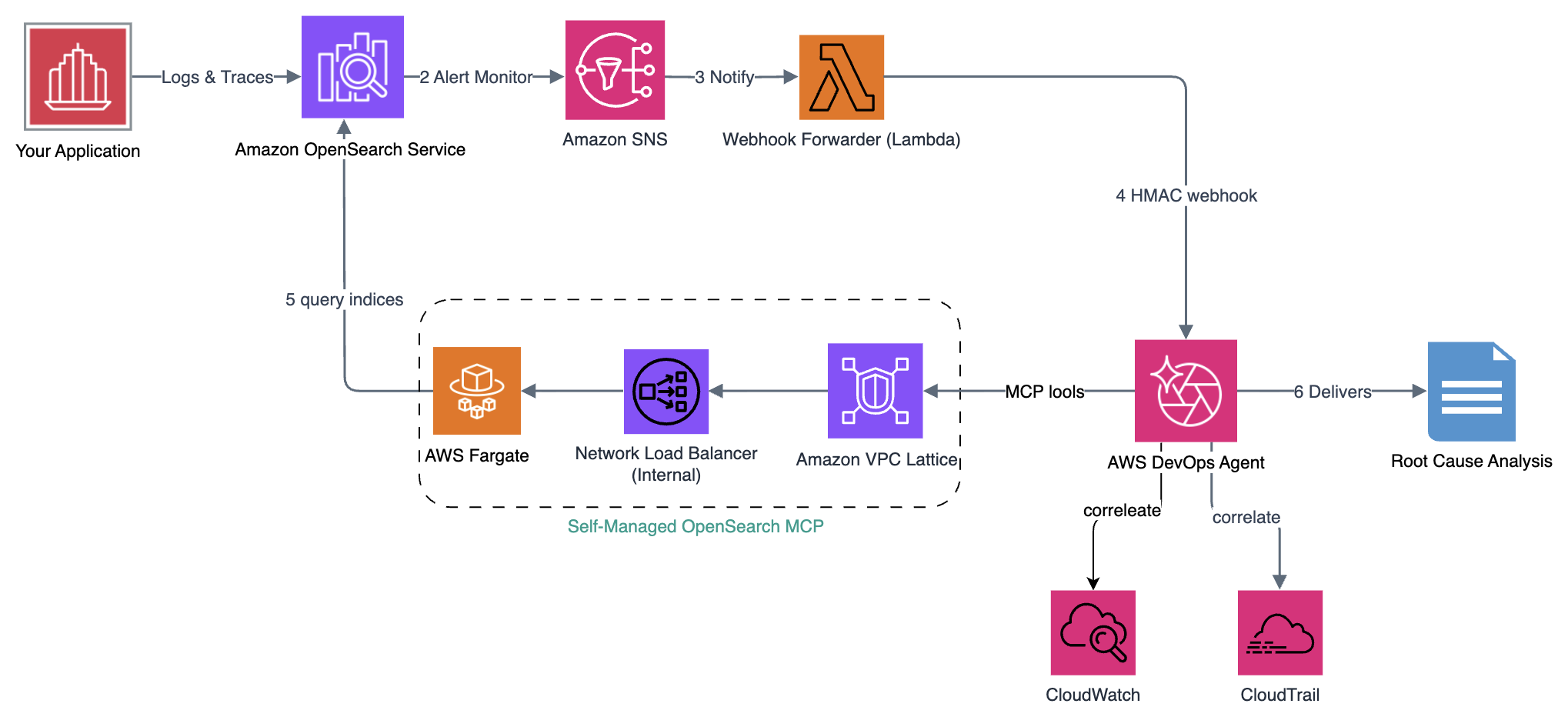
The operational architecture relies on a six-stage lifecycle that ensures data integrity and security. When a monitoring threshold is breached, the OpenSearch Alerting engine broadcasts a notification to Amazon Simple Notification Service (SNS). This notification is captured by a webhook forwarder, which performs payload transformation and HMAC-SHA256 signing before sending it to the AWS DevOps Agent’s Event Channel. The agent then assumes the role of an investigator, using MCP tools to traverse indices and correlate telemetry.
For organizations opting for the self-managed route, the security configuration is paramount. The MCP server must be deployed within a private VPC to maintain a zero-trust posture. By utilizing VPC Lattice, the agent can securely communicate with the MCP server without exposing endpoints to the public internet. This approach requires precise TLS certificate management; a self-signed certificate, with a subject alternative name matching the NLB DNS, is necessary to ensure successful handshake validation.
Rigorous Security and Governance
The implementation of Fine-Grained Access Control (FGAC) is the cornerstone of this autonomous model. Because the AI agent operates with elevated access to system telemetry, organizations must enforce strict role-based access controls. By mapping the IAM role of the DevOps Agent to a dedicated, read-only OpenSearch backend role, administrators can restrict the agent’s reach to specific indices, such as application-logs-* or otel-traces-*.
This "principle of least privilege" is essential. The agent does not require write or delete permissions to perform its investigative functions. By limiting the agent to read and search actions, the risk of accidental configuration drift or data modification is effectively mitigated. Furthermore, the use of HMAC-SHA256 signing for all webhooks ensures that the Event Channel only accepts data from verified, trusted sources, protecting the pipeline against injection attacks.
Chronology of an Autonomous Investigation
To understand the tangible impact of this technology, one must observe the timeline of a typical incident. Consider a scenario where a Lambda function’s reserved concurrency is erroneously set to zero.
- T+0s: The configuration change is executed, effectively throttling the application.
- T+30s: Error rates spike, and the OpenSearch
application-logs-*index begins recordingTooManyRequestsExceptionentries. - T+120s: The OpenSearch Alerting monitor reaches its threshold and triggers an SNS notification.
- T+130s: The webhook forwarder processes the notification and delivers it to the AWS DevOps Agent.
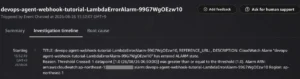
- T+135s: The agent initiates an investigation, cross-referencing log errors with CloudTrail history.
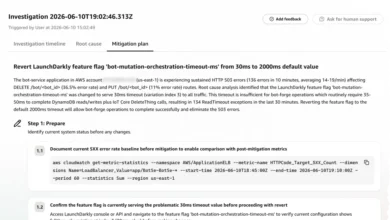
- T+300s: The agent delivers a final root cause analysis, identifying the exact timestamp of the configuration change and providing the specific CLI command required for remediation.
This five-minute window represents a dramatic improvement over manual response times, which are frequently hindered by "alert fatigue" and the cognitive load of switching between disparate dashboards.
Economic and Operational Implications
From a cost-benefit perspective, the infrastructure required to host the MCP server is modest. For a self-managed ECS implementation, the monthly overhead typically ranges near $70, covering Fargate tasks, network address translation (NAT) gateways, and load balancing. When weighed against the cost of engineering time lost to manual troubleshooting—or worse, the opportunity cost of extended downtime—the investment is marginal.
Furthermore, the shift toward autonomous root cause analysis aligns with broader industry trends toward "AIOps," or Artificial Intelligence for IT Operations. By offloading the investigative "grunt work" to an AI agent, senior engineers are freed to focus on high-level architecture and feature development. The agent does not replace the engineer; rather, it acts as a force multiplier, performing the initial data collection and correlation that is necessary for a human to make an informed, rapid decision.
Strategic Recommendations for Implementation
For organizations ready to adopt this model, the recommended starting point is not a system-wide overhaul, but a focused pilot project. Identify a single, high-frequency alert—a "noisy" monitor that frequently pages on-call staff—and integrate it into the MCP pipeline. This allows teams to gain confidence in the agent’s root cause analysis capabilities while refining the FGAC mappings and webhook transformation logic.
The transition to a closed-loop observability system is not merely a technical upgrade; it is a fundamental shift in operational culture. It requires a commitment to structured logging, standardized trace identifiers, and rigorous security hygiene. However, the result is a more resilient infrastructure capable of self-diagnosis. As enterprises continue to scale, the ability to resolve incidents automatically will likely become the primary differentiator between organizations that struggle with technical debt and those that achieve true operational excellence.
Conclusion
The convergence of AWS DevOps Agent, the Model Context Protocol, and Amazon OpenSearch Service provides a robust, scalable path toward automated incident response. Whether utilizing the flexibility of self-managed containers or the convenience of native OpenSearch 3.3+ endpoints, the architecture addresses the most significant friction point in cloud operations: the gap between identifying an issue and understanding why it occurred. By closing this loop, organizations can effectively reduce their Mean Time to Resolution (MTTR) and ensure that their engineering teams are focusing on innovation rather than investigation. As this technology matures, the standard for observability will move beyond simple monitoring and into the realm of active, autonomous resolution.