AWS Announces General Availability of Continuum for Code Vulnerabilities to Streamline Cloud Security and Automated Patching

Amazon Web Services (AWS) has officially announced the general availability of AWS Continuum for code vulnerabilities, a cutting-edge security service designed to identify, validate, and remediate application security flaws with unprecedented speed and precision. In an era where malicious actors leverage advanced artificial intelligence to weaponize vulnerability disclosures within minutes, enterprise security teams are routinely overwhelmed by thousands of daily scanner alerts. AWS Continuum aims to fundamentally transform this dynamic by cutting through the noise, distinguishing genuine threats from theoretical risks, and directly automating the generation of verified code patches through standard developer pull requests.
The launch addresses a critical operational bottleneck in modern software engineering. While automated scanners and continuous integration pipelines have accelerated feature delivery, they have also dramatically increased the volume of security findings that engineering and operations teams must process. Organizations managing extensive application portfolios frequently find themselves paralyzed by alert fatigue. Traditional vulnerability management tools assign generic severity scores based solely on the nature of the bug, treating a critical-severity vulnerability on an isolated development utility with the exact same urgency as a medium-severity flaw situated mere steps away from core customer databases or payment processing pipelines. Furthermore, because static analyzers lack critical context regarding runtime environments and network architectures, security personnel have historically been forced to spend grueling hours conducting manual investigations. Confirming whether a specific finding was genuinely exploitable required deep forensic analysis, and safely deploying a fix demanded days of cross-functional coordination between security, infrastructure, and application development teams.
To bridge this operational chasm, AWS Continuum constructs a dynamic, comprehensive context graph synthesized from two primary data streams: enterprise code repositories and live AWS cloud environments. Administrators deploy an AWS Continuum collector within the target account and region where workloads execute. This collector continuously harvests granular resource configurations, AWS Config states, and intricate network topologies. By synthesizing this information, Continuum develops a sophisticated understanding of system topology, mapping service dependencies, identifying asset ownership, tracking data flows, and recognizing business-critical systems such as authentication services, payment pipelines, and sensitive customer data stores. Consequently, the service evaluates every security finding not in isolation, but against its actual proximity to high-value assets and its exposure to potential network attack paths.

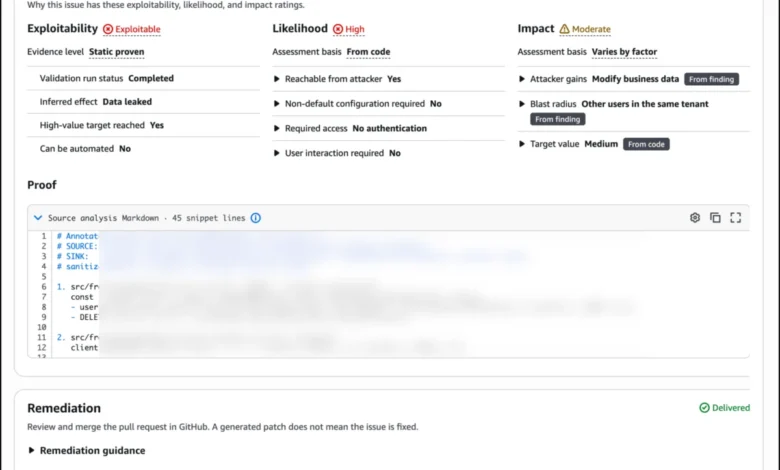
Rather than merely outputting a risk score, AWS Continuum subjects each finding to rigorous validation. The service evaluates the code against its environment context and assigns an explicit evidence level, such as verdicts proven directly through static analysis of vulnerable code execution paths. For vulnerabilities capable of being dynamically reproduced, Continuum executes the exploit within an isolated, secure sandbox environment. It then attaches concrete proof-of-concept code, step-by-step reproduction instructions, generated attack paths, and comprehensive blast radius assessments. Additionally, the platform evaluates whether existing runtime defenses, network controls, and monitoring systems would successfully detect and halt the validated attack vector before it could cause real-world damage.
Once a vulnerability has been verified and prioritized, AWS Continuum automates the initial phase of remediation. The service generates a precise fix—which may take the form of a code patch, a dependency upgrade, or a specific configuration modification—and automatically opens it as a pull request within the organization’s connected code repository. To maintain rigorous governance and operational safety, every remediation initially operates under a human-in-the-loop paradigm. Security and development teams review the proposed changes, inspect the embedded proof, and manually merge the pull request, ensuring that final authority over production deployments remains firmly in human hands. However, AWS has indicated that future iterations will introduce configurable guardrails and confidence gates—such as test coverage thresholds, scope boundaries, and historical success rates—allowing organizations to authorize Continuum to autonomously apply specific classes of low-risk fixes.
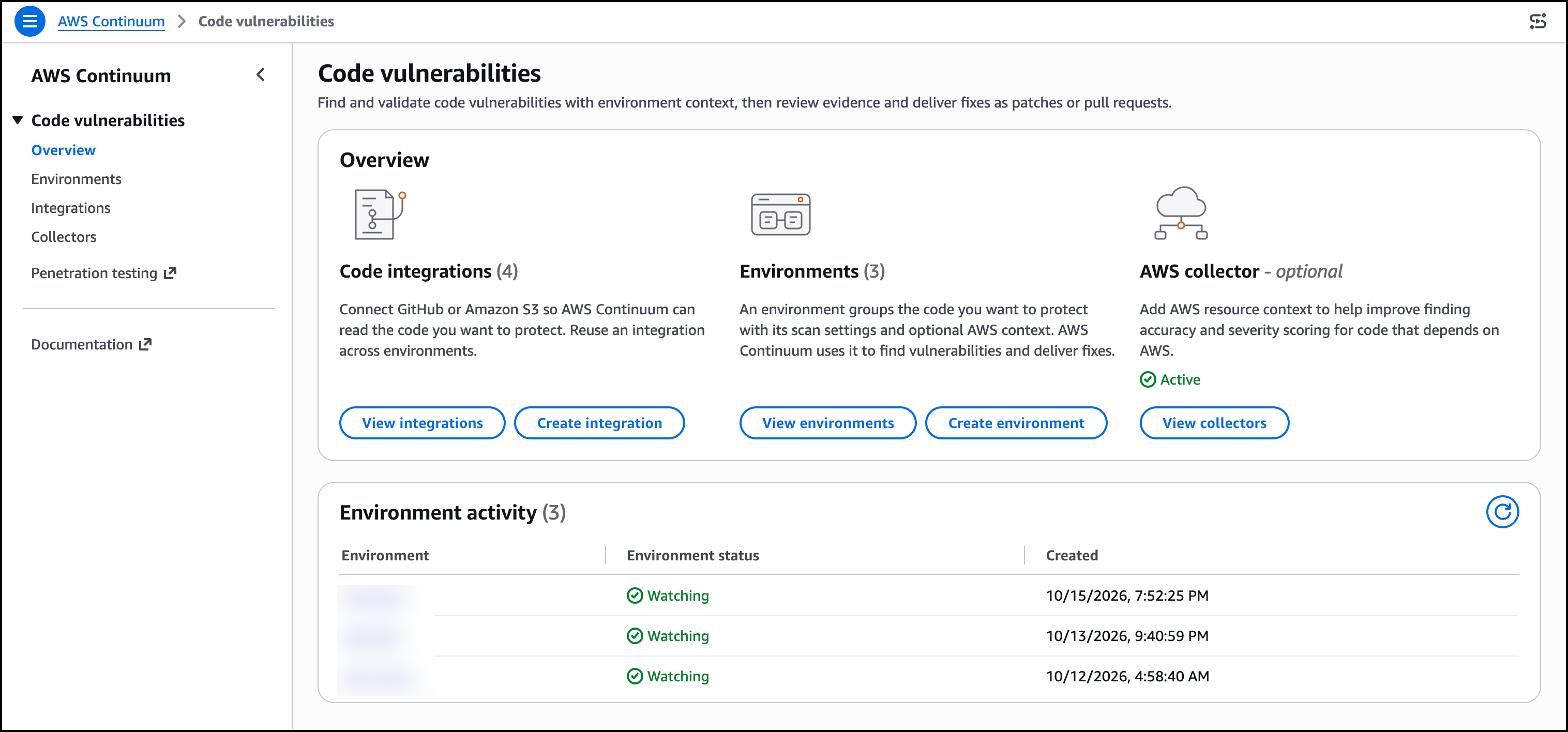
The operational workflow for integrating AWS Continuum has been designed for seamless adoption within existing developer ecosystems. Administrators initiate the process through the AWS Management Console by navigating to the Code vulnerabilities section of the Continuum service. Establishing an active environment requires connecting a code source, which can be accomplished via native GitHub integrations or designated Amazon S3 buckets. S3-based configurations require the storage bucket to reside within the same AWS account and region where Continuum is activated, with access granted through a securely configured AWS Identity and Access Management (IAM) role assumed by the service. Users then authorize the deployment of an AWS infrastructure collector to gather necessary runtime context.
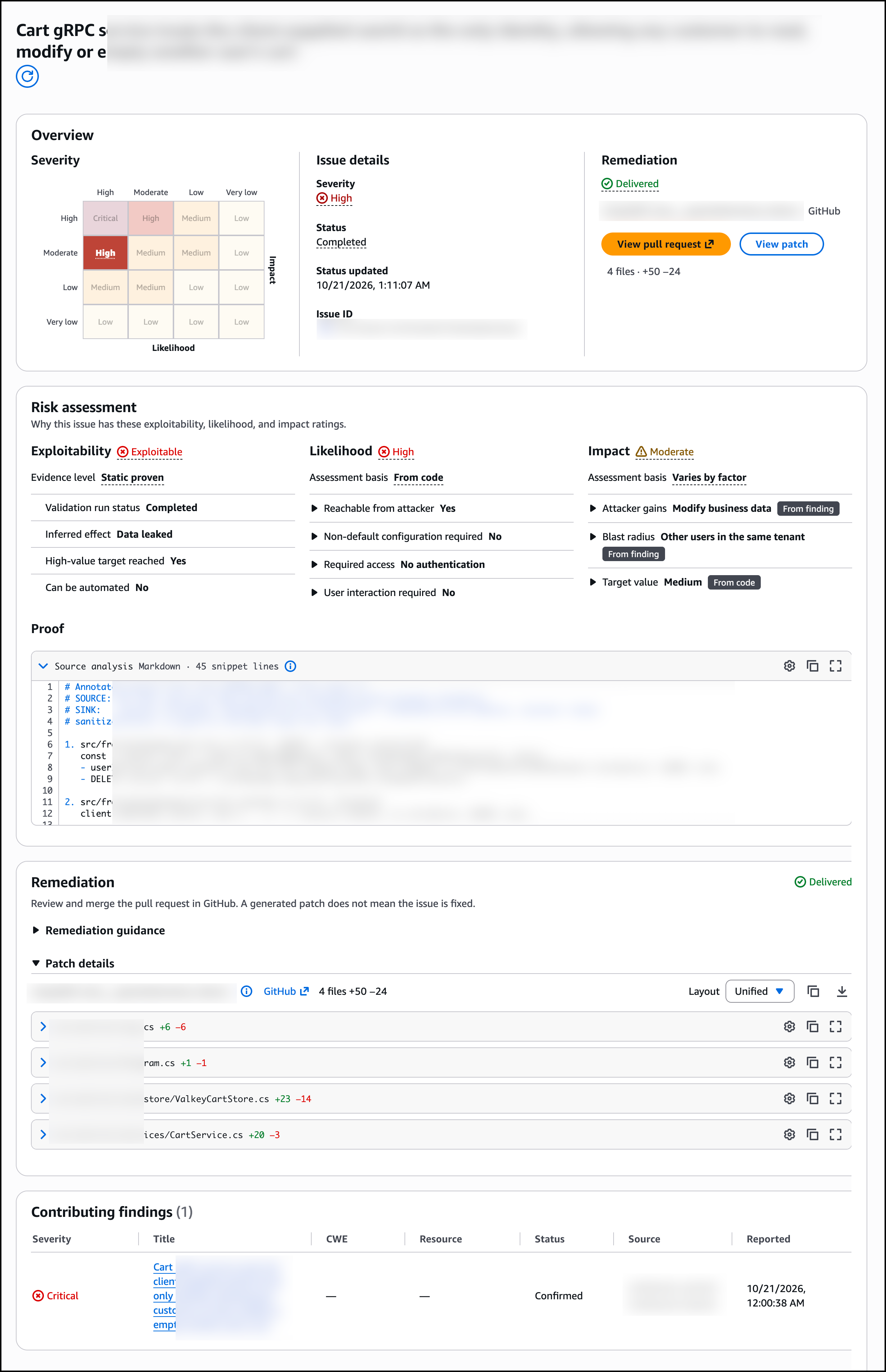
Once configured, the Continuum console presents a centralized Overview dashboard that aggregates code integrations, active environments, and the real-time operational status of AWS collectors. The core interface organizes findings into a prioritized queue of validated issues rather than raw, unverified scanner output. Selecting an individual issue reveals a detailed breakdown encompassing severity ratings, lifecycle status, timestamps, and exhaustive risk assessments. The risk profile delineates exploitability levels, likelihood metrics based on network accessibility and authentication requirements, and potential impact assessments detailing business data modification capabilities and tenant-wide blast radiuses.
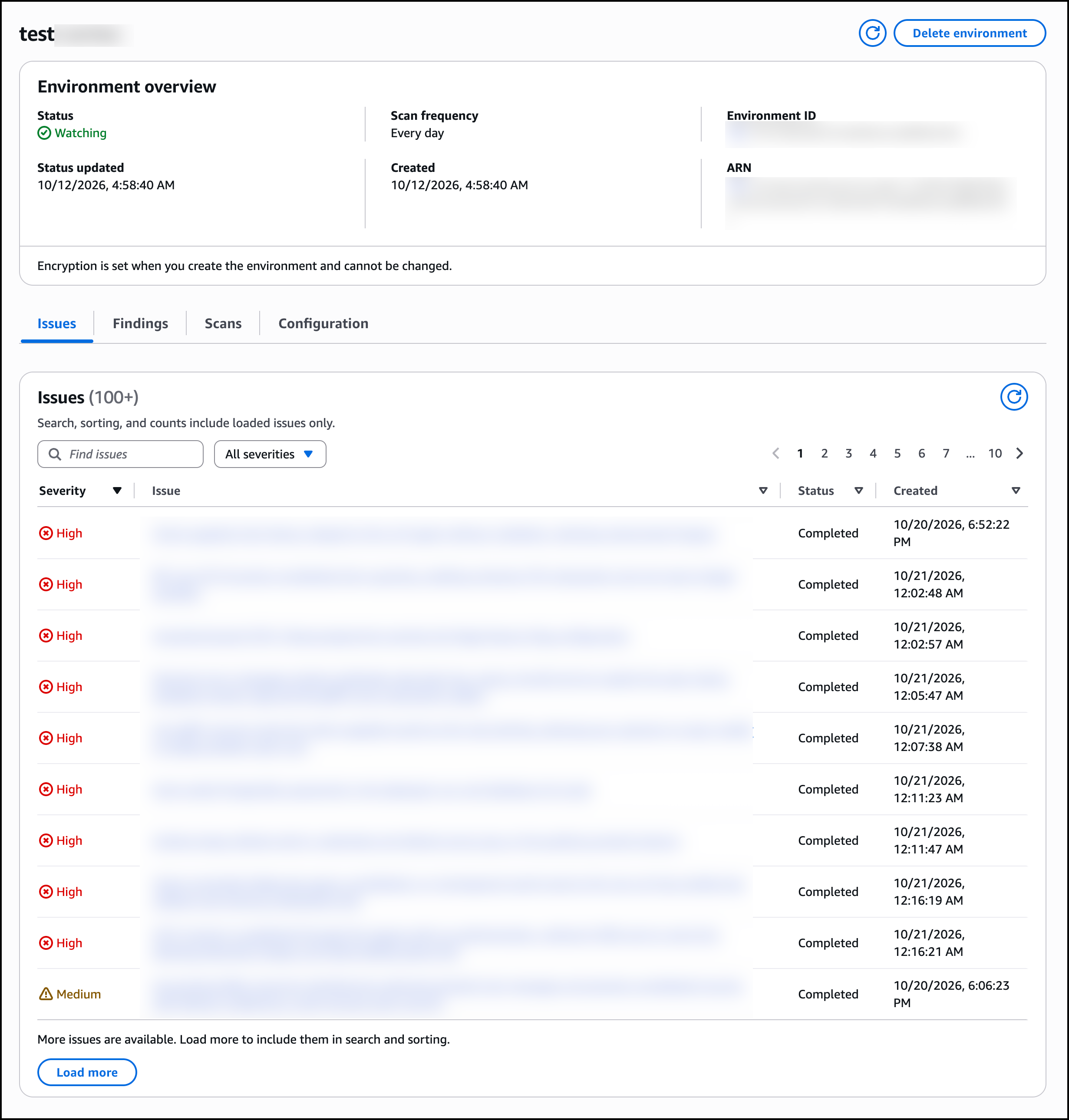
The accompanying remediation panel provides full transparency into the generated code modifications, displaying file changes, line additions, and deletions within specific application microservices. Because the generated patches are pushed directly as repository pull requests, reviewers can evaluate the technical fix and its underlying security justification without disrupting their standard code-review workflows. Furthermore, the platform maintains comprehensive historical logs of all executed scans, enabling teams to adjust scan cadences, trigger on-demand evaluations, and fine-tune environment configurations dynamically.
Industry analysts and early enterprise adopters have observed that the introduction of context-aware, automated remediation services like AWS Continuum marks a paradigm shift in cloud security posture management. As generative artificial intelligence empowers threat actors to discover and exploit zero-day vulnerabilities at unprecedented velocity, defenders can no longer rely on manual triage cycles that take days or weeks to close known security gaps. By compressing the timeline between vulnerability identification, validation, and patch deployment from weeks to mere minutes—while preserving rigorous human oversight—AWS Continuum provides organizations with the systemic agility required to secure complex, distributed cloud architectures.
Following its general availability release, AWS Continuum for code vulnerabilities is currently accessible in the US East (N. Virginia) and US West (Oregon) AWS Regions, with tiered pricing structures detailed on the official AWS Continuum pricing portal. Organizations seeking to deploy the service can reference the comprehensive AWS Continuum User Guide for step-by-step implementation prerequisites, repository integration protocols, and collector configuration standards.