Claude Fable 5.1 Lands on AWS Bringing Advanced Long-Running AI Capabilities and Rigorous Enterprise Safeguards

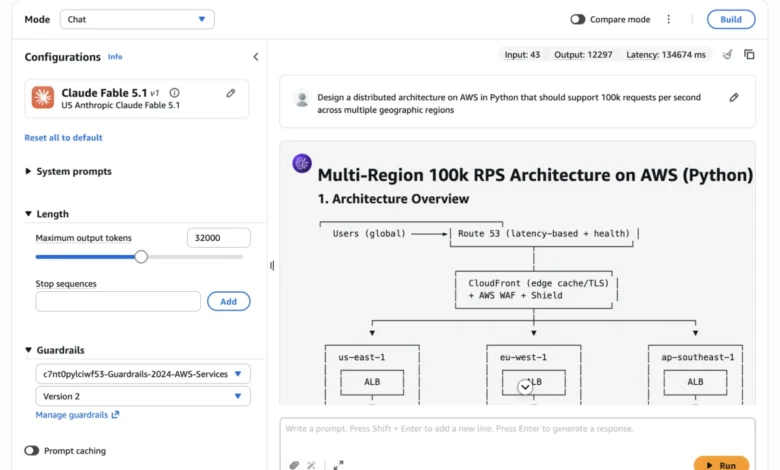
The landscape of enterprise artificial intelligence shifted significantly following the official deployment of Anthropic’s Claude Fable 5.1 onto Amazon Web Services (AWS). Marketed as a breakthrough in frontier intelligence, the new model is explicitly engineered to tackle complex, high-stakes, and protracted tasks across software engineering, scientific research, and extensive enterprise operations. Unlike previous iterations that excelled primarily in conversational or short-form transactional interactions, Claude Fable 5.1 is designed to maintain operational continuity over hours-long sessions, autonomously managing intricate projects, navigating massive codebases, performing meticulous code reviews, and executing performance optimizations across multiple integrated applications.
Evolution and Background of Frontier AI on AWS
The integration of Claude Fable 5.1 represents the latest milestone in the strategic alliance between Amazon Web Services and Anthropic. Over the past several years, the partnership has focused on democratizing access to state-of-the-art foundation models while addressing the stringent security, compliance, and governance requirements demanded by enterprise clients.
As artificial intelligence models have evolved from simple text-generation utilities into autonomous agents capable of independent reasoning and multi-step execution, the computational infrastructure required to support them has scaled proportionally. Traditional large language models often struggle with context degradation, logic drift, and token limitations during extended execution windows. Claude Fable 5.1 addresses these architectural bottlenecks by introducing enhanced context management and reasoning persistence, allowing engineers and researchers to delegate exhaustive workflows—such as refactoring legacy enterprise codebases or parsing genomic data—without requiring constant human intervention or prompt re-initialization.
The introduction of this model on AWS arrives at a time when enterprise adoption of generative AI is transitioning from proof-of-concept experiments to deeply integrated, mission-critical production environments. Organizations across financial services, healthcare, defense, and technology sectors increasingly demand AI systems that can operate reliably within closed, auditable ecosystems.
Architectural Access and Dual Deployment Paths
Enterprise clients seeking to leverage Claude Fable 5.1 can deploy the model through two primary pathways within the AWS ecosystem: Amazon Bedrock and the Claude Platform on AWS.
Amazon Bedrock, AWS’s fully managed service that provides access to high-performing foundation models via a single API, serves as the primary gateway for organizations looking to build generative AI applications without managing underlying infrastructure. Through Bedrock, developers can seamlessly integrate Claude Fable 5.1 into existing cloud native architectures, leveraging AWS security and scalability features. Alternatively, the Claude Platform on AWS offers specialized tooling tailored for advanced development teams requiring granular control over model interaction and workflow orchestration.
To accommodate varying compliance mandates, AWS has established comprehensive technical documentation and model cards. These resources provide engineering teams with explicit performance benchmarks, token economics, latency metrics, and API specifications necessary to architect robust, scalable deployments tailored to specific organizational demands.
Data Retention, Governance, and the AWS Review Framework
A defining aspect of the Claude Fable 5.1 deployment is the introduction of rigorous data governance frameworks designed to address enterprise privacy concerns. Anthropic has categorized Claude Fable 5.1 as a "Covered Model"—a specialized designation reserved for advanced models that necessitate enhanced safety reviews, strict data retention policies, and specialized access controls regardless of where they are hosted.
To support this classification, AWS has introduced a dedicated data retention mode designated as aws_review. Under this configuration, user prompts and model outputs are systematically retained within the secure boundaries of the AWS environment for a period of up to 30 days. This retention period facilitates necessary human safety reviews conducted by authorized Amazon personnel, ensuring that potentially harmful or anomalous model behaviors can be identified and mitigated.
The implementation of the aws_review mode supersedes legacy configurations such as provider_data_share. Under the current architecture, Amazon Bedrock explicitly prevents customer data from being shared directly with the model provider, thereby maintaining a strict firewall between proprietary corporate intellectual property and external entities. This structural guarantee is vital for heavily regulated industries bound by strict data residency and confidentiality regulations, such as HIPAA, GDPR, and financial compliance frameworks.
Complementing these retention controls is the deployment of Enterprise Frontier Safeguards (EFS). Developed through a joint engineering initiative between AWS and Anthropic, EFS empowers eligible enterprise customers to harness the full capabilities of Covered Models while retaining absolute control over their operational data within a secured cloud perimeter. This dual-layer approach—combining automated guardrails with explicit human-in-the-loop safety oversight—establishes a new benchmark for enterprise AI compliance.

Broader Industry Implications and Future Outlook
The launch of Claude Fable 5.1 on AWS carries significant implications for the global software development and enterprise automation markets. By shifting the paradigm from short-burst query handling to continuous, multi-hour autonomous execution, the model redefines the division of labor between human developers and artificial intelligence systems.
In software engineering, the ability of a model to independently own features across an entire codebase, conduct automated peer reviews, and resolve complex performance bottlenecks promises to compress product development lifecycles. However, it also introduces new challenges related to code provenance, intellectual property rights, and the potential propagation of systemic architectural flaws if autonomous agents operate without adequate human supervision.
From a macroeconomic perspective, the deepening collaboration between hyperscale cloud providers and specialized AI labs like Anthropic underscores the consolidation of the generative AI market. Enterprises are increasingly favoring unified cloud ecosystems that offer both state-of-the-art intelligence and enterprise-grade security over fragmented, multi-vendor point solutions.
As organizations begin to pilot and deploy Claude Fable 5.1 across their enterprise workflows, industry analysts will closely monitor productivity metrics, error rates, and the efficacy of the newly minted Enterprise Frontier Safeguards. The success of this deployment may well dictate the architectural roadmap for the next generation of enterprise AI integration, setting a precedent for how powerful, autonomous models are governed, secured, and deployed at global scale.
For developers and IT leaders wishing to explore the technical specifications, implementation guides, and integration tutorials for Claude Fable 5.1, documentation is actively maintained through the official Amazon Bedrock user guides and the AWS Builder Center. Ongoing updates regarding upcoming cloud architecture events, developer conferences, and regional AWS summits can be tracked via the official AWS announcements portal.