The Art and Science of Naming: A Comprehensive Guide to UI Components and Design Systems

Naming is one of the most fundamental yet persistently difficult challenges in software development and digital design. The language used within a team does more than merely label elements; it shapes the cognitive model of the product, dictates the efficiency of cross-departmental communication, and ultimately influences the user experience. When naming conventions are inconsistent, teams frequently encounter friction, with designers, developers, and product managers often speaking different "dialects" regarding the same functional elements. This lack of a shared vocabulary leads to confusion, bloated codebases, and a failure in feature discoverability.

The struggle to define variables, HTML classes, and design tokens often stems from a lack of standardization. Names that are too generic—such as "box-1" or "blue-color"—fail to convey intent or context, making maintenance a nightmare as a project scales. Conversely, names that are overly specific, such as "homepage-header-button-v2," stifle reusability and flexibility. Achieving the balance between semantic meaning and scalable structure is the hallmark of a mature design system.
The Evolution of Design Systems and Naming Taxonomy
Historically, the industry lacked a unified approach to design systems. In the early 2010s, as mobile-responsive design became mandatory, the complexity of managing disparate design elements grew exponentially. This led to the emergence of "Atomic Design," a methodology popularized by Brad Frost, which encouraged breaking interfaces down into atoms, molecules, and organisms. While this provided a structural framework, it did not solve the linguistic challenge of naming those components in a way that remained consistent across large, multi-team organizations.

By the mid-2010s, the concept of "Design Tokens" was introduced, famously by Salesforce’s Lightning Design System. Tokens act as the foundational building blocks of a design system—storing values like color, spacing, and typography—and serve as the single source of truth. As these systems matured, companies like Intuit faced the challenge of scaling tokens across diverse products including Mailchimp, QuickBooks, and TurboTax. The necessity for a flexible taxonomy became a business priority, as the cost of "naming debt"—the technical and design overhead caused by poor terminology—began to impact development velocity.
Frameworks and Resources for Effective Naming
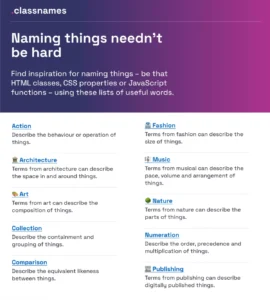
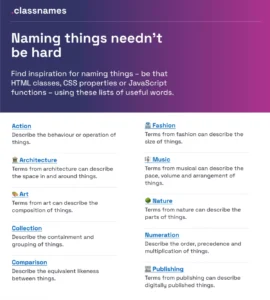
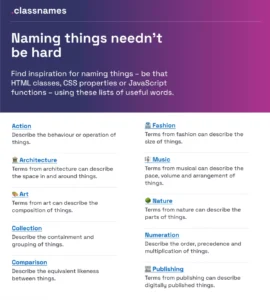
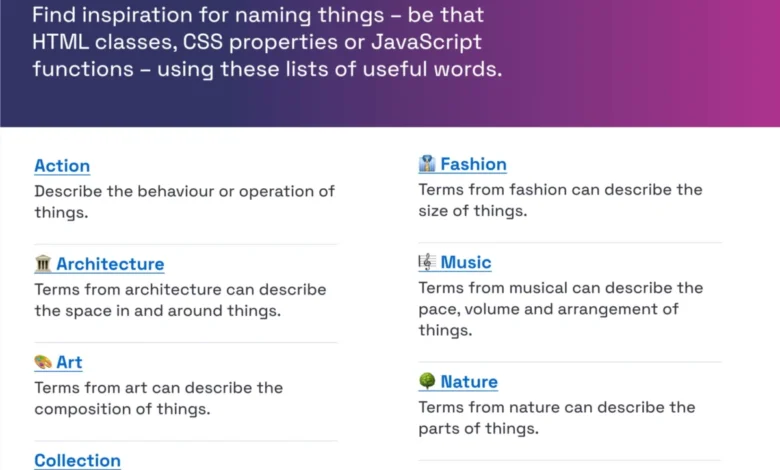
To address the ongoing issue of naming, several open-source resources and industry-standard practices have surfaced. For teams struggling with inspiration for CSS or JavaScript nomenclature, the platform Classnames provides a curated list of terms grouped by theme, such as behavior, association, and structure. This moves developers away from purely visual naming conventions (e.g., "red-text") toward more meaningful, functional labels (e.g., "error-message").

For the visual aspect of design systems, color naming has seen significant refinement. The project Color Parrot, maintained by David Aerne, serves as a massive repository of over 30,000 unique color names. By providing a standardized reference, it prevents teams from having to reinvent labels for every shade of gray or blue, ensuring consistency across design files and CSS variables.
Industry experts, including Javier Cuello, have established best practices for UI naming that emphasize logical, short, and non-visual labels. According to these guidelines, an effective name should never be tied to a visual property (like "bold" or "blue"), as those attributes are subject to change. Instead, names should reflect the role or state of the component. For example, rather than naming a component "green-button," a team should use "primary-action-button." This allows the underlying visual properties to be updated without breaking the code or requiring a re-naming process across the entire product.

The Business Impact of Feature Adoption
The implications of poor naming extend far beyond internal development cycles; they directly correlate with user adoption rates. A study by UX designers has highlighted that when features are named using internal jargon rather than the user’s language, discoverability drops significantly. Users struggle to connect a feature name with the problem it solves.
Successful product teams now employ a "Jobs-to-be-Done" (JTBD) approach to naming. By interviewing users and capturing the language they use to describe their pain points, companies can align their feature names with the user’s mental model. When a feature is named "Data Export" versus "Download CSV," the former resonates with the user’s intent, while the latter is a technical implementation detail. Data-driven feature adoption strategies suggest that clear, outcome-oriented naming reduces the time-to-learn for new users, thereby increasing the retention rate of new product updates.

Strategic Implementation: Case Studies in Scaling
Large-scale enterprises have begun implementing "Taxonomy Maps" to manage complexity. A prominent example is the Vodafone UK Design System, which utilizes a rigorous variable structure to manage a multi-brand, multi-themed environment. By segmenting tokens into four distinct collections—Brand, Primitive, Semantic, and Page—Vodafone ensures that developers can trace the usage of a token back to its origin. This level of organization allows for seamless "theming," where a single change at the "Brand" level can propagate through the entire design system without affecting specific, hard-coded components.
This hierarchical approach, often inspired by the work of Nathan Curtis, allows teams to filter and maintain tokens with ease. It removes the guesswork from development. If a developer needs to update a color, they can see exactly which tokens are affected by checking the taxonomy map, rather than performing a site-wide search for hard-coded hex values.

The Future of Unified Nomenclature
As artificial intelligence and automated design tools continue to integrate into the development workflow, the importance of standardized naming will only grow. AI-driven design assistants rely on semantic naming to generate accurate code. If a component is named "container-1," an AI has no context to interpret its purpose. If it is named "navigation-menu-sidebar," the system can infer accessibility requirements, styling, and behavior.
The industry is trending toward an era of "Design-as-Code," where the distinction between design tokens and production code is virtually eliminated. This requires a level of linguistic precision that was previously considered optional. Organizations that invest in a robust, shared vocabulary today are effectively future-proofing their products against the inevitable technical debt of the next decade.

Conclusion: Bridging the Communication Gap
The ultimate goal of a robust naming strategy is to reduce the "translation time" between stakeholders. When a designer says "modal," a developer should instantly recognize the functional requirements, and a product manager should understand the impact on user flow. By utilizing resources like the Component Gallery or the Design Token Naming Guide, teams can begin to audit their current nomenclature and establish a baseline of consistency.
Naming is not a static task; it is an iterative process that must evolve alongside the product. Teams should treat their naming taxonomy as a living document, regularly reviewing it to ensure it remains relevant to the current user base. By moving away from subjective, visual-based naming and toward a structured, semantic, and user-centric approach, organizations can eliminate the confusion that stifles creativity and hampers delivery. As the digital landscape continues to grow more complex, the ability to clearly define and name the components of that landscape will remain a defining competency of successful design and engineering teams.
Related posts: