Automating Continuous Improvement: How AWS DevOps Agent and LaunchDarkly Close the Gap Between Hypothesis and Production Success

Continuous improvement in modern software engineering is increasingly defined by the ability to experiment rapidly, measure outcomes, and iterate without disrupting the production environment. While the theoretical benefits of this "test-and-learn" cycle are widely understood, the reality for most development teams is a fragmented, manual process that often leads to stalled innovation. To address these systemic inefficiencies, a new reference architecture has emerged, integrating AWS DevOps Agent, Kiro, and LaunchDarkly to create a closed-loop system that autonomously manages the experimentation lifecycle—from hypothesis generation to safe, metric-driven rollouts.
The Problem: Why Experimentation Stalls
Industry analysts have long noted that the "overhead tax" on software experimentation often outweighs the potential gains. When teams attempt to implement iterative changes, they frequently encounter three primary roadblocks. First, the planning cost is significant; developers must define feature flag strategies, coordinate complex implementations, and wire dependencies together before a single user sees the new behavior. This manual setup is a drain on engineering resources.
Second, the disconnect between measurement and action remains a persistent hurdle. Even when metrics are configured, the remediation process following a negative result is often slow. If a feature causes a performance regression or a dip in conversion rates, teams typically rely on manual rollbacks or emergency deployments, both of which are high-risk maneuvers. Finally, the "stalled iteration" problem occurs because teams often fail to maintain a structured record of which specific changes produced which outcomes. Without this feedback loop, subsequent hypotheses become educated guesses rather than data-driven strategic moves.
The Architecture of Automated Experimentation
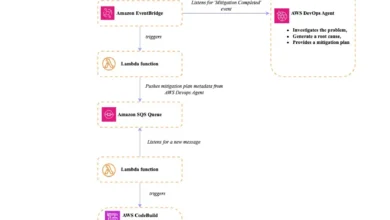
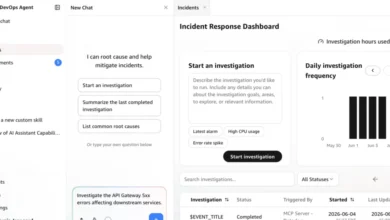
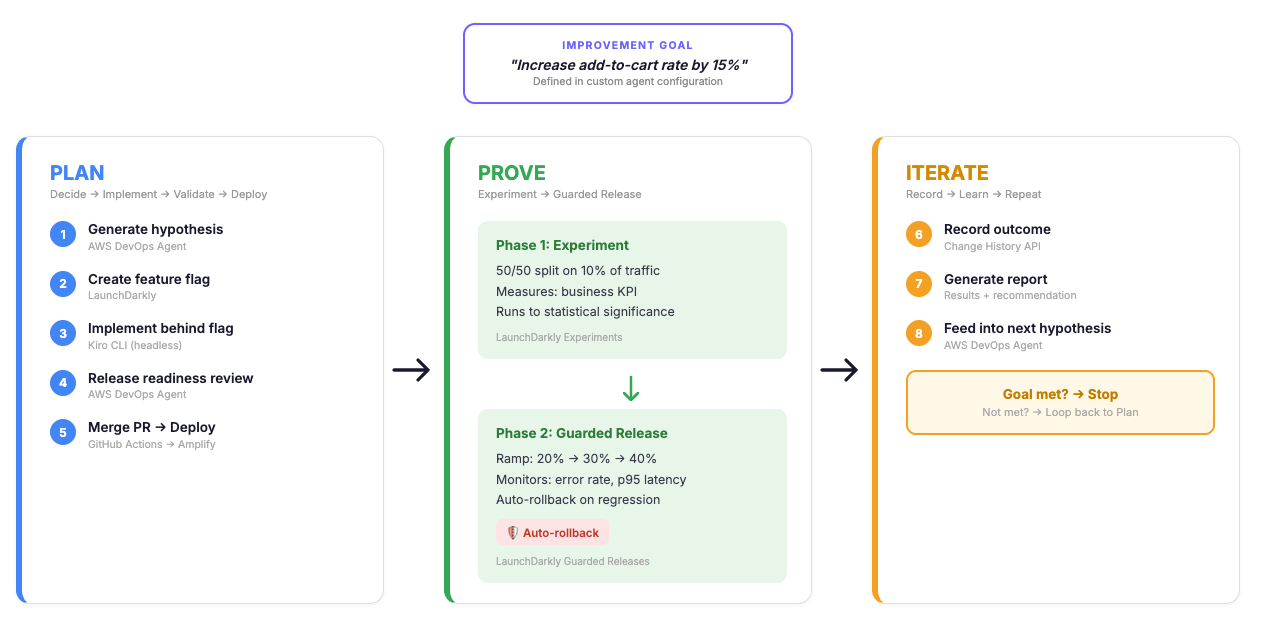
The solution to these challenges lies in a "Plan-Prove-Iterate" workflow orchestrated by the AWS DevOps Agent. By utilizing custom agent instructions and Model Context Protocol (MCP) servers, the system automates the most time-consuming aspects of the software development lifecycle.
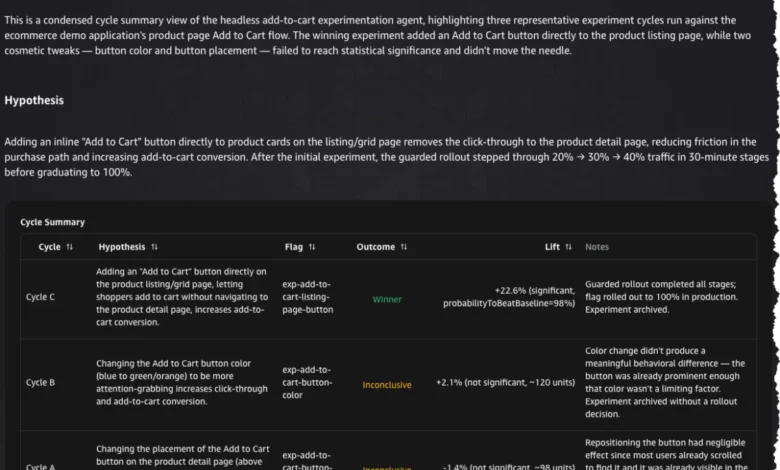
The workflow begins with a clear business objective, such as "increase add-to-cart rates by 15%." Once the goal is established, the AWS DevOps Agent, acting as a Custom Agent, takes control. It evaluates the codebase, generates a hypothesis, and instructs the Kiro CLI—operating in headless mode—to implement the required code changes behind a LaunchDarkly feature flag. This ensures that every experimental code path is gated from the moment of deployment.

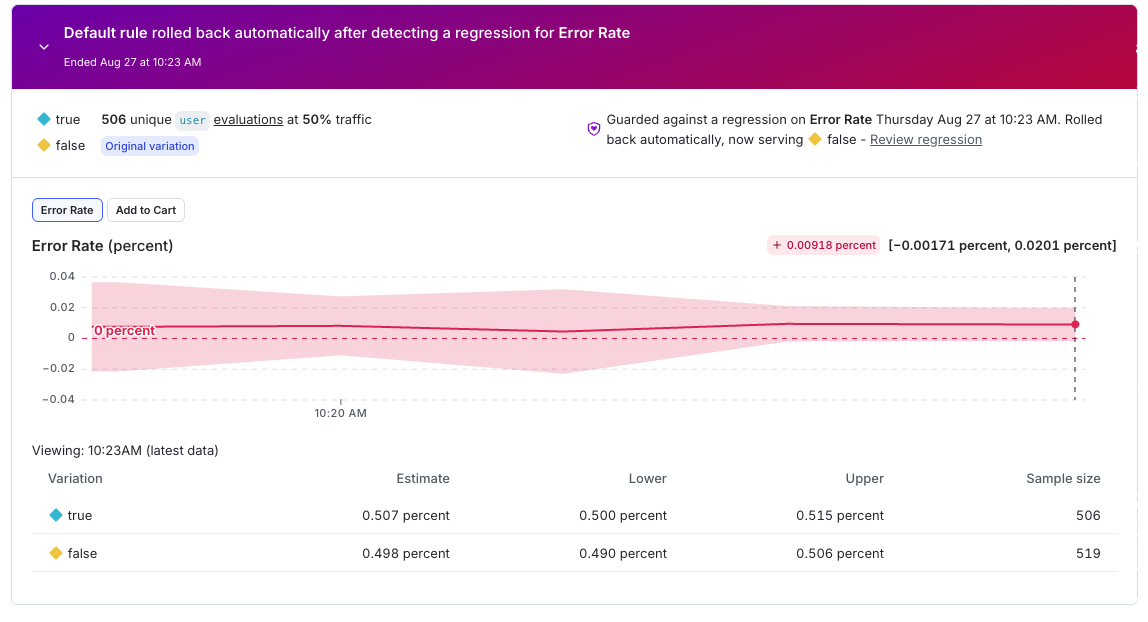
The integration with LaunchDarkly provides a robust layer of governance. Once the code is deployed, the agent initiates a 50/50 A/B experiment on a small, controlled segment of traffic. LaunchDarkly monitors business KPIs in real-time. If the experiment proves successful, the system transitions into a "Guarded Release." This phase ramps up traffic from 20% to 100% while continuously checking against operational guardrails, such as latency or error rates. If any threshold is breached, the system executes an automatic rollback, reverting the feature flag state instantly without the need for a redeployment or human intervention.
Chronology of the Development Cycle
The lifecycle operates in a highly disciplined, three-stage sequence:
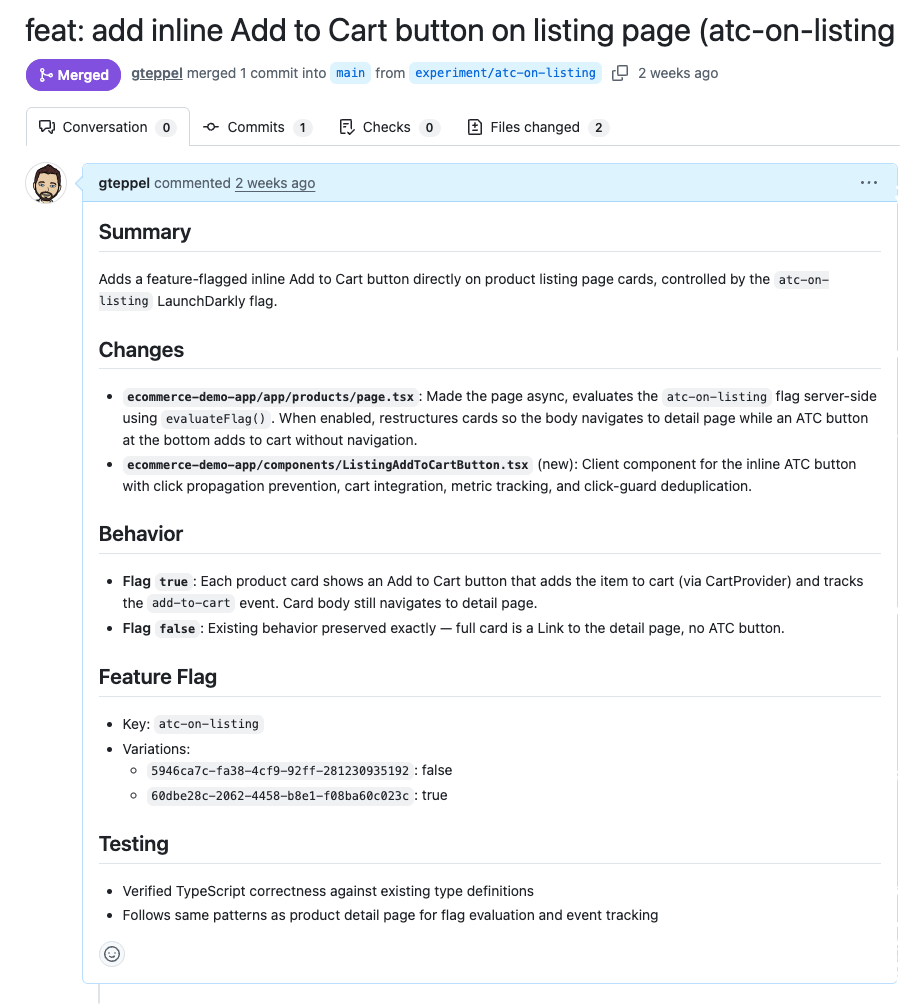
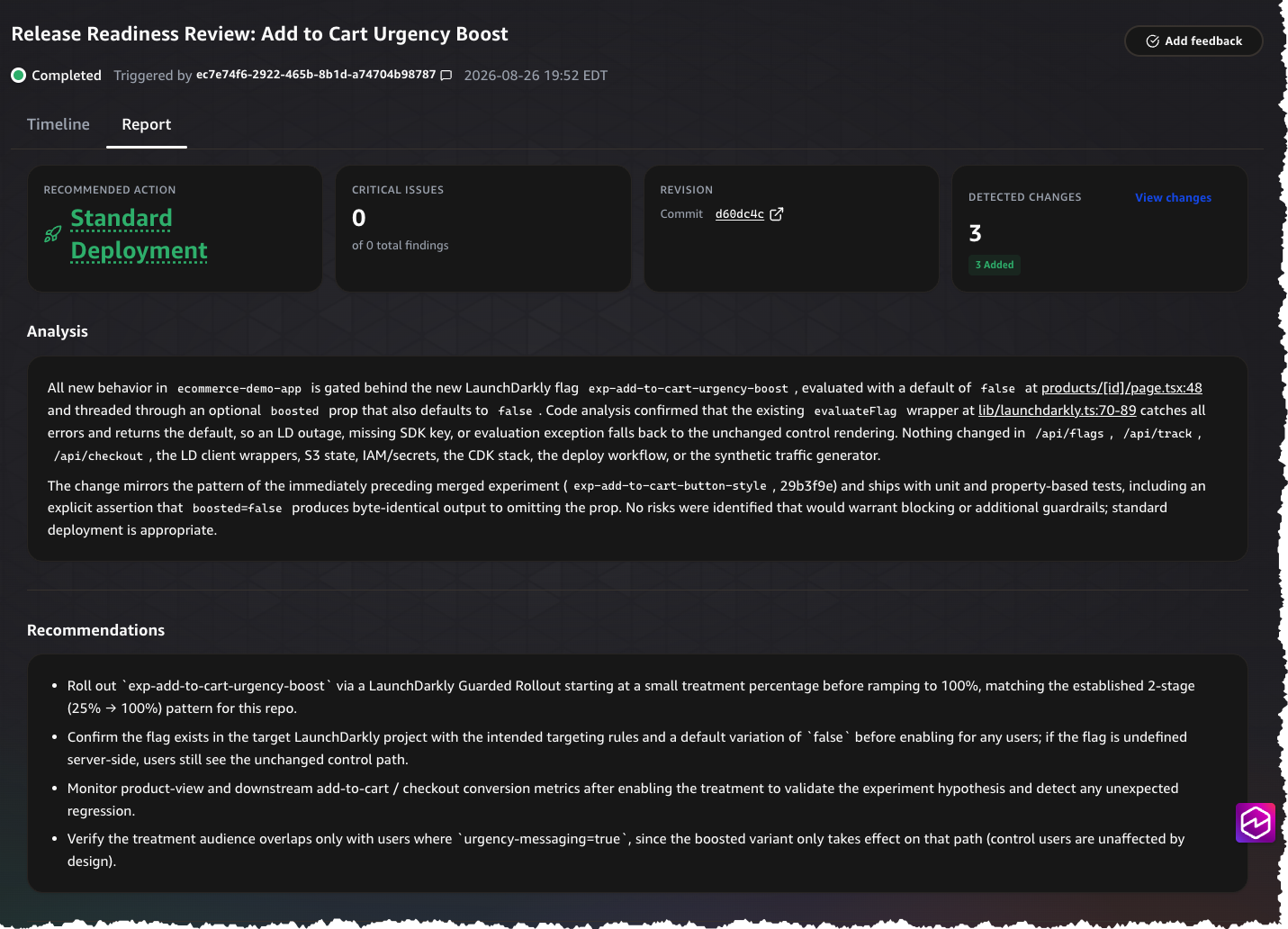
- The Planning Phase: The agent assesses the current state of the goal, checks for previous failed attempts in the flag history to prevent repeating mistakes, and drafts a PR. The AWS DevOps Agent then performs a release readiness review. If the review is successful, the PR is merged, and the application is deployed via AWS Amplify.
- The Proof Phase: This involves the sequential A/B experiment followed by the Guarded Release. The experiment validates the business hypothesis, while the Guarded Release validates the system’s stability at scale. By separating value measurement from safety measurement, the system prevents "winning" features from being released if they threaten system integrity.
- The Iteration Phase: Once the rollout concludes—or fails—the agent queries the LaunchDarkly Change History API. This creates a detailed record of the experiment’s outcome. This record is then fed back into the agent’s decision-making logic for the next hypothesis, creating a truly continuous improvement loop.
Supporting Data and Technical Implementation
The efficacy of this architecture is built on the separation of decision-making from execution. The AWS DevOps Agent acts as the "brain," while the MCP servers function as the "hands." The Experiment MCP Server, a Python application built on FastMCP, provides the necessary tools for code manipulation and deployment.
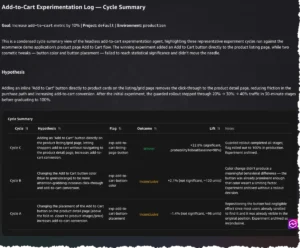
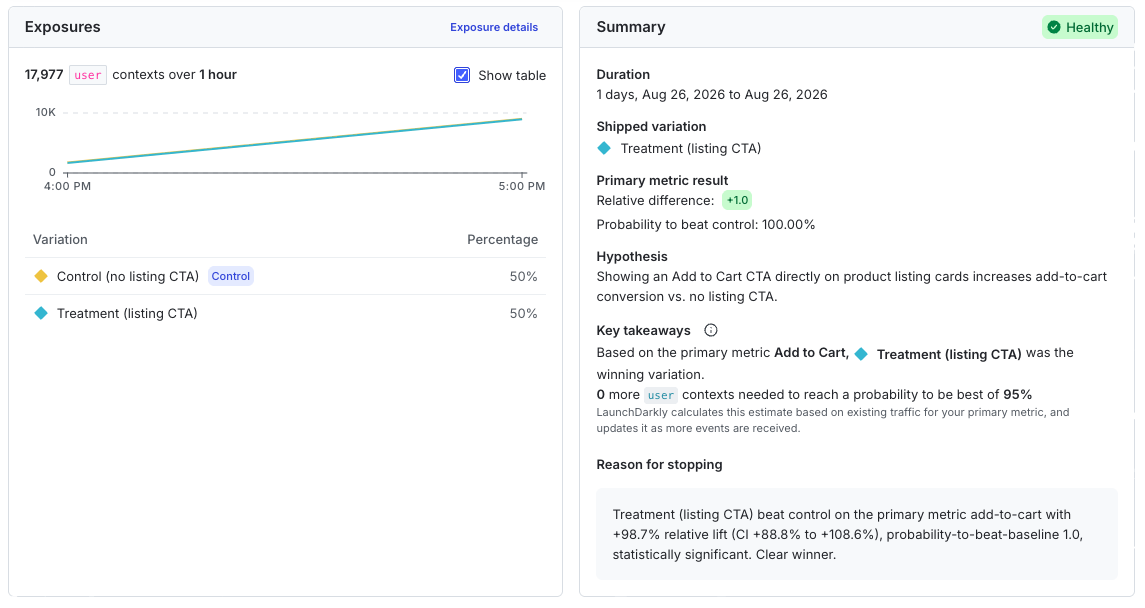
In a recent demonstration, a team tasked with optimizing a product listing page achieved a 17.7 percentage point lift in add-to-cart conversion rates using this system. During the process, the system encountered an error rate spike during a guarded rollout. The platform detected the regression within the monitoring window and automatically reverted the flag state in seconds, demonstrating the system’s capacity to function as a safety net.
Crucially, the system relies on stateless HTTP communication. By deploying the Experiment MCP Server to Amazon Bedrock AgentCore, the infrastructure can restart or replace containers without breaking in-flight requests. Task persistence is handled via S3-backed state stores, ensuring that progress survives even if the environment resets.
Industry Implications and Strategic Value
The shift toward agentic, closed-loop experimentation represents a fundamental change in how high-velocity engineering organizations operate. By reducing the manual overhead of feature flagging and testing, companies can move away from "big bang" releases toward a more granular, evidence-based development model.
For organizations, the implications are three-fold:
- Reduced Operational Risk: The ability to automatically roll back based on real-time metrics allows teams to push changes to production with significantly higher confidence.
- Accelerated Learning: Because every experiment is documented and automatically linked to a business goal, the "time-to-insight" is reduced from weeks to hours.
- Resource Optimization: Engineering talent is shifted from the manual wiring of experiments and managing rollbacks to the more valuable work of hypothesis generation and high-level strategy.
Official Guidance and Security Boundaries
Security remains a central component of this framework. All credentials for GitHub, LaunchDarkly, and other integrated services are stored within AWS Secrets Manager and accessed only via the MCP server. The system scope is strictly defined; the agent is restricted to specific repositories and branches, ensuring it cannot make unintended modifications to critical infrastructure.
For teams looking to adopt this approach, the process involves three distinct steps: registering the LaunchDarkly MCP server, deploying the Experiment MCP Server, and defining the orchestration skill in the AWS DevOps Agent. While the current reference implementation provides a powerful tool for developers, stakeholders note that the goal is a more turnkey experience in the near future.
As software systems grow in complexity, the human capacity to manually manage, test, and roll out features becomes the primary bottleneck for growth. By delegating the execution of the experimentation lifecycle to autonomous agents, organizations are not just increasing their deployment frequency; they are fundamentally changing the speed at which they can learn from their users and improve their products. The future of software development, as evidenced by this integration, is one where the code itself is as iterative as the business goals it is designed to meet.