GitHub Copilot Agent Runtime Completely Rewritten in 800000 Lines of Production Rust Using AI Agents


The architecture powering the GitHub Copilot ecosystem has undergone a monumental shift. Microsoft and GitHub have announced the successful completion of an unprecedented engineering feat: migrating the Copilot agent runtime—the underlying orchestration harness for the Copilot CLI, mobile applications, cloud services, and the Copilot Software Development Kit (SDK)—from TypeScript and Node.js to more than 800,000 lines of production-grade Rust.
Executed over a rigorous fourteen-and-a-half-week window between May and August, the project represents one of the largest automated language rewrites in modern software history. Crucially, the transformation was not performed behind closed doors in a prolonged, isolated feature branch. Instead, it was executed entirely in-place on the main branch through 128 incremental pull requests, resulting in 135 continuous public releases while the codebase was actively scaling.
Led primarily by a single developer heavily utilizing autonomous AI agent fleets, the rewrite challenges conventional wisdom regarding resource allocation, software longevity, and the practical application of generative artificial intelligence in enterprise-scale systems.

Background and Strategic Motivation for the Port
For years, the Copilot agent runtime relied on TypeScript, executing on Node.js and the V8 JavaScript engine. While this stack offered rapid initial development for console interfaces and terminal user interfaces (TUIs), it imposed severe architectural limitations as Copilot expanded across Microsoft and GitHub products.
The runtime powers not only the standalone command-line interface, but also code review tools, developer cowork applications, IDE integrations in Visual Studio and VS Code, and productivity suites across Excel, Outlook, PowerPoint, and Word. Initially, many of these individual products implemented disjointed agent loops. To unify intelligence, security, reliability, and performance, GitHub introduced the Copilot SDK as a single entry point to the shared runtime.
However, because the original stack was tightly coupled to the CLI, enabling programmatic access via the SDK required an architectural workaround: the CLI was forced to run in a headless mode, communicating with consuming applications via a JSON-RPC protocol over standard input/output streams. This meant that every SDK consumer—whether writing in C#, Python, Go, Java, or Rust—was forced to spawn a separate subprocess and carry the overhead of an embedded Node.js and V8 environment.
Each client instantiation incurred a working memory penalty of roughly 100 megabytes, compounded process boundaries, complicated debugging, and introduced brittle failure domains where a crash in the Node environment would terminate the entire session. To achieve fast startup times, high server density, predictable resource consumption, and seamless in-process embedding through a C Application Binary Interface (ABI), engineering leadership targeted Rust.
Chronology of the Migration
The migration strategy was structured to minimize risk while continuously validating functionality in production environments.
- Early May 2026: Initial scoping estimated the runtime at approximately 130,000 lines of TypeScript. Concurrently, ongoing feature development poured hundreds of thousands of lines of new code into the repository, resulting in an estimated 430,000 lines of production TypeScript ultimately passing through the translation pipeline.
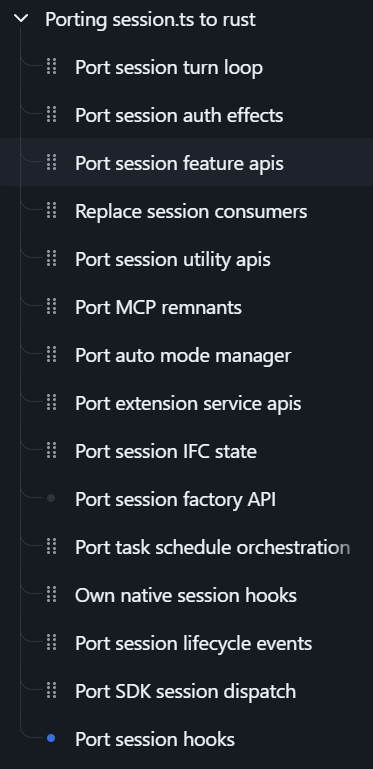
- May 1 to May 15: Foundation work was established. Two initial pull requests set up the Rust workspace, lint rules, CI build pipelines, and coding instructions. Pure-logic primitives with zero input/output or shared state were ported first to validate the interop machinery.
- June and July: Work progressed systematically from the leaves inward. Content exclusion utilities, shell helpers, and session filesystem operations were translated. Stateful subsystems, tools, hooks, and Model Context Protocol (MCP) integrations followed.
- August 3: The temporary interop seam—managed via the
napiRust crate for Node native addons—reached its peak, with 2,019 internal N-API exports and 3,356 TypeScript call sites actively bridging the two languages. - August 21: The port reached 100% production Rust, encompassing 832,378 lines of production code and 468,689 lines of unit tests. All internal TypeScript and temporary N-API seams were completely retired.
Rather than utilizing a big-bang cutover, the team shipped changes incrementally. The main branch deployed 135 releases over the 14.5-week window—averaging roughly 1.3 releases per day—allowing engineering teams to detect and remediate minor regressions immediately.
Interoperability and Architecture: Bridging Six Languages
To service developers working across multiple technology stacks, the newly optimized Rust runtime provides two primary integration pathways:
- The N-API Door: Maintained for Node.js environments and the CLI, allowing native loading as an addon.
- The C ABI Door: A streamlined, dispatch-based interface utilizing only 19 exported functions. Behind these core hooks, the engine processes 364 dispatch routes via JSON-RPC payloads.
By maintaining JSON-RPC as the internal byte transport even for in-process memory calls, the engineering team avoided the immense complexity of writing and maintaining bespoke per-method bindings across six separate SDK languages (C#, Go, Java, Python, Rust, and TypeScript). Consuming applications can now instantiate the client in-process with a single configuration flag:
// Example: Instantiating the C# SDK for in-process execution
var client = new CopilotClient(new CopilotClientOptions
    Connection = RuntimeConnection.ForInProcess()
);
This dual-mode architecture eliminates the mandatory Node.js dependency for non-Node host applications, providing native library integration across diverse enterprise architectures.
Supporting Data and Quantitative Metrics
The scope of the operation is underscored by comprehensive telemetry captured across 12,760,995 runtime events and thousands of automated agent sessions.
- Prompt Caching Efficiency: By maintaining stable system prompts, tool definitions, and conversation contexts, the system achieved a 96.22% prompt-cache hit rate. Fresh input accounted for only 0.71% of token volume, insulating the economics of long-running autonomous sessions from prohibitive computational costs. Total token consumption reached approximately 136.3 billion tokens, resulting in an API inference expenditure of roughly $120,000.
- Exploration vs. Mutation: Analysis of tool calls revealed that AI agents spent approximately 90% of their operational time gathering evidence—reading files, executing searches via
ripgrep, and inspecting git history—compared to only 10% spent executing direct code mutations (apply_patchandedit). - Safety and the Borrow Checker: Despite widespread assumptions that Rust’s strict compiler presents a barrier to AI code generation, ownership, borrowing, and lifetime errors accounted for merely 1.7% of compiler diagnostics. The vast majority of compiler interventions (84%) involved routine static typing mechanics, such as mismatched signatures or renamed fields. Within the entire production crate, only 158 unsafe blocks were utilized, every single one strictly isolated to necessary external system boundaries (C ABIs, Windows APIs, POSIX system calls, SQLite C bindings, and dynamic library loading).
Performance Improvements and Scalability
Performance benchmarking comparing the pre-port TypeScript/Node.js stack against the post-port Rust runtime demonstrates dramatic improvements across key operational metrics:
- Client, Session, and One Turn Execution: Dropped from a baseline of 5.25 seconds down to 1.33 seconds out-of-process, and 292 milliseconds when hosted fully in-process via FFI.
- Throughput: In high-concurrency pressure tests executing 1,000 sequential single-turn session lifecycles, the legacy TypeScript configuration achieved 7.55 sessions per second. The out-of-process Rust runtime achieved 57.45 sessions per second, while the in-process configuration reached 120 sessions per second—a nearly 16-fold throughput increase.
- Memory Overhead: Resident private memory added during a ten-client batch test fell from an expansion of 1,383 megabytes in the Node-based stack to 247 megabytes out-of-process, and a mere 126 megabytes in-process—representing a 91% reduction in memory footprint.
Industry Implications and Future Outlook
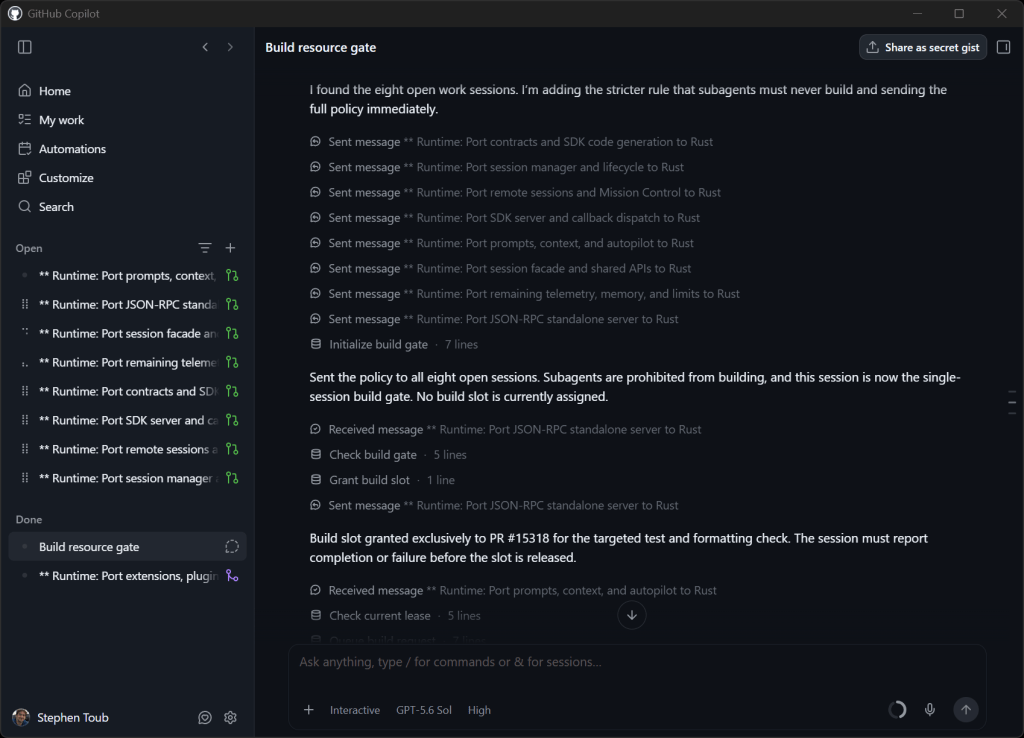
The completion of the Copilot agent runtime port marks a significant milestone in the intersection of generative AI and systems programming. Industry analysts note that while software rewrites of this magnitude were historically economically unviable due to prohibitive engineering labor costs—often requiring multi-year commitments from large developer teams—the strategic integration of autonomous agent fleets fundamentally alters the economic equation.
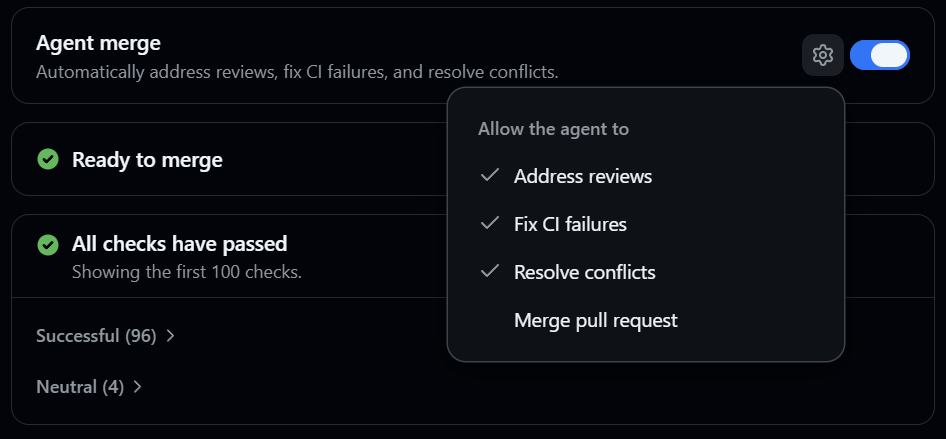
By pairing human architectural oversight, rigorous validation gates, and automated code review loops with high-velocity agent execution, complex infrastructural modernization can be achieved continuously without stalling product feature delivery.
With the runtime completely translated to Rust, Microsoft and GitHub have laid a lightweight, highly scalable foundation. Future engineering efforts will focus on leveraging Rust’s native concurrency and ownership models to further optimize performance, expand edge and embedded device compatibility, and scale the Copilot platform to meet rapidly accelerating enterprise demands.