GitHub Releases Transparency Report Detailing October Infrastructure Incidents and Reliability Overhauls


GitHub has published its monthly reliability and availability transparency report, detailing a challenging month of operations marked by eight major performance-degrading incidents throughout October. The engineering team has acknowledged that while substantial structural migrations to Microsoft Azure and significant capacity expansions were achieved, persistent operational vulnerabilities—particularly concerning database orchestration, regional network stability, and connection pool management—exposed gaps in the platform’s resilience.
The monthly disclosure is part of GitHub’s ongoing commitment to open engineering practices, adhering strictly to its core operational philosophy: availability first, followed by capacity, and finally, feature development. Despite aggressive scaling efforts, the platform suffered from multiple severe disruptions in October, impacting core developer workflows, including GitHub Actions, Copilot, enterprise migrations, and code repository management.
Infrastructure Scaling and Architectural Migration Milestones
Entering the final quarter of the year, GitHub’s engineering divisions have been aggressively decoupling the platform from legacy infrastructure by migrating core production workloads to Microsoft Azure. By November 9, operational metrics indicated that 140 out of 151 production services and 32 out of 50 MySQL primaries had been successfully transitioned to Azure Central US.

The newly provisioned cloud infrastructure has absorbed significant transactional volume. Azure currently handles 63% of all migrated-service reads, 66% of monolith reads, and 52% of Git reads. Furthermore, a compute expansion completed across all nine Central US Kubernetes clusters has effectively doubled available capacity. This expansion has proven vital for accommodating organic platform growth; traffic for migrated services has surged by 82% since March. By routing excess load through the Central US region, GitHub has successfully shielded its original on-premises datacenters from surpassing historical operating thresholds.
In addition to compute expansion, the team executed targeted reliability fixes. Optimizations within GitHub Actions boosted capacity for critical Azure control-plane requests. A network address translation (NAT) gateway mitigation successfully slashed usage by 85%, reducing projected production job failures from an estimated 800 down to just four during deployment. Client-side improvements, including stricter connection limits, were also implemented to prevent localized dependency interruptions from cascading into broader, platform-wide reconnection storms.
Database efficiency has likewise improved through structural refactoring. A high-traffic GitHub Actions endpoint—previously processing upwards of 250 million requests daily—was migrated to a more efficient service path, driving down peak database read operations by 85%. Similarly, introducing a mandatory three-character minimum search query for repository topics eliminated approximately 98% of slow or terminated query patterns.
However, these engineering triumphs were repeatedly undermined by operational vulnerabilities, most notably exemplified by write-routing errors and regional cloud infrastructure anomalies.
Chronology of October Incidents
October’s operational challenges manifested across multiple distinct outages, affecting various layers of the developer ecosystem.
October 5: GitHub Actions Cascading Failures
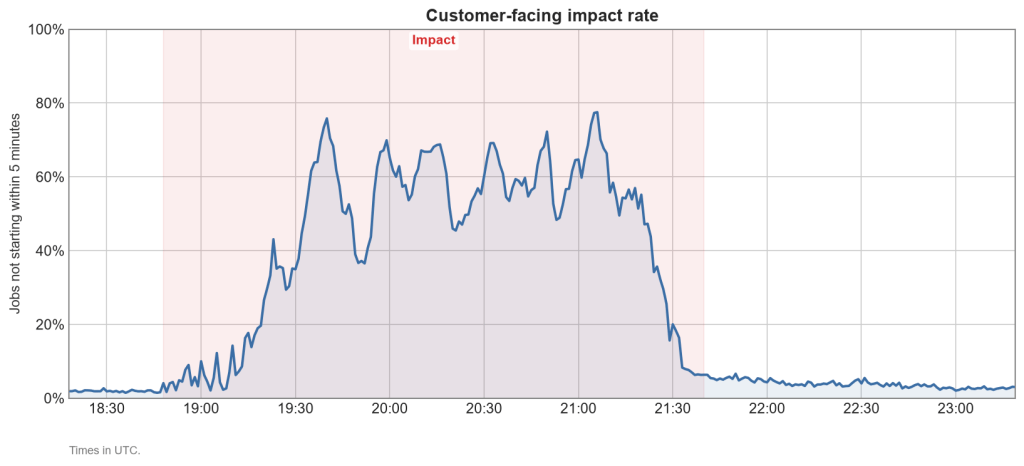
Beginning at 19:11 UTC and lasting for approximately three hours and forty-five minutes, GitHub Actions experienced severe degradation. Workflow jobs queued on GitHub-hosted runners failed to start promptly. At the peak of the incident, which persisted for roughly ninety minutes, the vast majority of jobs failed to initialize within the five-minute SLA threshold.
The disruption stemmed from a partial networking failure within the cloud provider’s infrastructure, severing connections between a datacenter region and its underlying cloud-hosted databases. Rather than failing fast, the affected service allowed network calls to hang, causing requests to pile up until memory exhaustion forced a service restart. Subsequent automatic failovers to a secondary region overwhelmed unreserved capacity, while idle runners that timed out were slow to be replaced, exacerbating the queue backlog. Self-hosted runners remained operational throughout the event.
October 6: Enterprise Importer Database Exhaustion
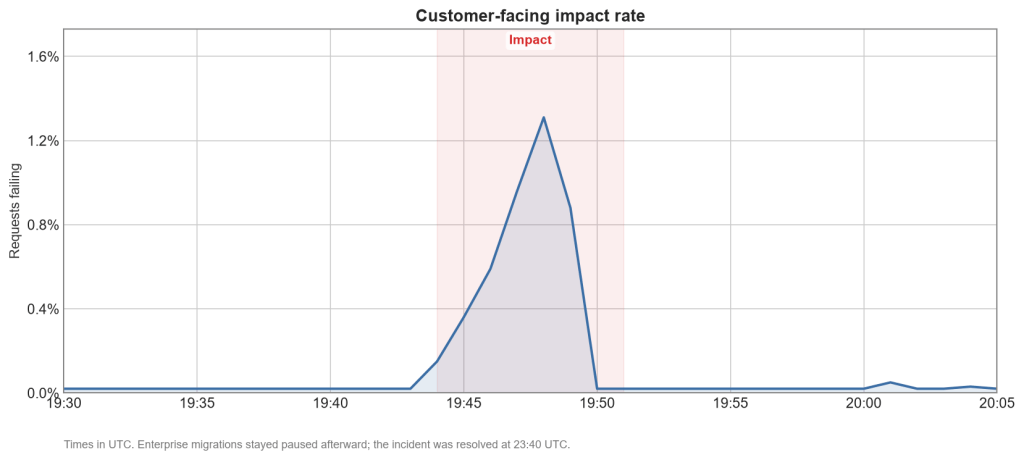
At 19:57 UTC, a traffic surge triggered by the GitHub Enterprise Importer overwhelmed a shared database cluster. The importer submitted an influx of massive queries that consumed the entirety of available database connections. This left core GitHub.com features—including user authentication, pull requests, and Codespaces—unable to acquire connections, generating error rates peaking at 1.3% across approximately 6,400 organizations. While general traffic recovered within six minutes as queries cleared, enterprise migrations remained paused for over three hours until a patched importer capable of batching queries was deployed.
October 7: Core Database Write Routing Failures
Perhaps most disruptive were two separate write outages occurring on October 7 at 15:14 UTC and 17:17 UTC, lasting ten and nine minutes respectively. Routine maintenance replacement of machines managing database write routing introduced a corrupted node containing outdated configuration records. Once elected as leader, the node broadcasted incorrect routing configurations that directed core database writes to retired servers.
Validation checks failed to catch the misconfiguration. Compounding the issue, an automated maintenance task ignored a designated operational pause and triggered a subsequent database election, reinstalling the flawed node as leader and causing a recurrence of the outage. Web and API request failure rates spiked to 8.9% and 9.3%, impacting over 12,000 and 11,000 organizations respectively, though no persistent data loss occurred.
October 19: Cache Disconnection and Network Saturation
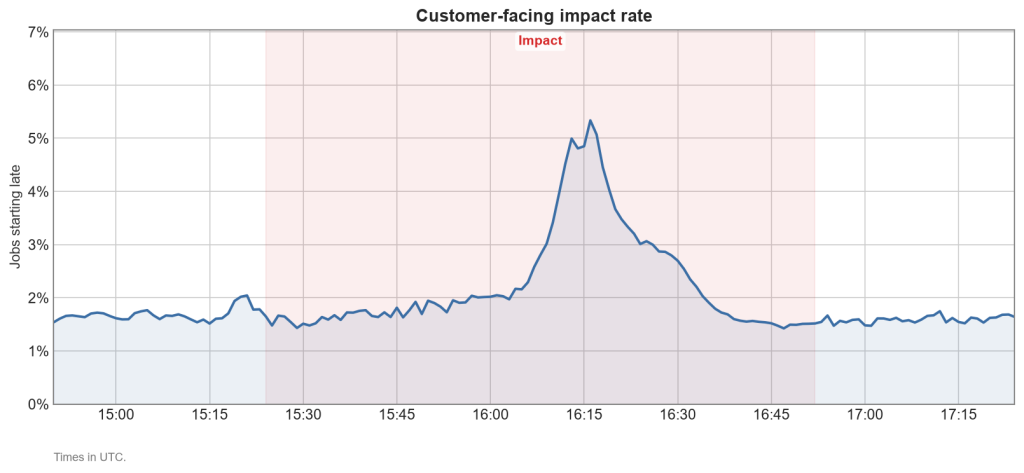
An internal Actions service responsible for storing workflow logs and run statuses lost connectivity to cache servers within a single cloud region at 15:49 UTC. A subsequent retry storm saturated network links between GitHub’s datacenter and the cloud region. The resulting network congestion degraded code search and live site updates, while roughly 5% of GitHub-hosted runner jobs suffered delayed starts over a 1h 28m window.
October 21: Event Streaming Platform Overload
At 14:52 UTC, memory limits were breached across servers within GitHub’s event streaming platform. As client connection requests failed, clients immediately initiated retries, compounding memory consumption and cascading overloads across adjacent brokers. While real-time features like pull request updates and webhooks recovered within hours, audit log processing suffered prolonged delays, taking nearly seven hours to fully clear the event backlog due to rate-limiting safeguards designed to protect downstream databases.
October 28: Copilot Upstream Authentication Failure
An upstream model provider suffered a credential invalidation starting at 14:12 UTC, causing authentication rejections for GPT-family models utilized within GitHub Copilot. Approximately one in ten requests failed across IDE chat interfaces, CLI tools, and code reviews. While auto-model fallback features successfully mitigated errors for chat interfaces by routing traffic to alternative models, specialized single-model features like code scanning autofix experienced total disruption until credentials were refreshed.
October 30: Database Connection Pool Exhaustion
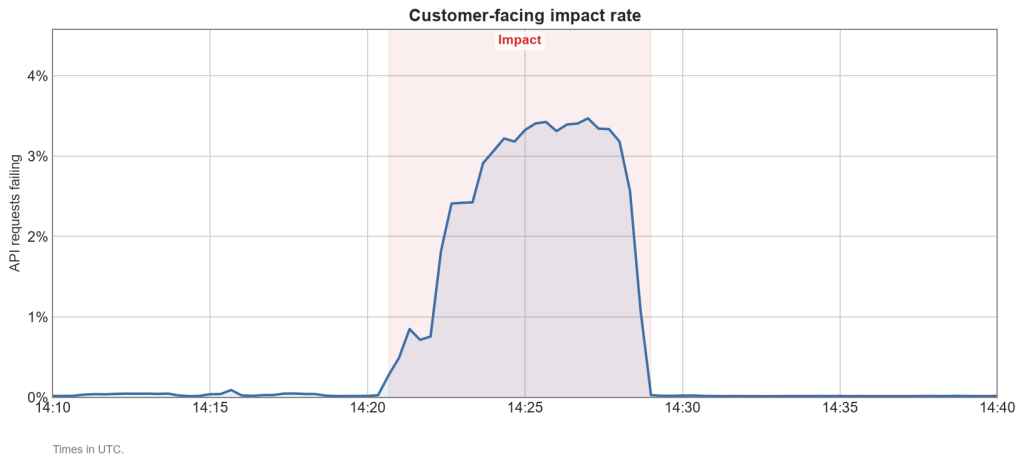
Concluding the month’s major incidents, a minor database connection pool exhaustion event occurred at 14:31 UTC, lasting just nine minutes. A confluence of high baseline connection utilization and long-running lookup queries tied up active database connections. Consequently, new requests waiting for connection allocations hit timeout thresholds, causing severe degradation for Git operations over SSH, Git LFS, and pull request merges—the latter of which saw a failure rate spike of up to 43% at its worst point.
Engineering Analysis and Future Outlook
Industry analysts reviewing GitHub’s October reliability logs note a recurring systemic pattern: while horizontal scaling and cloud migration have successfully mitigated raw capacity constraints, they have simultaneously introduced complex distributed-system failure modes. Network timeouts, cascading retry storms, and cache disconnections continue to act as multipliers for localized failures, turning minor component faults into systemic platform degradation.
In response, GitHub leadership has doubled down on operational safety hardening. The ongoing buildout of the East US 3 datacenter region has been slightly delayed by roughly one week to ensure rigorous safety validations are completed before traffic ramping begins in December. The engineering organization maintains that isolating dependencies, implementing safer database orchestration patterns, and enforcing strict circuit-breaker paradigms to prevent retry storms will remain the primary engineering focus moving forward.
As the platform scales to meet the surging demands of tens of millions of developers worldwide, GitHub’s architectural discipline—prioritizing unyielding system availability over rapid feature deployment—will face continuous testing in an increasingly complex cloud-hybrid environment.