Automating Database Migrations with AWS DevOps Agent and Model Context Protocol

Migrating a production database is a high-risk operational event that often pushes engineering teams to their limits. While AWS Database Migration Service (DMS) provides a reliable mechanism for moving data between relational engines, data warehouses, and other stores, the most critical failures rarely occur during the initial data copy. Instead, they manifest in the hours following cutover—a period defined by query performance degradation, connection pool exhaustion, and downstream service timeouts. These are not data integrity issues, but complex operational hurdles that require engineers to correlate fragmented telemetry from Amazon CloudWatch, RDS Performance Insights, and deployment logs under intense time pressure.
To address these challenges, AWS has introduced a framework for extending the AWS DevOps Agent into a specialized migration assistant. By utilizing the Model Context Protocol (MCP), organizations can now equip their autonomous agents with read-only tools and a library of codified runbooks, enabling the system to investigate, validate, and troubleshoot migrations with a level of speed and precision that significantly reduces the burden on on-call staff.
The Anatomy of Migration Failure
Modern database migrations often fail due to the "environment shift" phenomenon. An engine configuration that performed optimally on legacy hardware may trigger full table scans on a modern cloud-native database. Simultaneously, connection pools sized for traditional architectures frequently fail to handle the connection behavior of distributed services in the cloud. These problems are often invisible until the cutover event is complete and production traffic hits the new system.
Historically, the resolution process has been manual and reactive. Engineers must switch between multiple consoles, manually mapping DMS task states against application metrics. This context switching increases the Mean Time to Recovery (MTTR) significantly. The new integration with AWS DevOps Agent shifts this paradigm by providing an "always-available teammate" that understands resource relationships and correlates telemetry, code, and deployment data to pinpoint root causes autonomously.
Architectural Framework and Security
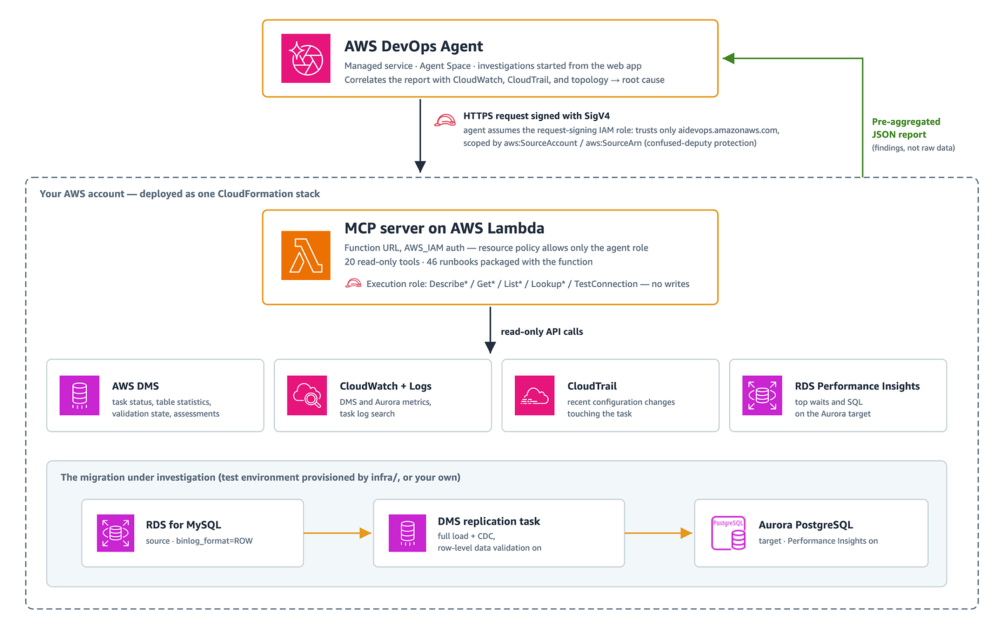
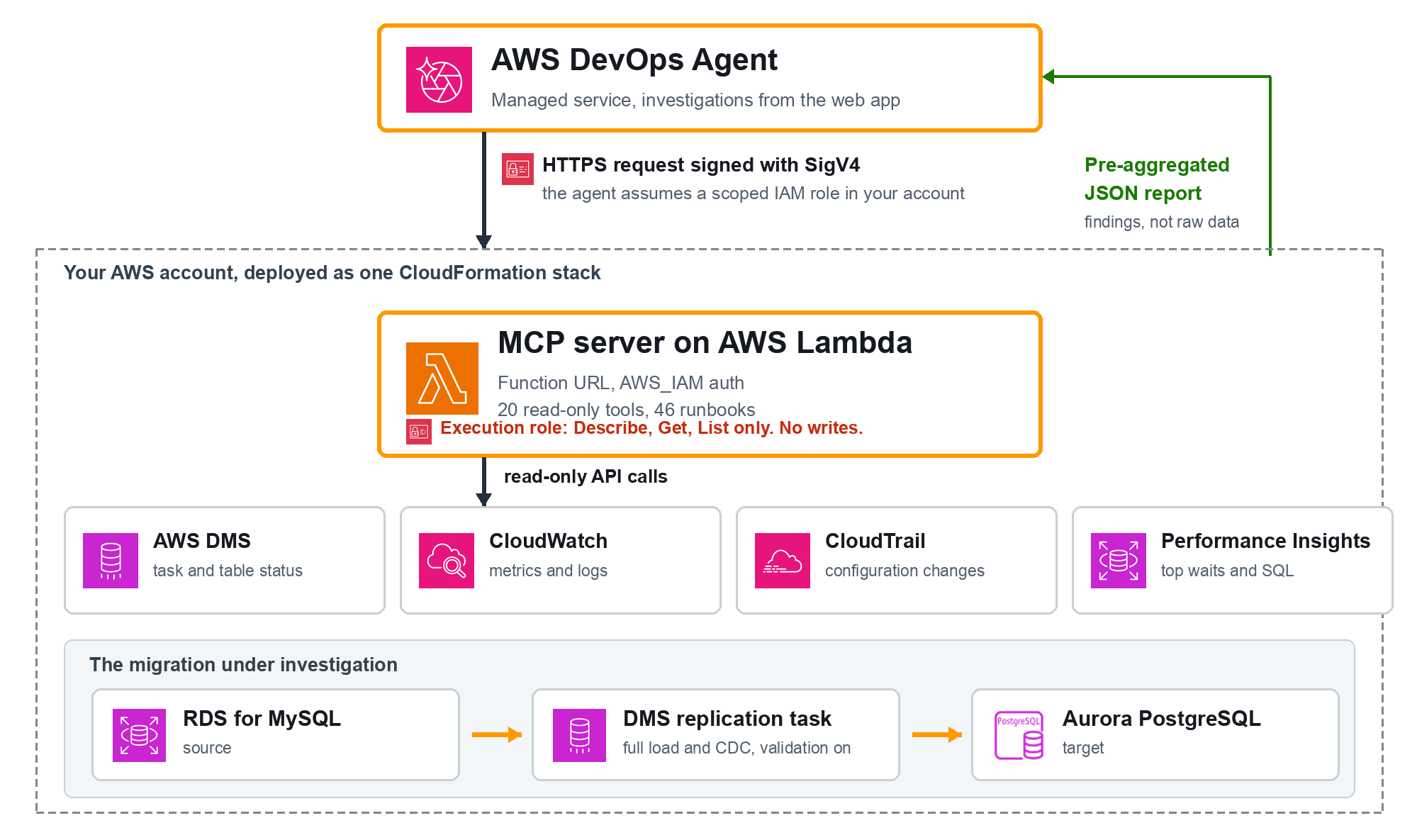
The integration relies on a robust security model that ensures operational safety. The DevOps Agent interacts with a custom MCP server deployed on AWS Lambda, communicating via HTTPS and authenticating through AWS Signature Version 4 (SigV4). By leveraging SigV4, the system eliminates the need for shared secrets or static keys, adhering to the same IAM mechanisms used by all core AWS services.
The architecture is designed to be least-privilege. The MCP server is deployed via a CloudFormation stack and serves as a read-only bridge. Because the tools provided to the agent are restricted to Describe*, Get*, List*, and Lookup* APIs, the agent can perform deep diagnostic investigations without possessing the authority to alter the state of the production infrastructure. This separation of concerns allows for the safe deployment of autonomous agents into high-stakes environments.
The Migration Lifecycle and Tooling
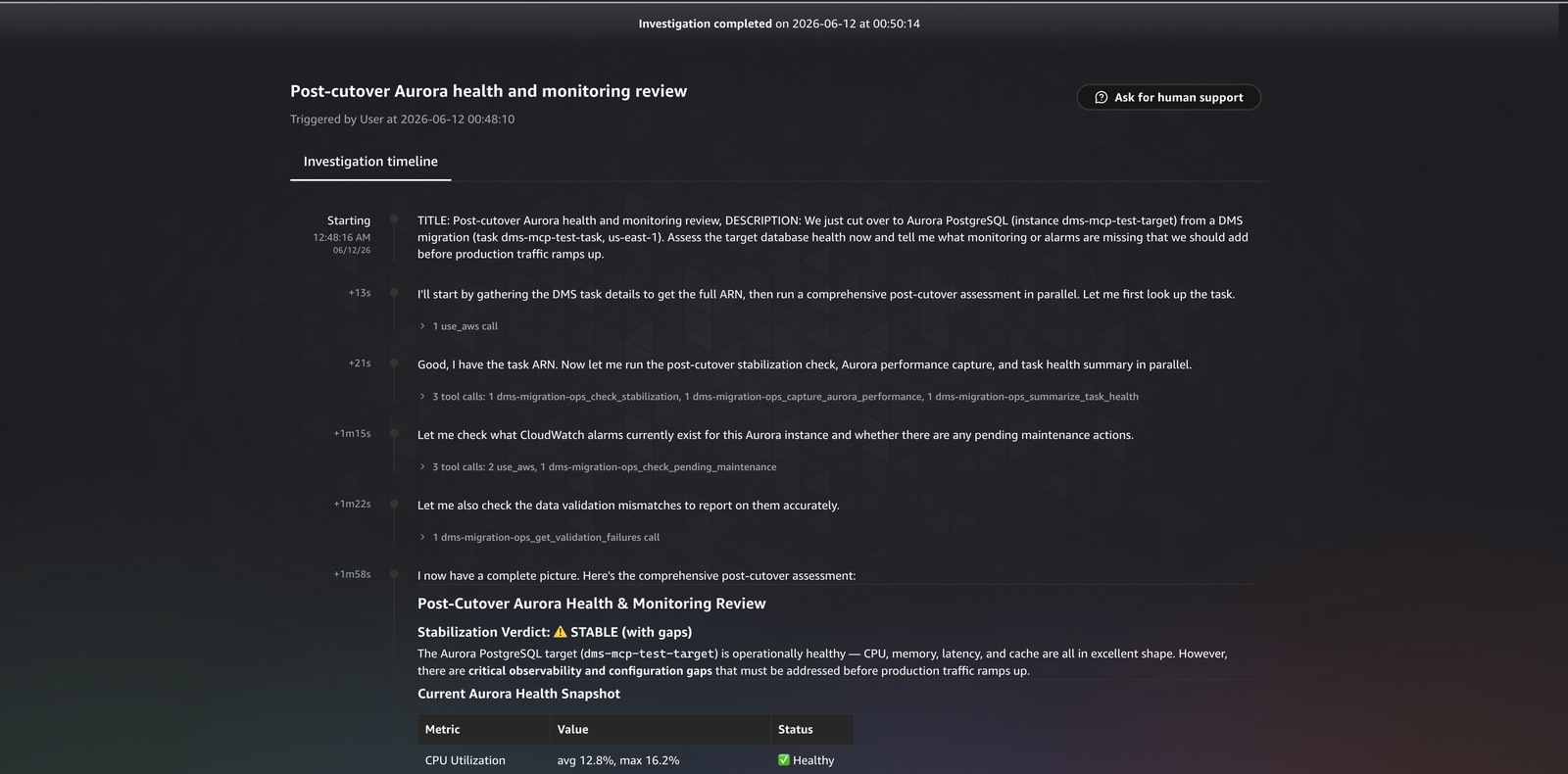
The MCP framework exposes 20 distinct tools tailored to the migration lifecycle. These tools allow the agent to perform granular checks that were previously the domain of senior database administrators. Key tools include analyze_cdc_latency, which distinguishes between source-side and target-side bottlenecks, and check_stabilization, which identifies post-cutover regressions and missing alarms.
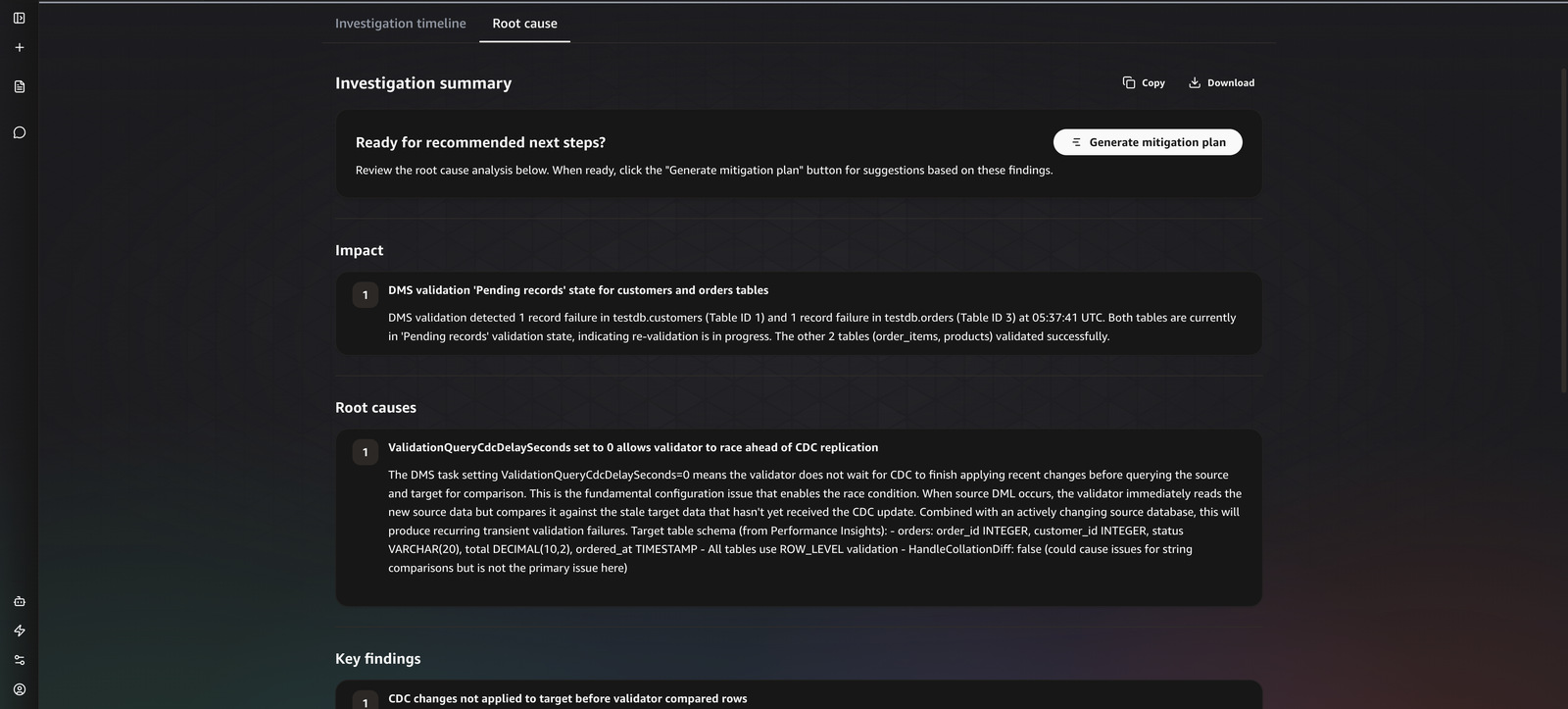
The utility of these tools is amplified by a library of 46 runbooks. These runbooks cover the spectrum of migration risks:
- Full Load and CDC: Monitoring the transition from bulk data movement to real-time replication.
- Connectivity and Health: Validating endpoint stability and replication-instance metrics (CPU, memory, swap).
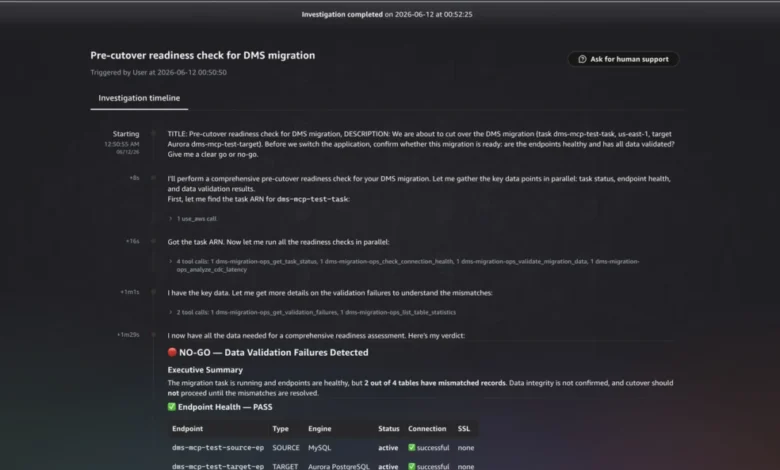
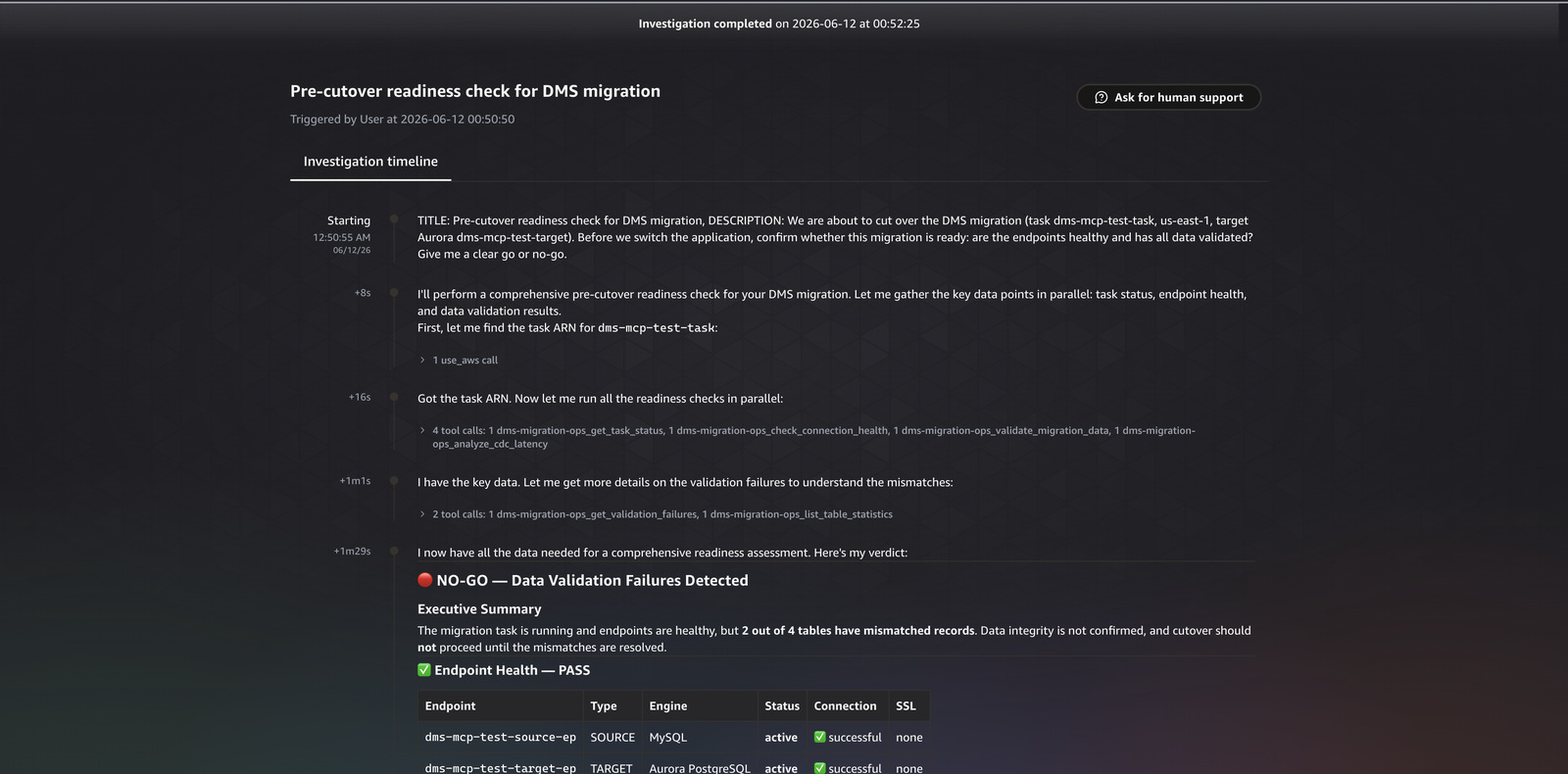
- Cutover Readiness: Performing automated "go/no-go" assessments.
- Aurora Target Health: Ensuring that the target environment is configured for production-level traffic.
Investigating Real-World Scenarios
The effectiveness of this agentic approach was validated through a series of simulated migrations involving Amazon RDS for MySQL replicating to Aurora PostgreSQL. In one scenario, researchers created a data validation failure by bypassing DMS to modify target rows directly. While a manual investigation would require cross-referencing logs across multiple services, the DevOps Agent executed 33 tool calls across 73 journal records in roughly three minutes.
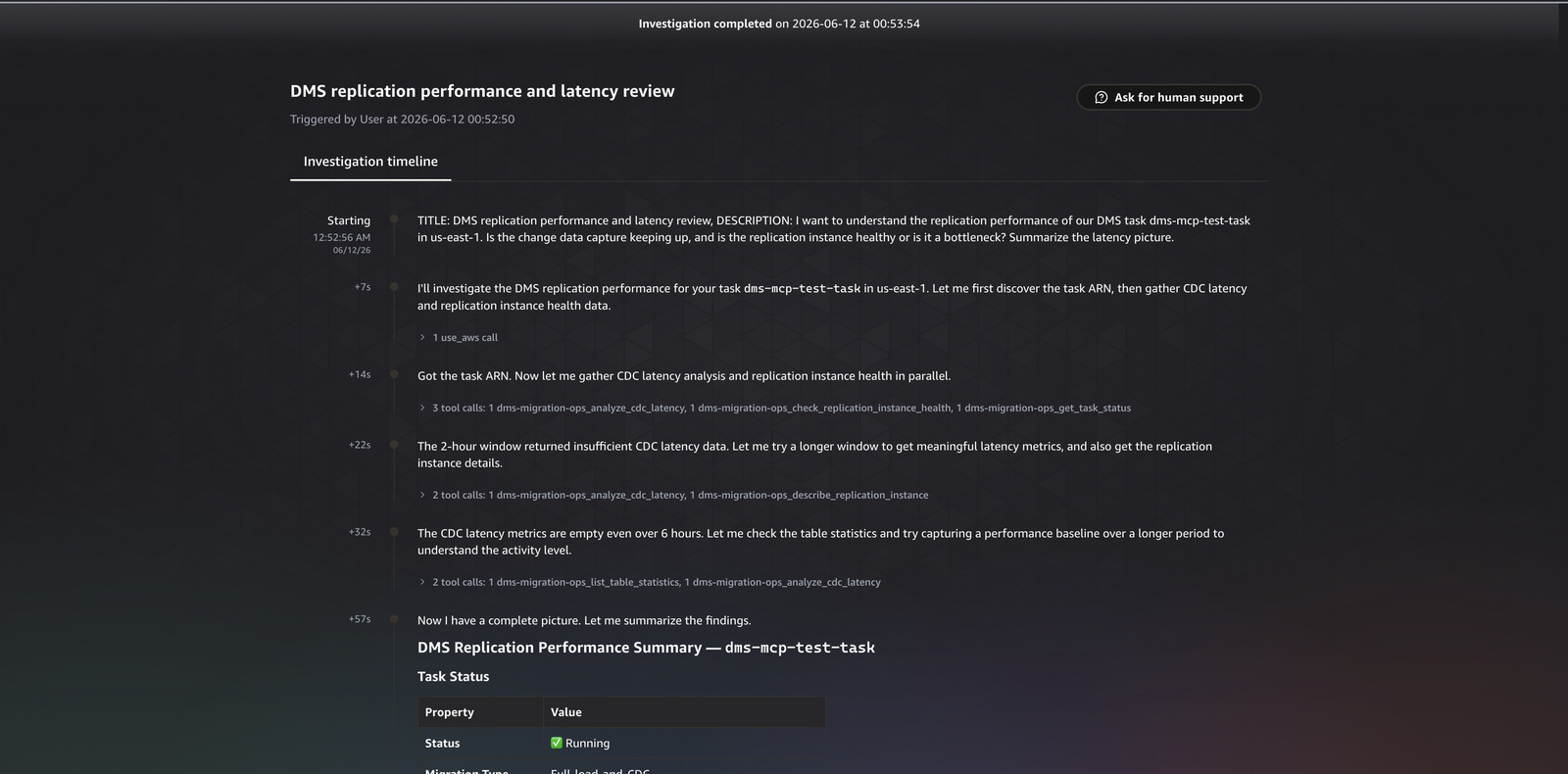
Crucially, the agent did not simply identify that the data had diverged. It identified the specific task configuration—ValidationQueryCdcDelaySeconds—that allowed the validator to race ahead of the change data capture (CDC) process. This level of root-cause analysis represents a significant advancement over standard dashboarding, as it provides actionable intelligence rather than raw data.
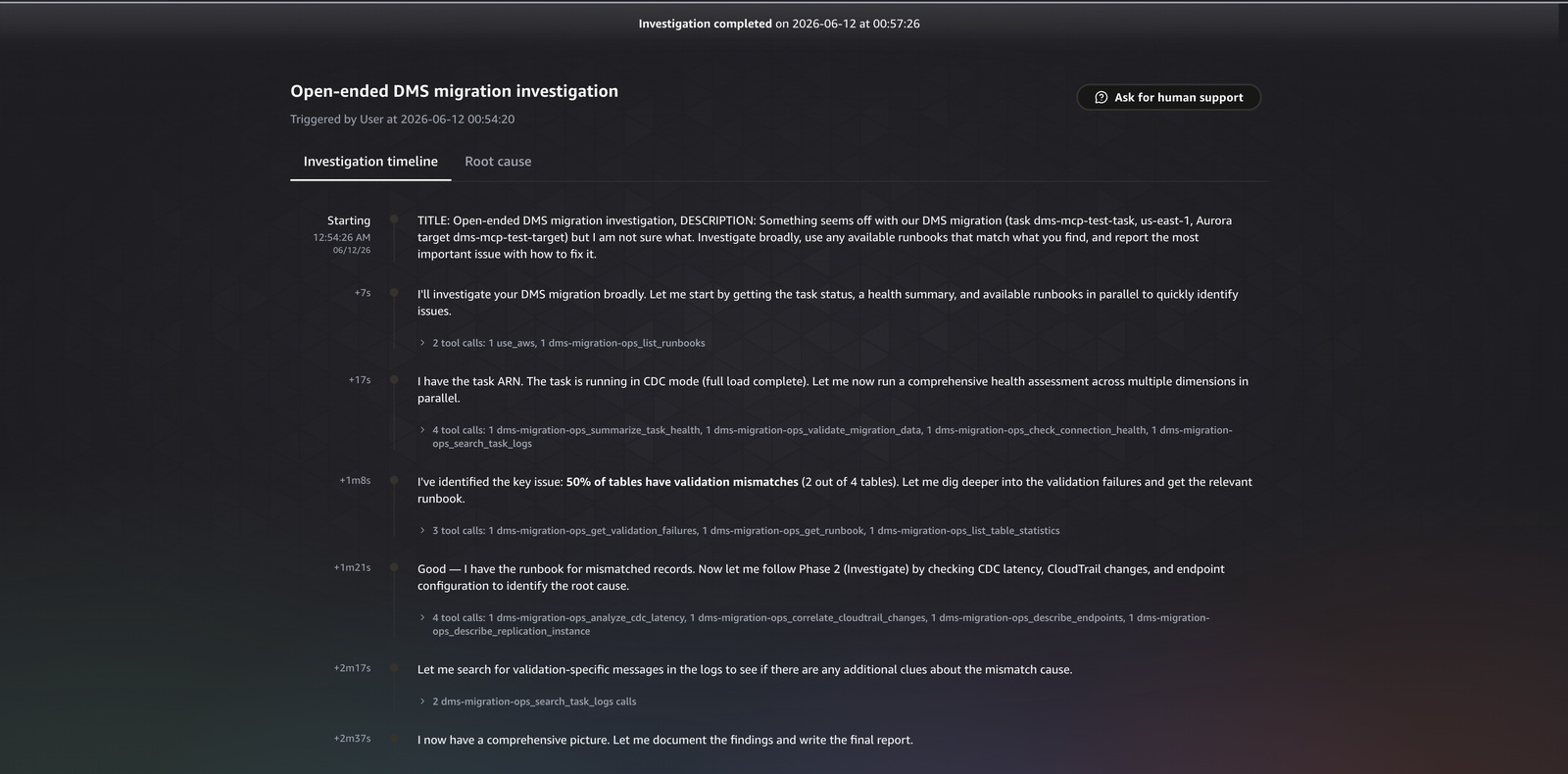
In another instance, the agent conducted an open-ended investigation into a vague performance degradation. By sweeping task status, latency metrics, and endpoint logs, the agent leveraged the list_runbooks tool to pull a relevant procedure. It subsequently identified a datatype precision mismatch that had been overlooked, demonstrating an ability to reason through complex, non-obvious issues.
Codifying Institutional Knowledge
A critical advantage of this framework is the ability to improve the migration process iteratively. When an issue is resolved, the findings can be folded back into "DevOps Agent Skills" and updated runbooks. These skills are Markdown-based instructions that govern how the agent interacts with the infrastructure.
For example, a skill set for data validation might explicitly instruct the agent to never generalize findings, to cite actual metrics from CloudWatch, and to cross-reference the DMS table-statistics API with target database logs. Because the agent continuously learns from these inputs, subsequent migrations benefit from the collective "memory" of previous incidents. This creates a flywheel effect: the first migration may reveal a race condition, but by the second migration, the agent is already programmed to recognize the symptoms on sight.
Broader Implications for Cloud Operations
The introduction of agentic tools for database migrations signals a shift in how enterprise operations are managed. By moving away from manual "dashboard-watching" and toward autonomous, evidence-based investigation, organizations can mitigate the risks associated with cloud migration.
However, industry experts note that this approach should be viewed as a complement to, not a replacement for, existing observability standards. Reliable monitoring, robust logging, and comprehensive alerting remain the foundational pillars of cloud resilience. The agent acts as an accelerator—a sophisticated "force multiplier" that enables engineers to resolve issues faster when they inevitably arise.

Operational Readiness and Deployment
For organizations planning large-scale migrations, the implementation process is streamlined through infrastructure-as-code. By deploying the MCP server via AWS CloudFormation and registering it with the Agent Space, teams can establish a secure, automated diagnostic pipeline.
The deployment involves two phases:

- Server Deployment: Provisioning the Lambda function, its URL, and the necessary IAM roles.
- Registration: Linking the server to the Agent Space and allowing the specific read-only tools required for the migration.
Once deployed, the agent provides a conversational interface where operators can input queries, review findings, and follow runbook procedures. This interface significantly flattens the learning curve for junior engineers while providing senior staff with a highly efficient tool for complex triage.
Final Assessment
The migration of production databases remains a high-pressure, high-risk activity. By extending the capabilities of the AWS DevOps Agent to include migration-specific MCP tools, AWS has provided a path to reduce the manual toil associated with these events. The ability to perform autonomous, grounded, and secure investigations into CDC latency, validation mismatches, and post-cutover stabilization represents a major step forward for database operations. As organizations continue to migrate increasingly complex workloads to the cloud, the integration of autonomous, runbook-driven diagnostic tools will likely become a standard component of the enterprise operational toolkit, ensuring that migrations are not only faster but significantly more resilient.