Building a Resilient Public Sector: Why Knowledge Layers Are the Essential Foundation for Government AI Strategy

Across the global public sector, the era of artificial intelligence experimentation has rapidly transitioned into a period of mandatory implementation. Budgets for AI initiatives have been approved by legislatures, pilot programs are populating agency portfolios, and the pressure to deploy functional systems is mounting. The expectations from taxpayers and policymakers are clear: AI must enable government organizations to do more with fewer personnel, facilitate faster decision-making in crisis scenarios, and significantly enhance operational capabilities. However, as these systems move from controlled environments to high-consequence sectors—including emergency response, national defense, healthcare, and critical infrastructure—a fundamental flaw in data architecture is beginning to emerge.
When AI models are applied directly to fragmented, siloed workforce data, they often produce outputs that are linguistically sophisticated but operationally incomplete. In high-stakes environments, a "well-written" answer that misses a critical variable can lead to catastrophic failure. The limitation is not necessarily found within the Large Language Models (LLMs) themselves, but rather in the architecture beneath the model. To bridge this gap, public sector leaders are increasingly looking toward the "knowledge layer"—a structured foundation that prioritizes the relationships between data points as much as the data itself.
The Strategic Shift Toward Quality and Connectivity
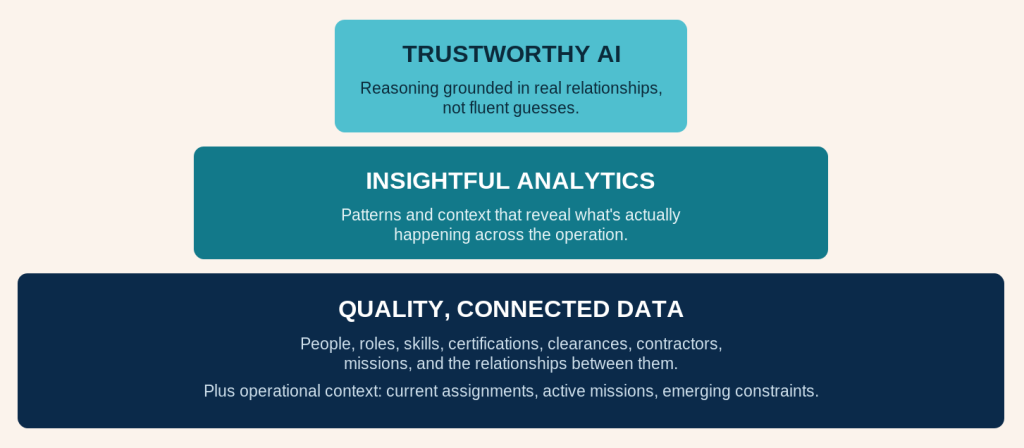
The current movement toward sophisticated AI architecture is best exemplified by the United States Department of Defense’s (DoD) Data, Analytics, and AI Adoption Strategy. This document serves as a blueprint for modernizing the world’s most complex workforce and provides an explicit hierarchy for success. At the base of this hierarchy sits quality data; building upon that foundation are insightful analytics, and at the pinnacle sits responsible AI. The strategy is uncompromising in its assertion that all analytic and AI capabilities require trusted, high-quality data.
A defining characteristic of this "trusted" data is that it must be linked. The DoD strategy emphasizes the need for data that allows users to exploit complementary data elements through innate relationships. This is a fundamental architectural requirement. In traditional government IT systems, data is often stored in isolated rows and columns, making it difficult to see how a change in one department impacts another. By treating relationships as first-class data assets—storing, governing, and querying them with the same rigor as the data itself—organizations can move beyond simple record-keeping into the realm of operational intelligence.
The Architecture of the Knowledge Layer
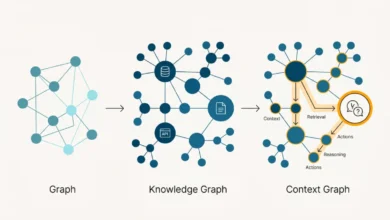
The "knowledge layer" acts as the connective tissue for an organization’s digital nervous system. While traditional databases are excellent at storing persistent facts, they struggle with the "compound questions" that define modern governance. A knowledge layer connects disparate facts about the workforce into a continuously maintained knowledge graph. This graph includes people, roles, skills, certifications, security clearances, contractors, suppliers, and missions, as well as the dynamic relationships between them.
Unlike a static report exported from a human resources system, a knowledge graph reflects operational reality in real-time. As personnel transition into new roles, as professional certifications expire, or as contractors enter and leave specific programs, the graph updates the network of dependencies. This prevents the "logic drift" that occurs when every individual AI application attempts to build its own understanding of the workforce from fragmented systems. Without a shared representation of reality, AI reasoning becomes inconsistent, logic is duplicated across departments, and decisions are ultimately based on where data happens to reside rather than the actual state of the mission.
Chronology of Public Sector AI Integration
The path to the current AI-centric landscape has been marked by several key phases over the last decade:
- The Legacy Era (Pre-2015): Data was largely siloed within specific agencies. Digital transformation focused on moving from paper to digital records, but interoperability remained a secondary concern.
- The Cloud Transition (2015–2020): Agencies began migrating to cloud environments. While this improved accessibility, it often resulted in "data lakes" that were difficult to navigate and lacked relational context.
- The Analytic Push (2020–2023): The COVID-19 pandemic accelerated the need for real-time data. Governments realized that having data was not enough; they needed the ability to query across departments to manage logistics and public health.
- The Generative AI Explosion (2023–Present): The rise of LLMs created an urgent demand for AI-ready data. Organizations are now realizing that for AI to be effective, it requires a "knowledge layer" to ground its reasoning in factual, relational truth.
Operational Scenarios: The Impact of Connected Intelligence
The necessity of a relational architecture is most visible when addressing compound questions. These are queries where the answer requires following a chain of relationships across entities that are not directly connected in a traditional database. Three common public sector scenarios illustrate the stakes involved.
Surge Decisions and Emergency Response
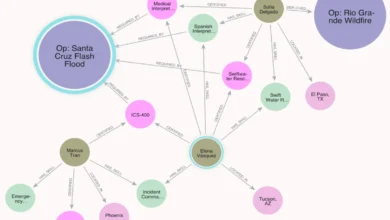
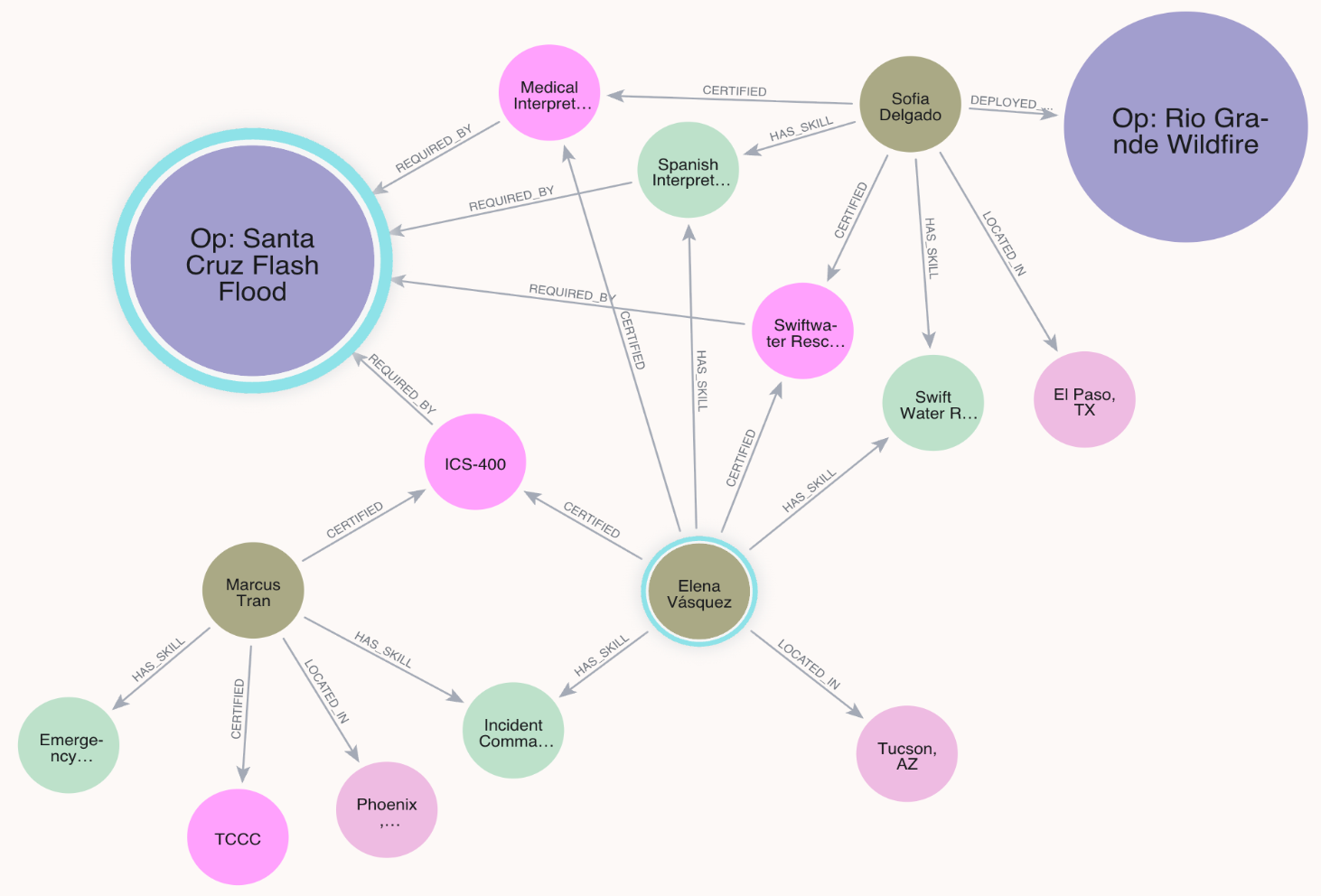
In a crisis, such as a natural disaster, the primary question for leaders is: "Who can deploy to this mission without creating a capability gap elsewhere?" Consider a hypothetical flash flood in a specific region requiring a specialized team within 24 hours. The requirements are narrow: personnel must have specific rescue certifications (such as ICS-400), medical interpreter credentials, and fluency in a specific language.
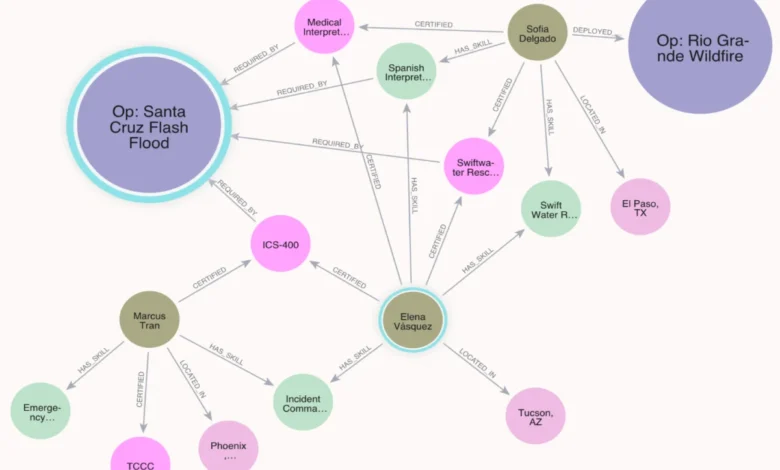
In a siloed system, an AI might identify two qualified candidates, Elena and Sofia. However, only a knowledge layer reveals that Sofia is currently the sole medical interpreter attached to an active wildfire response in a neighboring county. Redeploying her would leave the wildfire mission with a critical, unfillable gap. Elena, conversely, works in a department with redundant coverage. Only by mapping the relationships between personnel, active missions, and departmental capabilities can an AI provide a recommendation that ensures overall organizational stability.
Managing Contractor Dependency and Supply Chain Risk
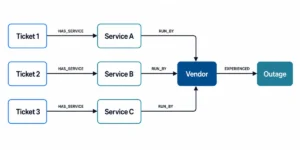
Governments increasingly rely on external contractors for critical functions. A central concern for risk management is understanding the operational impact if a specific contractor or supplier were to exit the market or be compromised. A knowledge layer allows for a multi-hop traversal of data: mapping which programs the contractor supports, which internal roles depend on their output, and what downstream missions become exposed.
This analysis extends beyond the immediate contract. It can trace ownership chains—identifying parent companies and subcontractors—to uncover financial, geopolitical, or regulatory risks. In an era of heightened global tension, understanding these deep-seated dependencies is a matter of national security.
Security, Access, and the Insider Threat
Ensuring that a person’s security clearance, training, and privileged access remain aligned with their current operational responsibilities is a constant challenge. Traditional clearance databases are often disconnected from daily operational systems. A knowledge layer connects formal records with the operational network, revealing how many cross-agency relationships an individual maintains and which systems they can reach.
The 2025 Insider Risk Report by Cybersecurity Insiders, which surveyed 635 security leaders, found that 93% of respondents consider insider threats to be as hard or harder to detect than external cyberattacks. The difficulty lies in the fact that the signals are relational—they involve who someone is talking to and what missions they are influencing. By grounding security decisions in explicit relationships, leaders can audit the reasoning path, seeing exactly what evidence was considered before granting or revoking access.
Analysis of Implications: Automation vs. Intelligence
The push for AI in the public sector is often framed as a quest for more automation. However, the true force multiplier is not automation, but connected intelligence. Automation speeds up existing processes, but if those processes are based on flawed or fragmented data, automation simply accelerates the rate of error.
The fiscal implications are also significant. Public sector organizations that attempt to apply AI directly to fragmented systems often find themselves needing to "re-platform" or clean their data mid-project, leading to massive cost overruns. Building the knowledge layer first ensures that AI has a trustworthy foundation from day one. This is particularly crucial as governments face structural challenges such as aging populations, diminishing specialist pipelines, and increasing reliance on complex contractor ecosystems.
Furthermore, the requirement for auditability in public sector AI governance cannot be overstated. Unlike private corporations, government agencies must be able to explain the "why" behind a decision, especially when that decision affects public safety or civil liberties. A graph-based knowledge layer provides a transparent, traversable trail of logic that traditional "black box" AI models cannot offer on their own.
Conclusion: The Choice Between Connected or Exposed
As AI budgets move from planning to execution, public sector leaders face a pivotal choice: build the knowledge layer before deploying AI, or attempt to retroactively fix the architecture later. The organizations that derive the most value from AI will not necessarily be those with access to the largest compute clusters or the most expensive models. Instead, they will be the ones with the strongest knowledge foundations.
By utilizing platforms like Neo4j’s Graph Intelligence, agencies can turn fragmented workforce records into a coherent operational intelligence model. This architecture allows AI to augment human judgment rather than merely replacing it, helping leaders answer the complex, compound questions that define modern governance. In an increasingly volatile world, the difference between a "connected" organization and an "exposed" one often comes down to how well they understand the relationships within their own data. Connected organizations identify critical dependencies and risks before a crisis occurs; exposed organizations only discover them once it is too late.
Related posts: