Innovation in Autonomous Productivity: Neo4j and Devnovate Host HackwithBay 3.0 at AWS Builder Loft San Francisco

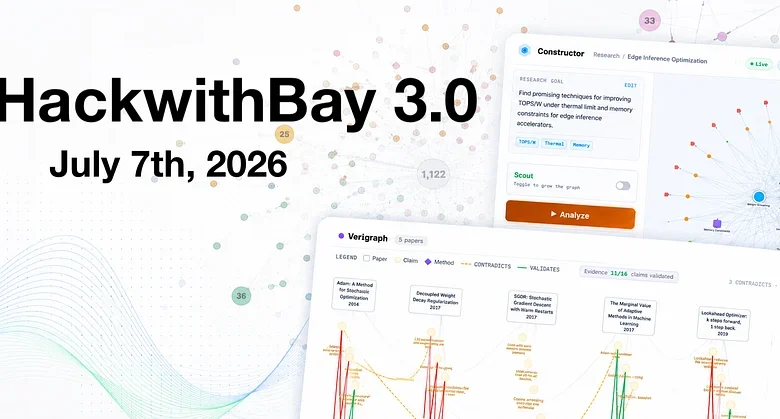
On July 7, 2026, the AWS Builder Loft on Market Street in San Francisco became the epicenter of rapid-cycle artificial intelligence development as roughly 200 developers gathered for HackwithBay 3.0. Organized by Devnovate, the event challenged participants to build functional, high-impact solutions within a strict five-hour window. The central theme, “Thoughtful Agents for Productivity,” signaled a shift in the industry from simple conversational chatbots toward autonomous agents capable of reasoning, verifying data, and executing complex workflows.
The hackathon was supported by a robust partner ecosystem, including Neo4j, RocketRide, Butterbase, Daytona, Nebius, and Opsera. Unlike traditional hackathons where tool selection is entirely open-ended, HackwithBay 3.0 required the integration of a graph database into every project. This requirement highlighted the growing consensus in the AI community that Large Language Models (LLMs) require structured, queryable "sources of truth" to function reliably in professional environments. By the end of the day, approximately 50 submissions were evaluated, showcasing the versatility of graph-based architectures in scientific research, hardware engineering, and social networking.
The Evolution of the HackwithBay Series
HackwithBay 3.0 represents a significant milestone in the evolution of Bay Area developer gatherings. While previous iterations focused on general generative AI and Retrieval-Augmented Generation (RAG), the 3.0 version prioritized the "agentic" turn in software development. By mid-2026, the novelty of simple text generation has been replaced by a demand for "thoughtful agents"—systems that do not merely predict the next token but can interact with sandboxed environments, perform multi-step reasoning, and maintain long-term memory via graph structures.
The choice of the AWS Builder Loft provided a high-density environment equipped with the cloud infrastructure necessary for scaling these agentic workflows. The event’s structure—less than five hours of active build time—was designed to test the maturity of modern development stacks. Participants were tasked with proving that advanced AI integration no longer requires months of "glue code" but can be orchestrated in a single afternoon using managed services and specialized APIs.
VeriGraph: Bridging the Gap Between Research and Results
Securing first place was VeriGraph, a project developed by the team of Ali Amjad, Siddharth Reddy, Dileep Kumar Sharma, and Sanmukh Sain Karri. VeriGraph addresses a systemic issue in the scientific community: the reproducibility crisis. While millions of research papers are published annually, verifying their claims often requires manual coding and environment setup, a process that is both time-consuming and prone to error.
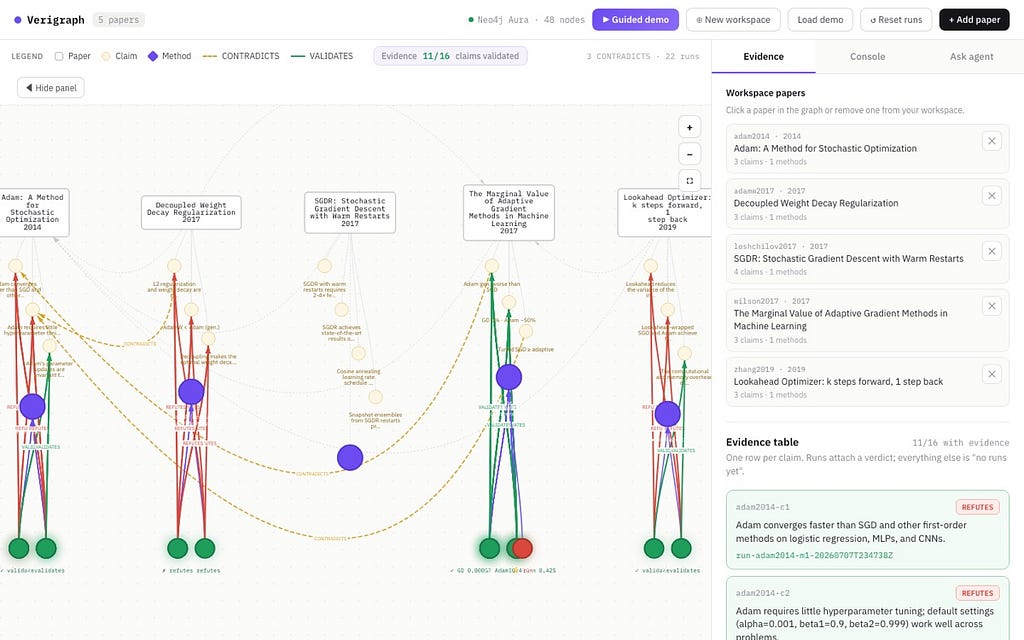
VeriGraph functions as an "executable evidence" engine. A user provides an arXiv link, and the agent extracts the paper’s primary claims and methodologies into a Neo4j knowledge graph. The system then identifies potential contradictions between different papers, visualized as amber-colored "CONTRADICTS" edges within the graph.
The most innovative feature of VeriGraph is its "Run" capability. Using a Daytona sandbox—an isolated environment for executing code—the agent writes the experiment code described in the paper, executes it, and measures the results. These outcomes are then written back into the Neo4j graph as "VALIDATES" (green) or "REFUTES" (red) relationships. During the live demo, the team reproduced a 2017 study by Wilson et al., which argued that the Adam optimizer could generalize worse than plain gradient descent. The VeriGraph agent successfully ran the test case, found a 43% error rate for Adam compared to 0% for gradient descent, and updated the evidence graph accordingly.
The technical sophistication of VeriGraph lies in its use of the graph as a constraint. The agent reads from the graph using natural-language-to-Cypher queries but is restricted from writing to it directly. Instead, deterministic Python scripts handle the data entry, ensuring that the agent cannot "hallucinate" a verdict that the empirical data does not support.
Constructor: Accelerating Semiconductor Innovation
The second-place prize was awarded to Constructor, built by Ramis Hasanli, Sid, Rohan Chavan, and Logan Rud. This project focused on the highly specialized field of semiconductor research, where engineers must evaluate various edge-AI accelerator techniques, such as quantization and weight streaming, under strict thermal and memory constraints.
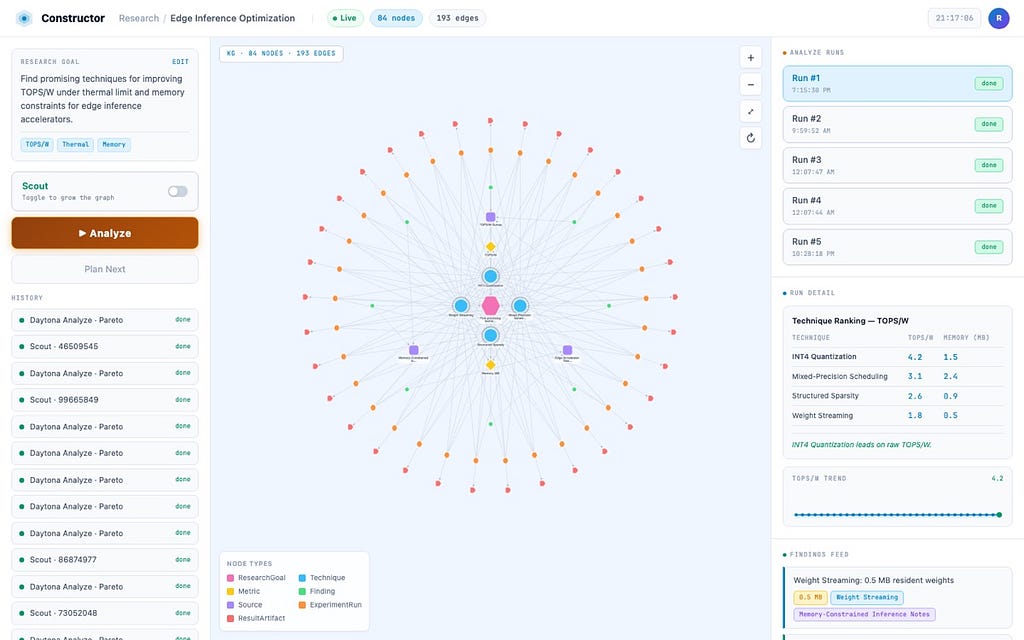
Constructor acts as an autonomous research assistant that continuously "scouts" for new sources and "analyzes" their findings. The system treats the Neo4j graph as an append-only ledger. When the agent identifies a new technique, it performs a Monte-Carlo simulation within a Daytona sandbox to determine the technique’s trade-offs. These results are then mapped onto a Pareto frontier, allowing researchers to see which methods offer the best balance of performance and power consumption.
The team utilized Butterbase’s serverless functions and the Model Context Protocol (MCP) to ensure that the frontend remained decoupled from the database. By using Neo4j’s HTTP Query API v2, the agents could write fresh "ExperimentRun" nodes without mutating previous data, effectively creating a chronological history of evidence. This allows users to watch the "Pareto frontier" shift in real-time as the agent ingests more data, transforming a static database into a dynamic timeline of scientific discovery.
The Ultra Super Social Passport: Human-Centric Graph Logic
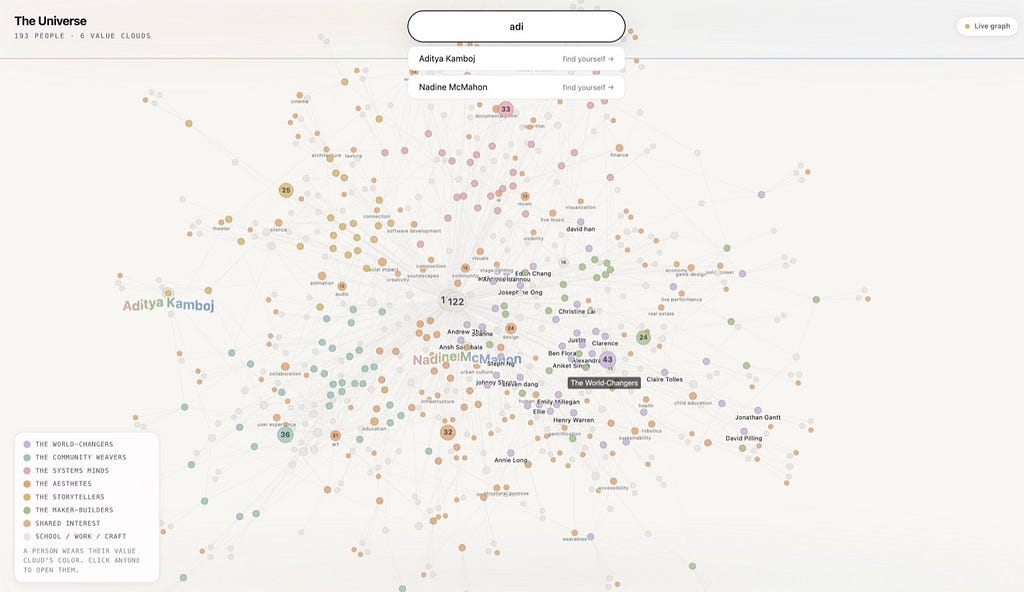
Third place went to The Ultra Super Social Passport, a project by Johnny Sheng and Teri Shim. While the first two winners focused on hard sciences, this project demonstrated the power of graph databases in social dynamics. Designed for a real-world event involving 193 creative professionals in Los Angeles, the app replaced traditional networking tags with a "social passport."
The system utilized community detection algorithms to group guests into six "value clouds" based on their beliefs and creative philosophies. When a guest registered, the agent performed a live graph traversal—using variable-length Cypher paths—to identify two specific people they should meet. The logic was specifically tuned to find one person who shared the user’s professional background and another who shared their core values.
The AI in this application remained largely invisible to the end user. Rather than interacting with a chatbot, users received a personalized digital gift: a passport containing "magic inferences" about their personality and receipted reasons for their suggested connections. This project highlighted the "human" side of graph technology, showing that complex data structures can be used to facilitate genuine interpersonal relationships.
Technical Analysis: The Integration of the 2026 Tech Stack
A recurring theme among the winning teams was the efficiency of their integration strategies. The five-hour build time necessitated a move away from traditional infrastructure management. The hackathon showcased three distinct ways to interact with Neo4j Aura, the managed cloud version of the graph database:
- Direct Driver Interaction: Used by teams requiring high-performance, low-latency connections for complex data modeling.
- HTTP Query API v2: Utilized by teams building serverless architectures, allowing agents to interact with the database via standard REST-style calls without the overhead of maintaining persistent connections.
- Portable Pipelines (.pipe): Leveraged through RocketRide, this allowed coding agents to treat the database as a modular component within a larger multi-step pipeline.
The use of the Model Context Protocol (MCP) was also pivotal. MCP-native functions allowed the agents to "understand" the backend capabilities of the stack intuitively, reducing the amount of manual prompt engineering required to get the agents to perform specific tasks like sandboxed code execution or graph updates.
Industry Implications and Future Outlook
The success of HackwithBay 3.0 offers a glimpse into the future of enterprise productivity. The shift from "chat" to "agents" suggests that the next generation of software will be defined by its ability to perform autonomous work in verified environments.
The hackathon proved that graph databases are no longer a niche tool for data scientists but a foundational element of the AI agent stack. By providing a structured schema that agents can reason over, Neo4j and similar technologies act as a "truth layer" that mitigates the risks of LLM hallucinations. Furthermore, the speed at which these 50 teams were able to ship functional products indicates that the "plumbing" of AI—integrating databases, sandboxes, and execution pipelines—is becoming increasingly standardized.
As organizations look to deploy AI agents in high-stakes environments like scientific research or hardware design, the methodologies showcased at the AWS Builder Loft will likely become the blueprint. The emphasis on "thoughtful agents" ensures that productivity gains are not just about speed, but about the accuracy and verifiability of the work being performed.
The event concluded with a call to action for the developer community to continue pushing the boundaries of what autonomous agents can achieve. With the support of platforms like Neo4j Aura and orchestration layers like RocketRide, the barrier to entry for building complex, graph-backed AI systems has never been lower. Devnovate and its partners have signaled that the next era of development will be defined by agents that are as reliable as they are autonomous.
Related posts: