AWS CloudFormation Automates Pre-Deployment Validation Across All Stack Operations, Boosting Development Velocity and Reliability


Amazon Web Services (AWS) has significantly enhanced its CloudFormation service by implementing automatic pre-deployment validation for all CreateStack and UpdateStack operations. This critical update extends the existing validation capabilities, previously confined primarily to change set creation, to every deployment path, ensuring faster feedback on template errors and dramatically accelerating infrastructure development workflows. The announcement also introduces three new validation checks, a DisableValidation parameter for granular control, and a seamless integration with the AWS Cloud Development Kit (CDK) via the cdk validate command, which now leverages CloudFormation’s server-side pre-deployment validation.
A Foundational Shift in Infrastructure as Code Reliability
AWS CloudFormation stands as a cornerstone for Infrastructure as Code (IaC) on the AWS platform, empowering developers and operations teams to model, provision, and manage cloud resources using declarative templates written in JSON or YAML, or through programmatic constructs with the AWS CDK. The ability to treat infrastructure like application code, complete with version control, testing, and automated deployment, has revolutionized cloud management. However, even with IaC, the deployment process has traditionally faced a significant challenge: detecting template errors only after provisioning attempts have begun. This often leads to time-consuming rollback cycles, delaying development and increasing operational overhead.
The concept of "shift-left validation" aims to address this by moving error detection as early as possible in the development lifecycle. CloudFormation had previously introduced pre-deployment validation during change set creation, a mechanism that allowed users to preview changes and catch certain errors, such as property syntax issues, resource name conflicts, and S3 bucket emptiness constraints, before actual resource execution. While beneficial, this still left direct CreateStack and UpdateStack operations susceptible to errors that would only surface during the resource provisioning phase, often resulting in failed deployments and subsequent rollbacks.
The Latest Enhancements: A Comprehensive Overview
Today’s announcement marks a pivotal evolution in CloudFormation’s validation strategy. By automating pre-deployment validation on every CreateStack and UpdateStack operation, AWS ensures that every deployment path—whether initiated manually, through CI/CD pipelines, or even by emerging AI agents—now benefits from these crucial checks without requiring any explicit configuration. This "always-on" validation significantly reduces the likelihood of failed deployments caused by common template misconfigurations.
Beyond the expanded scope, AWS has rolled out several new, intelligent validation checks designed to proactively identify potential issues:
- Service Quotas Limit Exceeded: This new check warns users if a proposed resource creation or update would exceed the default or requested service quotas for a particular AWS service. This is vital for capacity planning and preventing operational disruptions that can arise from hitting hard limits.
- AWS Config Recorder Conflicts: This validation identifies potential conflicts with existing AWS Config Recorders, which are essential for monitoring and assessing compliance of AWS resources. Preventing such conflicts ensures continuous governance and auditing capabilities.
- ECR Repository Delete Readiness: This check specifically validates whether an Amazon Elastic Container Registry (ECR) repository is ready for deletion, helping prevent accidental data loss or issues with dependent resources.
To provide users with flexibility, a new DisableValidation parameter has been introduced. This allows for operation-level control, enabling users to bypass pre-deployment validation for specific scenarios where it might be deemed unnecessary or counterproductive, though its use is recommended with caution due to the trade-off with early error detection.
Furthermore, the AWS CDK ecosystem receives a significant boost with the enhanced cdk validate command. This command now leverages CloudFormation’s server-side pre-deployment validation, offering a unified validation experience that combines multiple validation sources into a single, comprehensive report. Crucially, cdk validate provides construct-level source tracing, mapping errors directly back to the specific line of CDK code, a feature that dramatically streamlines debugging for CDK developers.
How Pre-Deployment Validation Operates
CloudFormation’s pre-deployment validation functions in two distinct modes, dictating how validation failures are handled:
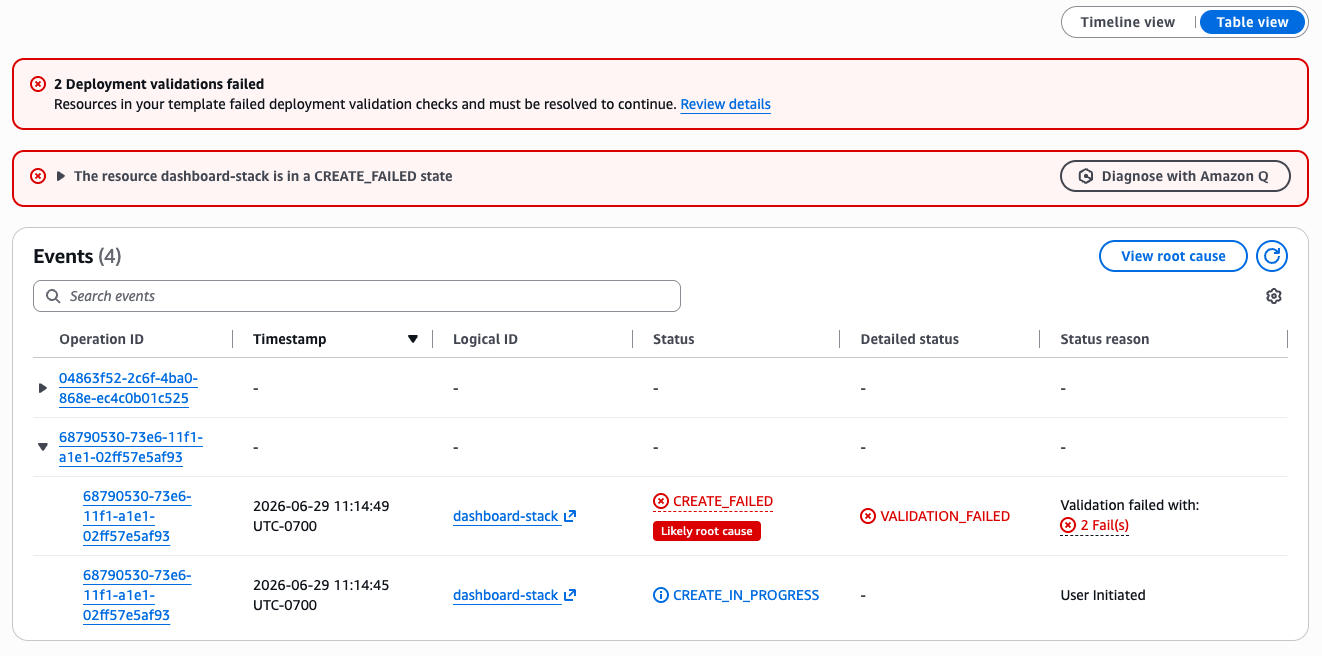
- FAIL Mode: When validation checks operating in FAIL mode detect an error, the stack operation (CreateStack, UpdateStack, or CreateChangeSet) is immediately halted. No resources are provisioned or modified, and the operation terminates with a failure status. This mode is typically used for critical errors that would inevitably lead to a failed deployment or an undesirable state.
- WARN Mode: For less critical issues, validation checks can operate in WARN mode. In this scenario, the validation results in a warning, but the stack operation is permitted to proceed. This allows users to review the warning, decide on a course of action (e.g., request a service quota increase), and then continue with the deployment if they deem it appropriate.
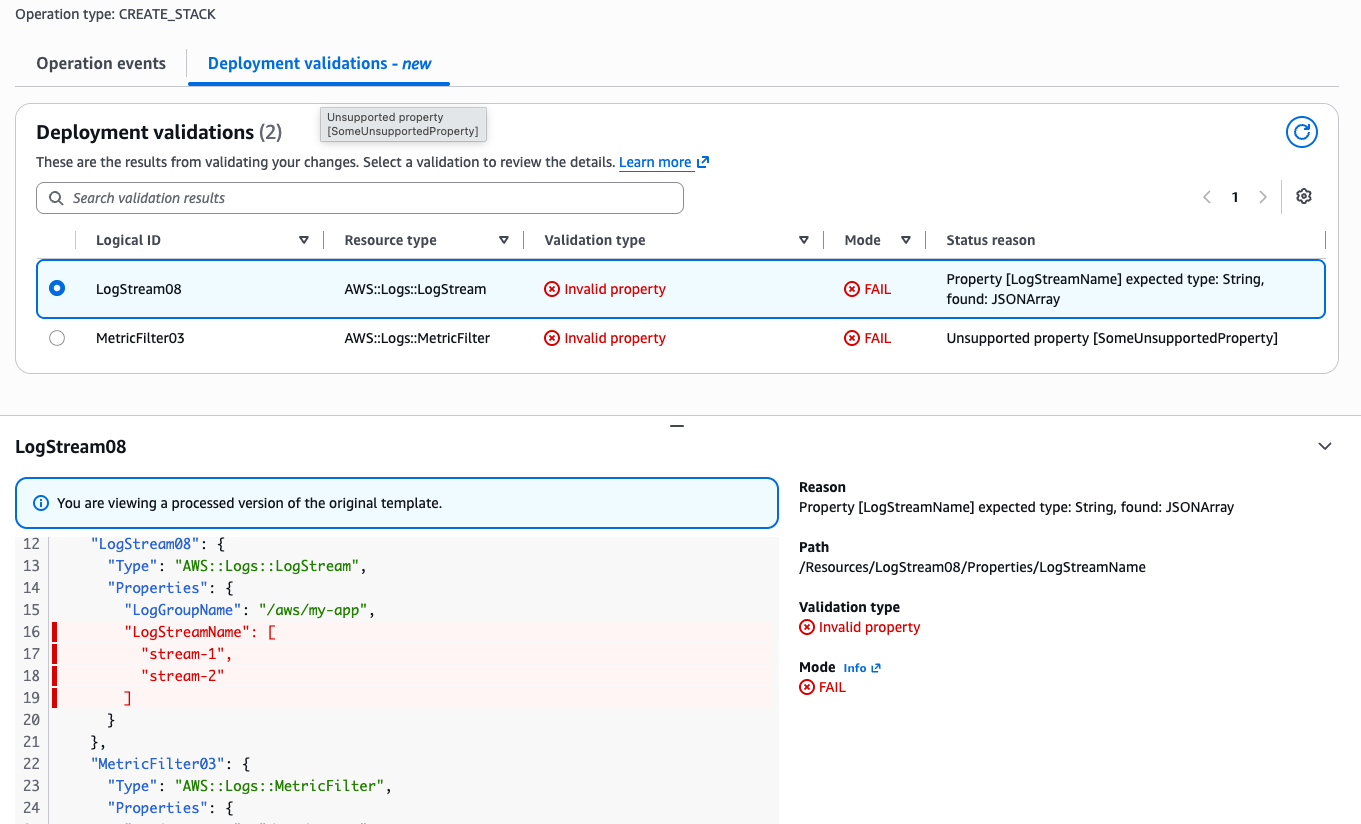
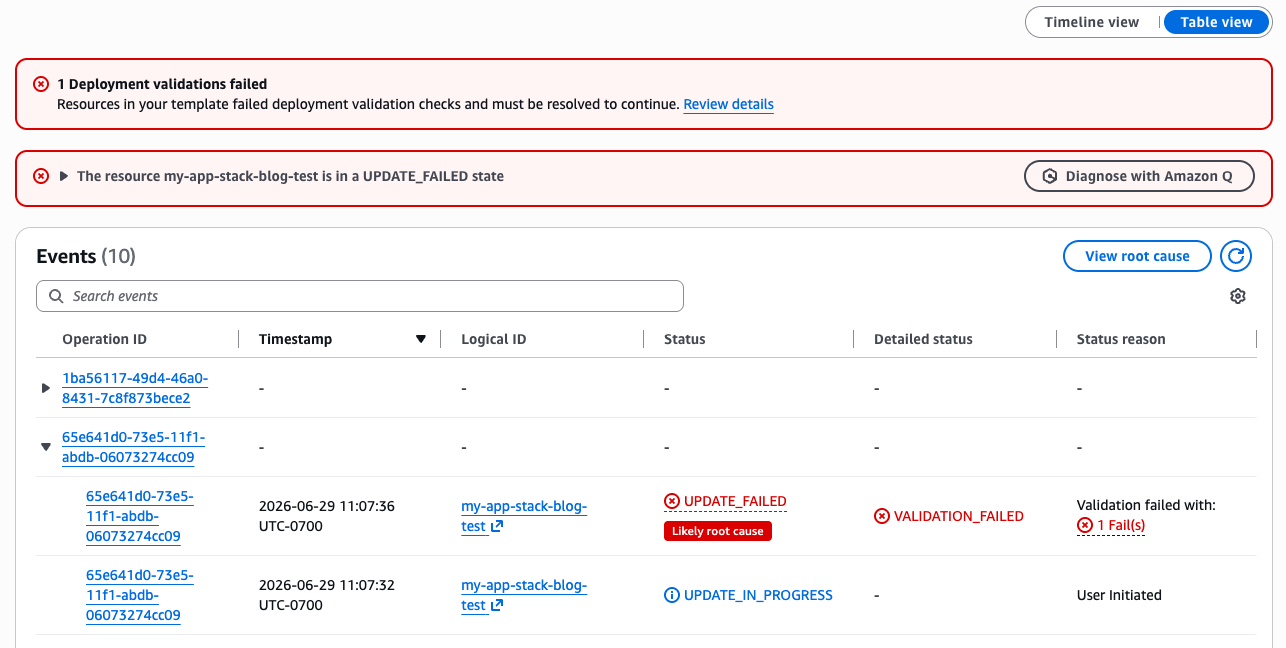
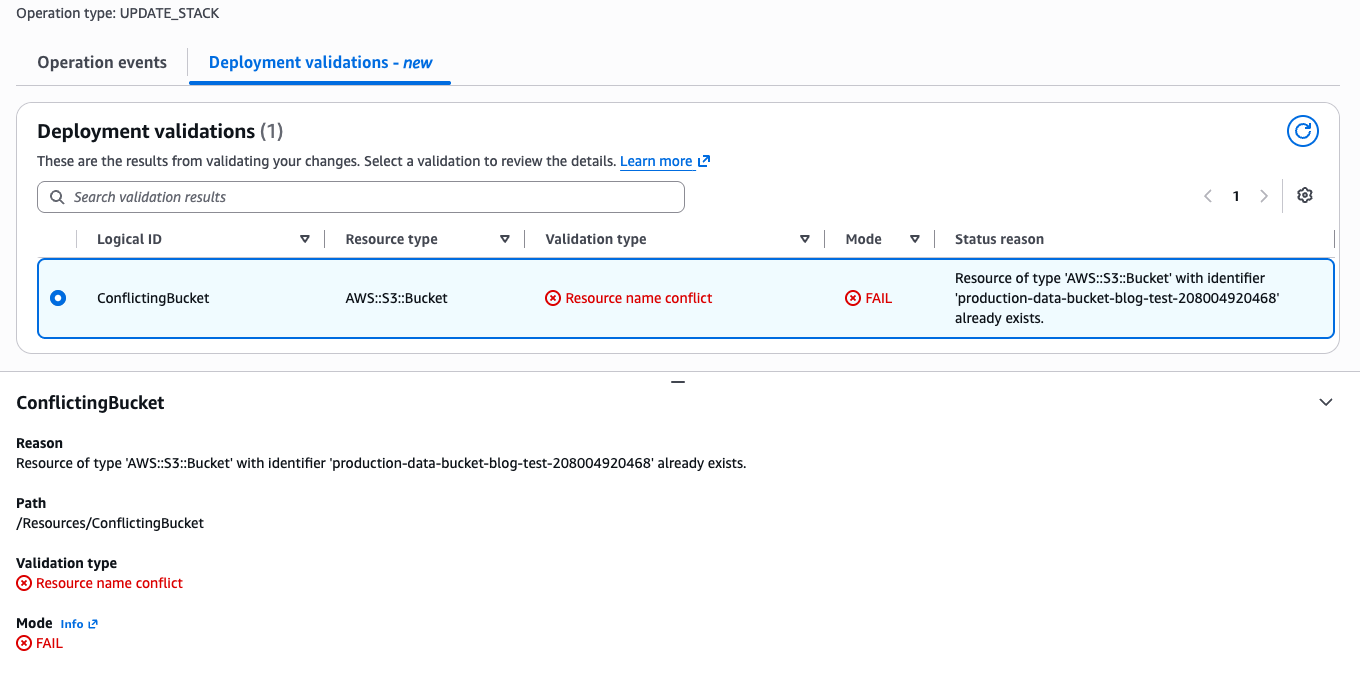
When a validation fails, whether in FAIL or WARN mode, CloudFormation provides detailed feedback. For operations that halt, the stack creation or update stops before any resources are provisioned. The system records specific events, including the logical resource ID, resource type, a precise status reason describing the property issue, and the validation path, which points to the exact location of the error within the template. This structured feedback is accessible via the describe-events API or through the CloudFormation console’s "Events" tab and dedicated "Deployment validations" view, which offers a clear, tabular summary of all validation results.
Practical Scenarios Demonstrating the Impact
Let’s explore how these capabilities translate into practical benefits for developers:
Scenario 1: Property Validation on CreateStack
Consider a template with common resource property errors, such as an unsupported property or an incorrect data type (e.g., expecting a string but receiving a JSON array). Previously, a CreateStack operation with such errors would initiate resource provisioning, only to fail minutes later when CloudFormation attempted to create the misconfigured resources. Now, upon executing aws cloudformation create-stack, pre-deployment validation runs automatically. Within seconds, the operation is halted, and the describe-events API or the CloudFormation console immediately reveals specific errors like "Unsupported property [SomeUnsupportedProperty]" or "Property [LogStreamName] expected type: String, found: JSONArray." This instant feedback eliminates wasted time waiting for resource provisioning and subsequent rollbacks.
Scenario 2: Resource Name Conflict on UpdateStack
Resource name conflicts, where a template specifies a resource name that already exists in the AWS account (even if not managed by CloudFormation), can lead to deployment failures. With the expanded validation, if an UpdateStack operation attempts to add an S3 bucket with a name that clashes with an existing bucket, the pre-deployment check will detect this conflict. The update operation will stop before any modifications are made, providing a clear error message: "Resource of type ‘AWS::S3::Bucket’ with identifier ‘production-data-bucket’ already exists." This proactive detection prevents partial updates and ensures the integrity of existing resources.
Scenario 3: Service Quota Warning on CreateChangeSet
The new Service Quota validation operates in WARN mode. If a CreateChangeSet operation proposes to add a significant number of resources (e.g., many VPCs) that would push the account beyond its current service quota for that resource type, CloudFormation will issue a warning. The change set will still be created, allowing the developer to review the warning, understand the potential impact, and take corrective action—such as requesting a quota increase through the Service Quotas console—before executing the change set. This enables proactive management of AWS resource consumption, preventing runtime failures. Similar warning mechanisms apply to AWS Config Recorder conflicts and ECR Repository delete readiness checks.
Scenario 4: Enhanced CDK Validate Experience
For developers leveraging the AWS CDK, the cdk validate command is now a powerful tool for comprehensive pre-deployment checks. When executed, cdk validate synthesizes the CDK application into CloudFormation templates, creates a change set to trigger server-side pre-deployment validation, and then collects the results. The unique strength of this integration lies in its construct-level source tracing. Instead of merely pointing to a CloudFormation logical resource ID, cdk validate maps errors directly back to the exact construct and line of code within the developer’s CDK application. This allows developers to pinpoint and fix issues with unprecedented speed and accuracy.
Scenario 5: Controlling Validation with DisableValidation
While pre-deployment validation is generally highly beneficial, there might be niche scenarios where temporarily disabling it is necessary. For instance, in rare cases of complex, interdependent deployments or when troubleshooting highly specific edge cases, a developer might opt to skip validation. The DisableValidation parameter, available for create-stack and update-stack commands via the AWS CLI, provides this control. However, AWS strongly advises against routine disabling of validation, as it reintroduces the risk of common errors going undetected until resource provisioning, potentially leading to costly and time-consuming rollbacks.
Enabling AI Agents and Automated Workflows
The structured, machine-readable feedback provided by pre-deployment validation is a game-changer for AI agents and automated infrastructure provisioning workflows. When an AI agent attempts to provision infrastructure and encounters a template error, the validation process returns a precise error message within seconds. This rapid feedback loop allows the agent to parse the error, identify the root cause, automatically adjust the template, and retry the deployment almost immediately. This capability transforms what used to be multi-minute or even hour-long human debugging cycles into second-level, automated iteration loops.
With cdk validate, AI agents can even receive construct-level source tracing, enabling them to map errors directly to the original CDK code. This deep integration facilitates fully automated fix-and-retry loops without requiring human intervention, pushing the boundaries of autonomous infrastructure management. AWS provides a CloudFormation agent skill within the AWS Agent Toolkit, designed to empower AI agents with the ability to create stacks, validate templates, and iterate on errors using this pre-deployment validation feedback.
Getting Started and IAM Considerations
The most compelling aspect of this enhancement is its ease of adoption: pre-deployment validation runs automatically on all CreateStack, UpdateStack, and CreateChangeSet operations, requiring no configuration or opt-in. Developers and teams can immediately benefit from faster feedback simply by continuing their existing CloudFormation deployment practices.
While core property syntax validation and resource name conflict detection require no additional IAM permissions beyond those needed for the stack operation itself, the new warning-mode validation checks do necessitate specific permissions for CloudFormation to perform its checks against other AWS services. For instance:
- Service Quota Check: Requires permissions such as
servicequotas:ListAWSServiceAccessForOrganization,servicequotas:ListServiceQuotas, andservicequotas:GetServiceQuotato inspect current quotas and usage. - Config Recorder Check: Needs
config:DescribeConfigurationRecordersto detect potential conflicts. - S3 Bucket Empty Check: Requires
s3:ListBucketto verify the emptiness of S3 buckets. - ECR Repository Delete Readiness Check: Needs
ecr:DescribeRepositoriesto assess delete readiness.
It is important to note that if these specific IAM permissions are not granted, the corresponding validation checks will be skipped without blocking the overall stack operation. This provides a graceful degradation path, ensuring that core deployments are not unnecessarily hindered by missing permissions for optional checks. For CDK users, simply running cdk validate before deployment will initiate the unified validation process.
Best Practices for Optimized Workflows
To maximize the benefits of these new validation capabilities, AWS recommends several best practices:
- Integrate Validation into CI/CD Pipelines: Embed CloudFormation pre-deployment validation and
cdk validateinto automated CI/CD pipelines to catch errors early in the development lifecycle, preventing flawed templates from reaching production environments. - Always Review Validation Feedback: Pay close attention to validation warnings and errors, whether in the AWS CLI output, the CloudFormation console, or
cdk validatereports. Addressing these issues proactively is key to reliable deployments. - Leverage
cdk validateExtensively: For AWS CDK users, makecdk validatea standard part of the development and testing process. Its construct-level tracing is invaluable for rapid debugging. - Understand
DisableValidationTrade-offs: Use theDisableValidationparameter sparingly and only when the operational trade-offs are fully understood and justified. - Regularly Review IAM Permissions: Ensure that the IAM roles used for CloudFormation deployments have the necessary permissions for all desired validation checks, especially for the new warning-mode validations.
- Monitor Service Quotas: Proactively monitor AWS service quotas and request increases well in advance of anticipated needs, leveraging the Service Quota validation to identify potential bottlenecks.
Conclusion: A Leap Forward in Cloud Infrastructure Management
The automation of pre-deployment validation across all CloudFormation stack operations represents a significant leap forward in AWS’s commitment to its "shift-left" validation strategy. By catching common deployment errors in seconds, before any resources are provisioned, this capability dramatically reduces the need for time-consuming rollback cycles and fundamentally accelerates development workflows across the board. The integration of new, intelligent validation checks for service quotas, AWS Config Recorder conflicts, and ECR repository delete readiness further strengthens the proactive error detection mechanism.
Combined with the powerful cdk validate command, which now offers a unified validation experience with crucial construct-level tracing, and the DisableValidation parameter for specific operational control, development teams now possess a comprehensive toolkit for managing the delicate balance between validation coverage and deployment speed. Furthermore, the provision of structured, machine-readable feedback empowers AI agents and automated pipelines to achieve immediate self-correction, transforming what were once multi-minute debugging cycles into highly efficient, second-level iteration loops.
This robust enhancement is available immediately in all AWS Regions where CloudFormation is supported, requiring no configuration or opt-in. It reinforces AWS CloudFormation’s position as a robust and developer-friendly service for managing cloud infrastructure, paving the way for more reliable, efficient, and automated cloud deployments. For more detailed information, users are encouraged to consult the CloudFormation User Guide on validating stack deployments.
Related posts: