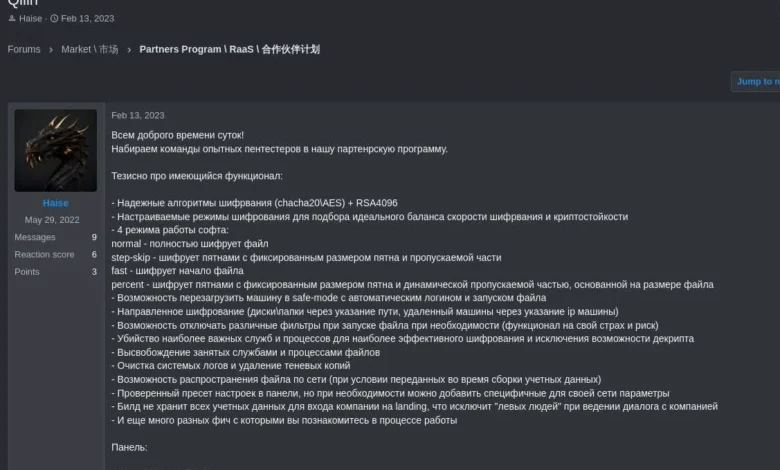
The cybercrime group known as Qilin has ascended to the dubious position of the world’s most prolific ransomware-as-a-service (RaaS) affiliate program, having targeted at least 365 organizations in the third quarter of 2026 alone. While the group’s operational model is sophisticated, a trail of breadcrumbs left by its administrator—a 36-year-old resident of St. Petersburg, Russia—has allowed cybersecurity researchers to systematically pierce the veil of anonymity. Through a combination of historical forum activity, leaked government database records, and advanced stylometric analysis, investigators have identified the individual behind the handle "Haise" as Aleksey Mikhailovich Yakovtsev.
The Rise of Qilin: A New Standard in Digital Extortion
Qilin entered the ransomware landscape in September 2022, distinguishing itself through an aggressive, high-stakes recruitment strategy. By offering affiliates up to 80 percent of extortion proceeds, the group rapidly built a formidable network of hackers. Unlike many of its contemporaries, Qilin broke the linguistic barrier common in Russian-based cybercrime syndicates, actively recruiting English-speaking affiliates and coordinating with notorious groups such as Scattered Spider and RansomHub.
The group employs a "double extortion" methodology, a tactic that has become the gold standard for modern ransomware gangs. In this model, the perpetrators do not merely encrypt a victim’s data to demand a ransom; they exfiltrate sensitive files first. This allows the group to threaten victims with the public release of confidential information, thereby exerting pressure even if the victim manages to restore their systems from backups. This dual-layered threat significantly increases the leverage held by the attackers, forcing many organizations to pay to prevent catastrophic reputational and regulatory fallout.
The Anatomy of an OpSec Failure
The downfall of "Haise"—the primary architect of Qilin—stems from a classic operational security (OpSec) failure: the persistence of digital identity markers across time. While Haise understood the necessity of rotating pseudonyms to avoid detection, the administrator failed to completely sever links to previous identities.
The investigative trail began in earnest with the seizure of the RAMP (Ransomware Anonymous Marketplace) forum by the FBI in January 2026. Forensic analysis of RAMP’s internal communications revealed that when Haise applied for membership in June 2022, the administrator linked the account to the Telegram handle "Alexbigboss44."

Tracing this handle backward through threat intelligence platforms such as Intel 471 and Flashpoint uncovered a timeline of escalation. Before becoming the head of a global ransomware operation, the user behind Alexbigboss44 was active on Russian cybercrime forums like Exploit and XSS under the handle "Rjun" as early as 2020. During this period, the user was primarily involved in the illicit trade of corporate access, logs, and traffic brokering—a precursor to the more complex infrastructure management required for RaaS operations.
Chronology of an Evolving Threat
The evolution of the actor known as Rjun/Haise follows a trajectory commonly observed in the progression of professional cybercriminals:
- 2013–2014: Early digital footprint established; flight records indicate initial travel patterns between St. Petersburg and Murmansk.
- 2018–2019: The individual begins operating as a novice arbitrageur, focusing on credit card fraud and lower-level cybercriminal activities.
- 2020: The user "Rjun" becomes a prominent presence on forums such as Darkmarket and Zloy, consistently utilizing the email address [email protected].
- 2022: The transition to RaaS occurs. "Haise" emerges as the leader of Qilin, coordinating high-volume attacks and forming alliances with other threat actors.
- 2025–2026: The breach of the Russian state service portal Gosuslugi provides the critical link, connecting the alias "Rjun" and the email address [email protected] to the real-world identity of Aleksey Mikhailovich Yakovtsev.
The Data Breach That Exposed the Architect
The identification of Yakovtsev was facilitated by a massive security breach of the Gosuslugi portal in late 2025. This breach exposed the personal data of over 20 million Russian citizens, including full names, birth dates, and mobile numbers. Because the email address [email protected]—previously tied to the Rjun persona—was present in the leaked database, researchers were able to link it directly to Yakovtsev’s legal identity.
Further verification came through the analysis of Telegram account ID 118329521, which had been used by Haise for years. This ID was found to be linked to a Russian phone number (+79602347275). When pivoted against historical databases, this phone number was found to be registered to Yakovtsev’s immediate family member, with Yakovtsev frequently utilizing his sister’s contact information and email addresses to register for various online services—a common but risky practice that effectively bridged the gap between his criminal and private lives.
Implications for Global Cybersecurity
The identification of Yakovtsev serves as a stark reminder of the limitations of anonymity for even the most "professional" cybercriminals. The use of advanced AI-driven stylometry and cross-platform correlation has made it increasingly difficult for threat actors to maintain disparate personas over a long period.
"The progression we see here—from a fringe fraudster to the administrator of an international ransomware syndicate—is emblematic of the modern cybercrime economy," notes a lead researcher from a prominent threat intelligence firm. "However, the digital world is remarkably persistent. Every mistake, every reused email, and every breach of a third-party service adds to the footprint that eventually leads back to the doorstep."

The implications for the victims of Qilin are significant. With the administrator identified, international law enforcement agencies now have a specific target for investigation and potential prosecution. Furthermore, organizations targeted by Qilin can now better understand the infrastructure and tactics employed by their adversaries.
The Broader Landscape of Ransomware-as-a-Service
Qilin’s success is a reflection of the RaaS model’s efficiency. By separating the development of the ransomware strain from the execution of the attack, the syndicate can scale its operations rapidly. However, the centralization of power in the hands of a single administrator, as seen with Yakovtsev, creates a single point of failure.
The reliance on English-speaking affiliates and the adoption of modern, enterprise-like business practices have made Qilin a formidable threat to industries ranging from healthcare and finance to logistics and manufacturing. The group’s willingness to operate across geopolitical boundaries highlights the borderless nature of modern cybercrime, where an individual in St. Petersburg can coordinate the paralysis of a corporation in North America or Europe with the click of a button.
Concluding Observations
Despite the sophisticated technical defenses employed by ransomware groups, the weakest link remains the human element. Yakovtsev’s decision to reuse identifiers, rely on family-linked contact information, and participate in forums under historical aliases provided the necessary threads for researchers to weave together his true identity.
As of this writing, there has been no official statement from Yakovtsev, and attempts to reach him for comment have been met with silence. Nevertheless, the documentation of his activities provides a vital resource for cybersecurity professionals working to defend against the Qilin threat. The exposure of the man behind the curtain serves as a potent deterrent, demonstrating that even those who believe they have mastered the art of digital concealment are subject to the enduring scrutiny of a global security community committed to transparency and accountability.