Admission in Kubernetes Clusters with the New Headlamp Plugin
The modern cloud-native ecosystem relies heavily on automated batch processing, machine learning training workloads, and high-performance computing tasks executed on Kubernetes. However, as cluster utilization scales to tens of thousands of pods, platform engineers frequently encounter resource contention bottlenecks that standard Kubernetes schedulers struggle to resolve natively. When a submitted Kubernetes Job fails to immediately instantiate pods, diagnosing the root cause historically required a fragmented, manual investigation across dozens of command-line operations and massive YAML configuration files.
This operational friction has prompted the introduction of a specialized diagnostic solution: the Kueue plugin for Headlamp, released as an initial 0.1.0-alpha version in October 2026. Developed as part of the CNCF Linux Foundation (LFX) Mentorship program for Term 2, the tool bridges a critical visibility gap between Kubernetes resource management and advanced batch queueing controllers. By unifying workload evaluation pathways into a cohesive graphical user interface, the plugin transforms how site reliability engineers and platform administrators troubleshoot pending workloads.
Background and Ecosystem Evolution
Kubernetes excels at managing stateless microservices and long-running deployments, but natively scheduling large-scale batch jobs presents significant challenges. Standard scheduler mechanics focus on immediate node-level placement rather than cluster-wide resource allocation, fair-sharing, or job prioritization. To address these limitations, Kubernetes Special Interest Groups (SIGs) developed Kueue, a native job queueing controller designed to manage resource quotas across multi-tenant environments.
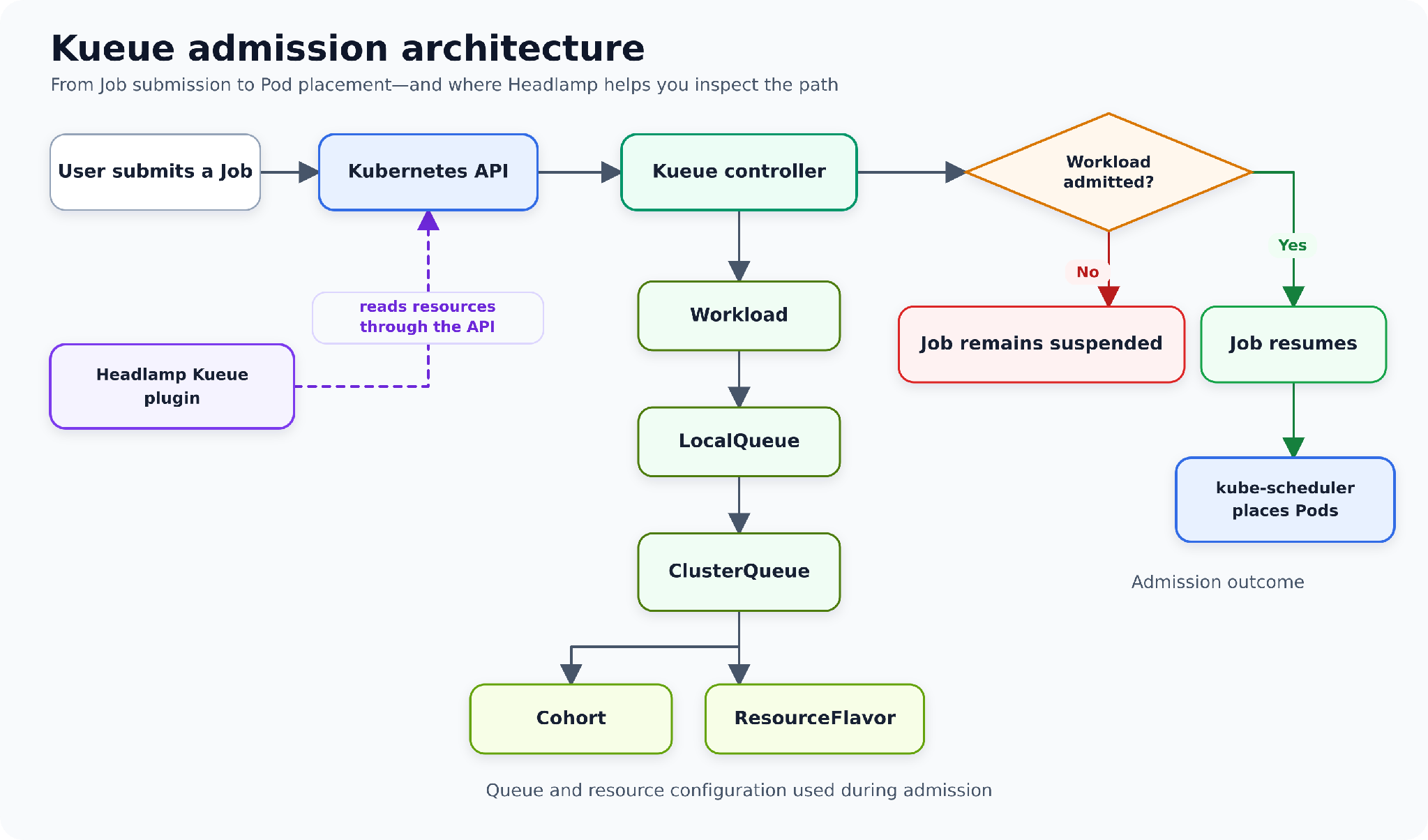
Kueue operates upstream of the default Kubernetes scheduler. When an engineer submits a Job object, Kueue intercepts the deployment, converts it into an internal Workload custom resource, and evaluates whether adequate cluster capacity exists. If resources are unavailable, the Job remains suspended. While effective for resource governance, this architecture introduced a complex diagnostic challenge. Operators frequently found themselves questioning why pods remained missing, confusing standard scheduling failures with higher-level queue admission denials.
Recognizing the need for better observability, developer Utkarsh Raj, working alongside project maintainers Renée Dudfield and Kevin Hannon, engineered the Headlamp Kueue plugin. Released under the umbrella of the Headlamp extensible Kubernetes web UI project, the tool provides read-only transparency into the intricate web of Kueue admission components, including Cohorts, ClusterQueues, LocalQueues, ResourceFlavors, and Workloads.
Core Architecture and Diagnostic Methodology
The primary innovation introduced by the Headlamp Kueue integration is the strict separation of admission decision-making from pod-level scheduling. Understanding this operational boundary fundamentally alters how engineers approach troubleshooting.
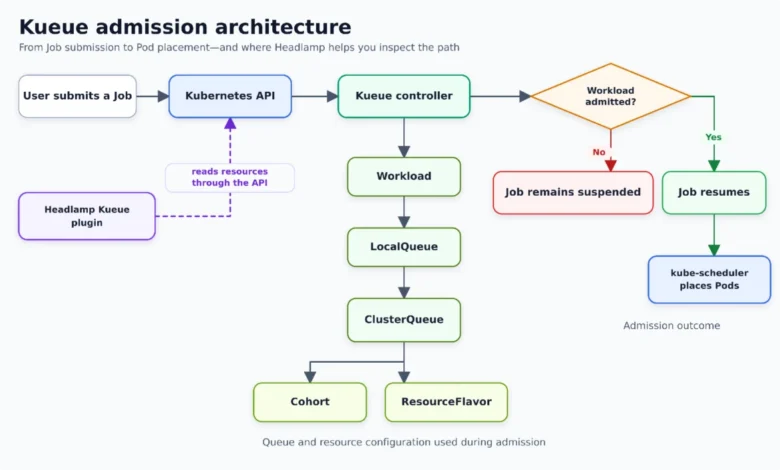
Under the hood, the diagnostic lifecycle follows a structured hierarchy:
- Job Submission: A user submits a standard Kubernetes Job, which is automatically intercepted and translated by Kueue into a namespaced
Workloadresource. - Queue Evaluation: Kueue evaluates the Workload against the designated
LocalQueue, which bridges namespaced requests to cluster-scopedClusterQueues. - Resource and Quota Validation: The controller checks available quotas, factoring in
ResourceFlavors(which map to hardware attributes, taints, or node selectors) andCohorts(which allow multiple ClusterQueues to pool and share unused capacity). - Admission and Handoff: Once quota is successfully reserved, Kueue resumes the Job, passing control to the standard Kubernetes scheduler for node placement.
Previously, verifying this multi-tiered validation path required executing sequential kubectl describe and kubectl get commands across various resource types, then cross-referencing output manually. The Headlamp plugin consolidates this entire inspection workflow into an interactive, hyperlinked graphical interface.
Step-by-Step Investigation Workflow
When investigating a pending job within a Kueue-managed cluster, platform operators utilizing the Headlamp plugin follow a streamlined, systematic evaluation path designed to isolate bottlenecks rapidly.
Step 1: Evaluating the Workload Status
Rather than inspecting application logs or searching for absent pods, administrators begin by navigating to the Kueue Workloads view within Headlamp. Selecting the appropriate namespace surfaces the specific Workload generated for the suspended Job. At this initial glance, operators can review high-level status indicators and condition flags—most notably QuotaReserved and Admitted. If the Workload fails to appear entirely, engineers can immediately verify namespace filtering, verify queue targeting, or check RBAC permissions to ensure the current identity possesses adequate read privileges.
Step 2: Analyzing Status Conditions and Events
Opening the Workload detail view exposes granular status conditions and historical events. Rather than parsing raw YAML manifests, administrators can read human-friendly condition messages detailing exact blockers—such as insufficient CPU quota within a specific ClusterQueue or missing ResourceFlavor assignments. These messages provide an immediate, definitive answer regarding why a deployment remains stalled.
Step 3: Assessing Aggregate Resource Requests
Batch jobs frequently define parallelism and multi-pod requirements that scale total resource consumption well beyond single-pod templates. The Headlamp plugin aggregates requested pod counts, CPU allocations, and memory footprints across the entire workload request. Comparing these consolidated figures against assigned quotas clarifies whether the cluster’s current resource limits can satisfy the submission.
Step 4: Tracing Queue Hierarchies
When admission is blocked, engineers follow direct hyperlinks within Headlamp from the Workload to its associated LocalQueue. This namespaced entry point indicates whether the queue itself is active, stopped, or experiencing queue congestion due to competing workloads. From the LocalQueue, operators can transition seamlessly to the cluster-scoped ClusterQueue to review nominal capacity limits versus current active usage.
Step 5: Examining Flavors and Cohorts
For complex environments utilizing specialized hardware—such as GPU-accelerated node pools—the investigation often extends to ResourceFlavors and Cohorts. Headlamp visually maps parent and child cohort structures, member cluster queues, borrowing and lending limits, and fair-sharing metrics. This visibility allows operators to determine whether a workload is stalled due to local exhaustion, strict borrowing limits, or a lack of compatible hardware nodes.
Transitioning to Standard Kubernetes Views Upon Admission
Once Kueue successfully admits a workload and reserves the necessary quota, the Admitted condition updates to true, and the underlying Job is resumed. At this operational inflection point, responsibility shifts from the Kueue admission controller to the standard Kubernetes scheduler.
If pods continue to remain in a Pending state post-admission, operators must transition out of the Kueue section of Headlamp and into standard Kubernetes Workloads and Pod views. At this stage, pending statuses are no longer related to batch queue quotas; instead, they typically stem from traditional scheduling constraints, including:
- Insufficient raw node capacity across the cluster
- Unmet node affinity or anti-affinity rules
- Unresolvable taints and tolerations
- Topology spread constraints
- PersistentVolume claim binding failures
- Image pull errors or container registry timeouts
Establishing this clear diagnostic boundary prevents engineers from misallocating time debugging cluster quota configurations when the actual bottleneck lies in node-level scheduling constraints.
Technical Implementation and Community Reception
The Kueue Headlamp plugin was built utilizing modern web technologies, including TypeScript, React, standard Kubernetes APIs, and the native Headlamp plugin architecture. Developed during the mid-2026 CNCF LFX Mentorship term by contributor Utkarsh Raj, the project received significant code review and architectural guidance from maintainers Renée Dudfield and Kevin Hannon.
Community feedback from early adopters across both the Headlamp and Kueue ecosystems has shaped the plugin’s status presentation, navigation flow, and initial documentation. While the current 0.1.0-alpha release is strictly read-only—meaning it does not natively introduce custom create, edit, stop, resume, or delete workflows for Kueue resources—it successfully fulfills its primary design mandate: simplifying interactive troubleshooting. For automated CI/CD pipelines, GitOps workflows, and scripting tasks, command-line utilities like kubectl and kueuectl remain essential. However, for systems administrators actively diagnosing complex queue starvation issues in real time, the linked graphical path provided by Headlamp significantly reduces mean time to resolution.
Current Limitations and Future Roadmap
As an initial alpha release, the Headlamp Kueue plugin maintains specific operational boundaries. The tool currently provides read-only visualization for Kueue v1beta2 API objects, encompassing Cohorts, ClusterQueues, LocalQueues, ResourceFlavors, and Workloads. It relies entirely on existing Kubernetes RBAC configurations to govern user access, displaying descriptive notification messages when current identities lack permissions to read specific resources.
Future development cycles, guided by ongoing community feedback submitted through official project repositories and tracking issues, are expected to expand administrative capabilities, potentially introducing direct resource modification and management workflows within the user interface. By continuously refining observability tools for multi-tenant batch processing, the Kubernetes community aims to streamline the operational burden of running large-scale distributed workloads in production environments.
Related posts: