Active Exploitation of Critical GeoServer Vulnerabilities Demands Immediate Patching of Infrastructure

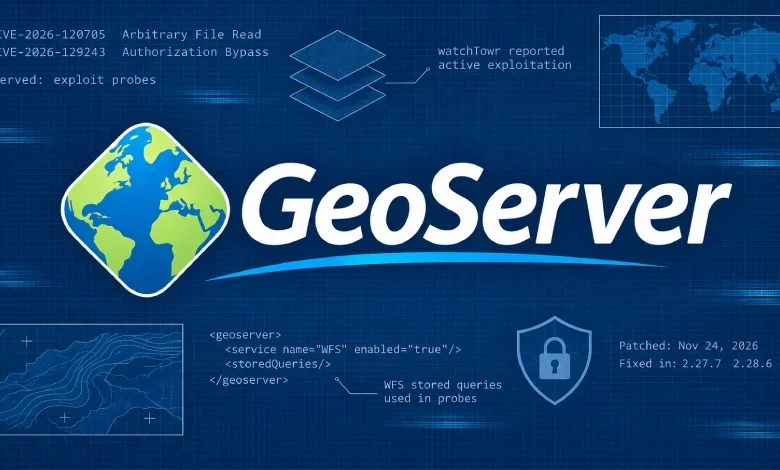
Threat actors are actively weaponizing two newly disclosed and patched security vulnerabilities within GeoServer, a widely utilized open-source server for sharing geospatial data. The discovery, confirmed by preemptive exposure management firm watchTowr, underscores a persistent trend of malicious entities targeting critical infrastructure software. The vulnerabilities, identified as CVE-2026-120705 and CVE-2026-129243, represent significant security gaps that, when chained together, allow for unauthenticated remote code execution (RCE). As organizations across the globe—ranging from government bodies to private logistics firms—rely on GeoServer for complex spatial data management, the urgency to apply recent patches has reached a critical threshold.
The Anatomy of the Exploit Chain
Security researchers have identified a sophisticated multi-stage attack vector that bypasses standard administrative safeguards. According to detailed technical analysis, attackers are employing error-based exploit probes to verify the vulnerability of a target server. This is achieved by creating and invoking stored queries, a process that allows unauthorized actors to probe the system’s defenses without immediate detection.
The core of the threat lies in the ability to chain these vulnerabilities. Specifically, Eye Security, the firm responsible for the discovery and initial reporting of CVE-2026-120705, has highlighted that the flaw functions as a linchpin. By combining this vulnerability with others within the GeoServer ecosystem, an adversary can successfully bypass authentication entirely.

Jonah Burgess, a senior security researcher at Rapid7 known in the cybersecurity community as "CryptoCat," independently discovered a five-step RCE chain on August 2, 2026. His findings explain that by prefixing the Web Feature Service (WFS) name—such as utilizing an "x/WFS" syntax—attackers can effectively circumvent the "admin-only" restrictions placed on stored queries. Once inside, the server inadvertently transforms escaped text within a saved query into live "xi:include" elements. This action facilitates the exfiltration of sensitive configuration files, specifically those containing the "remember-me" security keys and the administrator password digest.
With these credentials in hand, the attacker can forge an administrative session cookie without needing to perform the computationally expensive task of cracking the password. Once the administrative status is established, the attacker can point a Java Database Connectivity (JDBC) user service toward an uploaded HSQLDB database. The bundled driver then deserializes a stored value, triggering the execution of arbitrary system commands. This sequence illustrates the catastrophic potential of combining seemingly minor configuration oversights into a full-scale system takeover.
Chronology of Discovery and Disclosure
The timeline of these vulnerabilities spans several months, revealing a complex process of discovery, verification, and remediation that began in the summer of 2026.
- August 2, 2026: Jonah Burgess (CryptoCat) discovers and reports the five-step unauthenticated remote command execution chain.
- October 2026: GeoServer maintainers release initial patches addressing parts of the vulnerability chain.
- November 24, 2026: Official advisories for CVE-2026-120705 and CVE-2026-129243 are formally published, providing comprehensive documentation for users.
- November 25, 2026: Security firm watchTowr reports that threat actors are actively leveraging these flaws in the wild, confirming that the "window of opportunity" for attackers is currently wide open.
This development follows a tumultuous year for GeoServer security. Just three months prior to the current crisis, the platform faced a critical zero-day threat under CVE-2026-76904, which carried a CVSS score of 9.8. The repeated targeting of this software suggests that threat actors have identified GeoServer as a high-value target, likely due to its role as a central hub for sensitive geospatial data, which is often used in infrastructure planning, environmental monitoring, and defense operations.

Implications for Global Infrastructure
The implications of these vulnerabilities are profound. GeoServer is an essential tool for OGC (Open Geospatial Consortium) standard-compliant data exchange. Because it often sits at the edge of internal networks to facilitate public-facing mapping services, it is inherently exposed to the internet.
When a server running GeoServer is compromised via RCE, the attacker gains the ability to move laterally within the network. In an enterprise environment, this could lead to the theft of intellectual property, the encryption of files via ransomware, or the establishment of a persistent backdoor for future espionage. Furthermore, because GeoServer is frequently integrated into larger geographic information systems (GIS), a single compromised instance can serve as a gateway to broader, more secure corporate databases.
The maintainers of GeoServer have issued stern warnings regarding the inadequacy of manual workarounds. Some administrators attempted to mitigate the risk by modifying the "security/config.xml" file; however, the project maintainers clarified that if an attacker has already obtained the administrator password digest through the file disclosure vulnerability, changing the configuration key is futile. The key is often revealed in the same disclosure event, rendering the attempted manual patch ineffective.
Urgent Remediation Steps
The consensus among security professionals is that immediate patching is the only viable defense. GeoServer has released updated versions specifically designed to address these risks. Users are urged to migrate their installations to the following versions immediately:

- GeoServer 2.27.7
- GeoServer 2.28.6
- GeoServer 3.0.2
Organizations that cannot update immediately are advised to isolate their GeoServer instances from the public internet. Access should be restricted via robust VPNs or IP whitelisting to prevent unauthenticated actors from reaching the WFS endpoint. Furthermore, system administrators should perform a forensic audit of their logs to check for "error-based exploit probes" or anomalous requests that suggest an attempt to access stored queries or manipulate the JDBC configuration.
The Broader Cybersecurity Landscape
The active exploitation of GeoServer vulnerabilities serves as a reminder of the fragility of the open-source supply chain. While open-source software provides unparalleled flexibility and cost-efficiency for organizations, it also requires a proactive security posture. When vulnerabilities are disclosed, the speed at which threat actors develop exploits—often within hours or days—means that the traditional patch management cycle of "weeks or months" is no longer sufficient.
Furthermore, the rise of "preemptive exposure management" firms like watchTowr has changed how these stories break. By monitoring global traffic patterns and identifying exploit probes before a full-scale breach occurs, these firms provide a vital, if frantic, early warning system. However, the onus remains on the end-user to interpret these warnings and prioritize patching as a core operational task rather than a secondary IT requirement.
As the industry moves into the close of 2026, the case of the GeoServer exploits will likely be cited as a textbook example of the risks associated with complex, multi-stage RCE chains. The ability of researchers to uncover these deep-seated flaws is a testament to the sophistication of modern security research, but the active exploitation of these same flaws highlights the ongoing struggle to secure the digital backbone of our interconnected world. Organizations that ignore these warnings risk not only the integrity of their geospatial data but the security of their entire network architecture. The message from the security community is unambiguous: if you run GeoServer, the time to update is now.
Related posts: