GitHub Actions supply chain vulnerability resurfaces as disabled repositories are inadvertently reactivated

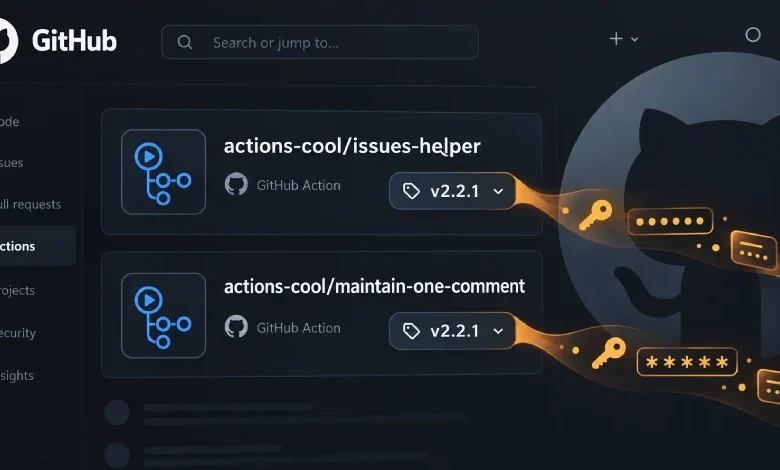
In a disturbing development for software supply chain security, two GitHub Actions repositories, previously neutralized due to their involvement in a malicious campaign, were briefly reactivated by the platform last week. This unexpected restoration allowed for the potential re-execution of dormant malware, underscoring critical vulnerabilities in how developers manage third-party dependencies within their CI/CD pipelines. The incident, identified by researchers at Socket, highlights a precarious scenario where security remediation can be undone by the simple, accidental reactivation of compromised codebases.
The affected repositories, which were initially identified as vectors for the Mini Shai-Hulud supply chain attack, became accessible again on September 16, 2026. For a window of several hours, any automated workflow configured to pull these actions—specifically those relying on version tags rather than immutable commit SHAs—would have once again downloaded and executed the malicious payloads originally injected in May. While GitHub staff have since disabled the repositories a second time, the incident serves as a stark reminder of the persistent nature of software supply chain threats.
Chronology of the Mini Shai-Hulud Incident
The saga of these specific GitHub Actions began in mid-2026, marking a significant escalation in automated software supply chain attacks.

- May 18, 2026: The initial compromise occurs. Threat actors successfully inject malicious code into the two GitHub Actions. These actions, designed for repository housekeeping—such as managing issue statuses and pull request comments—are modified to harvest sensitive credentials from the CI/CD environments where they are executed. Stolen credentials are subsequently exfiltrated to an attacker-controlled server, identified by the domain
t.m-kosche[.]com. - Late May 2026: The security community identifies the "Mini Shai-Hulud" campaign. The activity is linked to a broader cluster of attacks that also targeted the npm ecosystem, specifically the
@antvpackage ecosystem. - May/June 2026: Following the discovery of the malicious payloads, GitHub intervenes, disabling the affected repositories to prevent further exploitation.
- September 16, 2026: Between 11:09 a.m. and 6:16 p.m. GMT+2, the repositories are mysteriously re-enabled. Crucially, the malicious code remains within the release tags. Any automated build system referencing these tags immediately resumes pulling the compromised code.
- Late September 2026: Security researchers at Socket discover the reactivation and alert the community. GitHub subsequently re-disables the repositories.
The Mechanism of the Attack
The primary danger in this incident lies in the reliance on mutable version tags. In the GitHub Actions ecosystem, developers often define dependencies using tags like v1 or v1.2. These tags are pointers that can be updated by the repository owner at any time. When a developer pins an action to a tag, they are essentially telling their workflow to "fetch the latest code associated with this label."
In the case of the Mini Shai-Hulud attack, the threat actors did not need to deploy new infrastructure or write new malicious scripts to regain control once the repositories were re-enabled. Because the release tags were never cleaned or purged of the malicious commits, the "latest" version remained the compromised one.
"Most supply chain incidents involve something new: a newly published malicious version, a newly hijacked account, or a newly injected workflow," noted Karlo Zanki, a security researcher at Socket. "This one did not. No new code was published and no configuration was changed. Both actions automate issue and comment housekeeping, such as closing inactive issues, checking newly opened ones, or keeping a single bot comment up to date. The workflows that call them usually run on a daily schedule or whenever someone opens an issue or pull request. In practice, most affected repositories probably ran the payload within a day of the re-enablement."
Broader Implications for CI/CD Security
This incident exposes a significant blind spot in modern DevOps practices: the assumption that a disabled repository remains permanently inert. For enterprise organizations, the reliance on third-party actions is nearly universal. These actions perform vital tasks, from linting and testing to security scanning and deployment. However, the ease with which these tools can be compromised—and subsequently reactivated—presents a systemic risk.

The fact that the malicious payload remained active for months without any manual intervention from the attackers is particularly concerning. It suggests that once a supply chain is poisoned, the damage can persist indefinitely, waiting for a trigger to wake the dormant code. If the attackers had intended to inflict widespread damage, the re-enablement could have served as a perfect catalyst for a massive, coordinated exfiltration of environment variables, API keys, and cloud infrastructure credentials.
Defensive Best Practices
Security experts are using this event to reiterate the necessity of immutable infrastructure, even within the context of CI/CD pipeline definitions. The following strategies are recommended to mitigate the risks of similar supply chain attacks:
- Pin by SHA, Not by Tag: The most effective defense is to pin all GitHub Actions to their full commit SHA (e.g.,
actions/checkout@a1b2c3d4e5...) rather than a mutable tag. A commit SHA is a unique identifier that cannot be changed by the repository owner, ensuring that even if the upstream repository is compromised, the workflow will continue to execute the known-good code it was originally configured to run. - Audit CI/CD Dependencies: Organizations should regularly audit the third-party actions they consume. If an action is not actively maintained or comes from an untrusted source, it should be replaced or audited internally.
- Use Private Mirrors: For highly sensitive environments, organizations should consider hosting their own internal versions of required GitHub Actions. By mirroring the code into a private, controlled repository, the organization ensures that external changes cannot impact their build processes.
- Monitor for Unusual Network Activity: Since the Mini Shai-Hulud attack relied on exfiltrating data to specific external domains, robust egress filtering and monitoring within the CI/CD environment can help detect and block unauthorized data transfers.
- Implement Least Privilege: CI/CD runners should operate with the minimum level of permission required. If an action does not need access to sensitive secrets, it should be explicitly restricted from accessing those environment variables.
The Path Forward
The brief reactivation of these repositories serves as a stark reminder that the software supply chain is inherently fragile. While GitHub has taken steps to secure the platform, the responsibility for verifying the integrity of dependencies ultimately falls on the developers and organizations that integrate them.
As the industry moves toward more complex automated systems, the risk of "latent" threats—code that is compromised but inactive—will likely grow. Security teams must account for the fact that a repository disabled today might, through administrative oversight or platform error, be re-enabled tomorrow. In such an environment, the only defense is a "zero-trust" approach to third-party code, where every dependency is treated as potentially volatile.

The incident also highlights the need for better communication between platform providers and the developer community. When repositories are disabled for security reasons, the process for remediation should include clear guidance on how to ensure that tags are purged and that the malicious state is not preserved. Until then, developers must assume that their build pipelines are only as secure as their most granular dependency pin. By shifting to immutable references, the developer community can significantly reduce the window of opportunity for threat actors, ensuring that a simple platform-side error does not translate into a catastrophic security breach.