The rapid commercialization and deployment of Large Language Models (LLMs) have transformed the landscape of global digital communication, yet a fundamental economic and structural disparity remains largely hidden beneath the surface of user billing statements and system architectures. While modern artificial intelligence is marketed as a universal, multilingual tool capable of bridging cultural and linguistic divides, recent empirical research into tokenization mechanisms reveals a stark economic penalty for users communicating in non-English scripts. A newly published benchmark focusing on the Urdu language demonstrates that token inflation—the disproportionate fragmentation of non-English text into micro-units—imposes significant financial, computational, and contextual burdens on developers and end-users operating outside the Anglosphere.
At the core of this disparity is the mechanism of tokenization, the process by which raw text is converted into numerical identifiers that neural networks can process. Because foundational language models are predominantly trained on vast corpora of English-language data, their underlying tokenizers are heavily optimized for English morphology, syntax, and character frequencies. When these tokenizers encounter scripts with which they have minimal exposure—such as the Perso-Arabic script used in Urdu—they systematically fail to map words efficiently. Instead of treating coherent words or meaningful sub-word roots as single tokens, the algorithm falls back on raw byte-level encoding or aggressive character-by-character slicing.
To quantify this phenomenon accurately without running afoul of restrictive licensing gates on standard multilingual benchmarks like FLORES+, independent researchers developed a specialized, openly licensed parallel corpus. Released under a Creative Commons attribution license on Hugging Face, the corpus consists of 30 meticulously verified sentence pairs spanning 17 everyday domains, including news reporting, legal discourse, medical consultations, and agricultural technicalities. To ensure structural integrity, all strings were verified for Normalization Form C (NFC) compliance, omitting zero-width joiners and Arabic presentation forms that artificially inflate token counts through typographic artifacts rather than true linguistic variance.
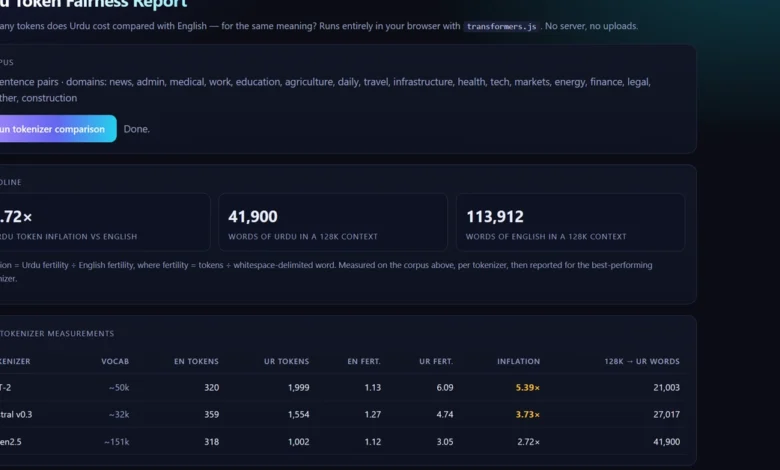
The empirical findings derived from this corpus expose the acute dimensions of token inflation across varying model architectures. When evaluating identical semantic content translated between English and Urdu, the disparity in token consumption is striking. On the older GPT-2 tokenizer, which features a standard vocabulary size of approximately 50,000 tokens, a benchmark passage costing 320 tokens in English required 1,999 tokens in Urdu. This yields an Urdu inflation factor of 5.39x, meaning that expressing the exact same factual information in Urdu consumes more than five times the computational bandwidth.
Crucially, this penalty is not entirely mitigated by scaling vocabulary sizes. When tested against Mistral v0.3, which utilizes a smaller vocabulary of approximately 32,000 tokens, the Urdu inflation factor drops to 3.73x (359 English tokens versus 1,554 Urdu tokens). Conversely, Qwen2.5, featuring a significantly expanded vocabulary of roughly 151,000 tokens, achieves an inflation rate of 2.72x (318 English tokens versus 1,002 Urdu tokens). These comparative metrics demonstrate that while a larger vocabulary aids in broader character coverage, the sheer diversity of the training corpus—specifically the inclusion of non-Latin scripts during the tokenizer’s foundational training phase—plays an equally critical role in mitigating token bloat.
To understand the practical impact of these ratios, one must examine token density through the lens of characters per token. In English implementations using GPT-2, an average of 5.35 characters are packed into a single token. In stark contrast, Urdu text processed by the same tokenizer yields an average of just 1.34 characters per token. This operates perilously close to pure character-level encoding, forcing the model to process Urdu nearly one letter at a time. Consequently, a standard thousand-character document consumes approximately 187 tokens in English, whereas the same character length in Urdu demands roughly 746 tokens.
This systemic inefficiency cascades directly into the operational limits of LLMs, most notably regarding context windows. Modern foundation models frequently advertise expansive context capacities, such as 128,000 tokens. However, the effective linguistic payload of that window shifts dramatically depending on the target language. While a 128,000-token context window on a GPT-2-based architecture can comfortably ingest roughly 113,000 words of English text, its capacity for Urdu plummets to approximately 21,000 words. Even with the advanced tokenization strategies of Qwen2.5, the Urdu word capacity struggles to reach 42,000 words—barely a third of its English-language processing ceiling.
The implications for enterprise deployment, retrieval-augmented generation (RAG) pipelines, and localized consumer applications are profound. Organizations attempting to process extensive Urdu documentation—such as historical archives, legal frameworks, or governmental policies—face severe truncation issues, losing the majority of a document’s substance when attempting to load it into a standard context buffer. Furthermore, in RAG architectures, where retrieved chunks compete for limited prompt space, an Urdu query and its corresponding context consume vastly more token budget than their English equivalents, effectively reducing the depth and relevance of retrieved information.
Financially, this inefficiency translates into a direct economic tax on linguistic minorities. Because cloud-based LLM providers bill customers strictly on a per-token basis for both input prompts and output generations, processing Urdu-language interactions costs between 2.7 and 5.4 times more than processing identical English workloads. For businesses, researchers, and public-sector entities in South Asia and diaspora communities utilizing AI infrastructure, this hidden surcharge acts as a structural barrier to digital equity.
Industry analysts and computational linguists suggest that resolving this disparity requires a fundamental redesign of how tokenizers are initialized. Relying on post-hoc vocabulary expansions or fine-tuning existing models on multilingual datasets is insufficient to overcome deep-seated architectural biases. Instead, developers of next-generation foundation models must prioritize balanced tokenization strategies from the inception phase, ensuring that non-Latin scripts receive equal representation in tokenizer training sets. Until such structural reforms are universally adopted, the token tax will continue to penalize millions of speakers of underrepresented languages, transforming a technical oversight into a persistent economic disadvantage in the global artificial intelligence economy.