React Native 0.86 Official Release Brings Android 15 Edge-to-Edge Support and DevTools Enhancements

The cross-platform mobile development landscape has received a notable update with the official launch of React Native 0.86. Developed by a massive global community of open-source contributors and heavily backed by industry leaders, this latest stable release introduces a slate of critical improvements aimed at modern mobile hardware standards. Most notably, React Native 0.86 delivers comprehensive edge-to-edge support for Android 15 and above, alongside robust enhancements to React Native DevTools. True to the framework’s recent trajectory—following version 0.83—this milestone release contains zero user-facing breaking changes, continuing a strategic push toward predictable, frictionless upgrade paths for enterprise applications and indie developers alike.
For engineering teams managing large-scale codebases, the absence of breaking changes marks a significant shift in how the React Native core team handles versioning. By focusing on internal stabilization, performance optimization, and backward compatibility, the framework is addressing historical pain points associated with mobile framework migrations. Developers moving from version 0.85 can expect a seamless transition without altering existing application logic.
A Historic Organizational Transition: The React Foundation
Beyond the technical enhancements contained within the source code, version 0.86 arrives during a transitional period for the broader React ecosystem. The core React Native repository, alongside related projects such as React, Metro, Yoga, and the official React Native website, has officially transitioned from the legacy facebook GitHub organization to the dedicated react organization.
This structural migration marks the formal operational shift of React and React Native into the newly established React Foundation. Formed as an independent, vendor-neutral entity, the foundation is dedicated to securing the long-term stewardship, sustainability, and governance of the React ecosystem. Industry analysts view this move as a maturation milestone, ensuring that the framework remains resilient, community-driven, and independent of any single corporate roadmap. For developers and organizations utilizing these tools, GitHub automatically manages the transition by redirecting all existing URLs, issues, and pull requests to the new namespace, ensuring zero disruption to existing CI/CD pipelines or workflow integrations.
Modernizing Android: Comprehensive Edge-to-Edge Support for Android 15+
Mobile operating systems continually evolve their user interface paradigms, and Google’s push toward mandatory edge-to-edge layouts in Android 15 has required a proactive engineering response from cross-platform frameworks. React Native 0.86 delivers comprehensive fixes and architectural alignment for Android 15+ edge-to-edge execution.
Historically, enabling edge-to-edge rendering—where application content flows seamlessly behind the system status and navigation bars—required explicit configuration via Gradle properties like edgeToEdgeEnabled. However, with modern Android runtimes increasingly enforcing edge-to-edge rendering at the operating system level, apps built on older versions of React Native frequently encountered layout clipping, overlapping touch targets, and improper padding.
Version 0.86 addresses these edge cases systematically. The release ships with deep framework-level fixes that handle OS-enforced edge-to-edge rendering natively, even when developers have not explicitly declared the Gradle property. This ensures that text, scroll views, and interactive components gracefully respect system window insets, providing a polished, native feel that complies with Google’s latest human interface guidelines.
Developer Experience Upgrades: Light and Dark Mode Emulation in DevTools
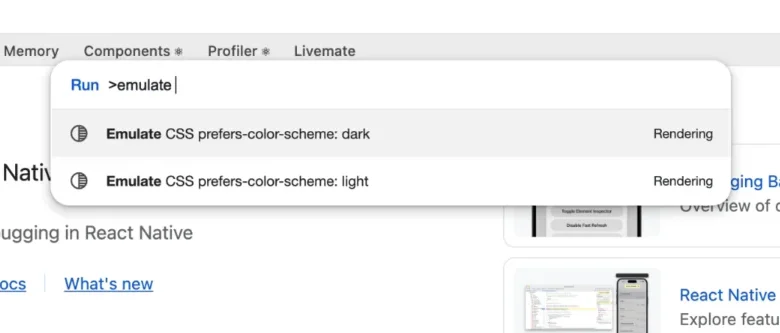
A polished developer experience remains a cornerstone of React Native’s adoption strategy. Version 0.86 introduces powerful new capabilities to React Native DevTools, most notably native support for light and dark mode emulation.
Previously, testing how a React Native application handled dynamic theme switching required developers to manually navigate system-level settings on physical devices or emulators. With the integration of Emulation.setEmulatedMedia, developers can now simulate different appearance modes directly from the React Native DevTools interface. By utilizing the Command Palette via the cmd + shift + P (or ctrl + shift + P) shortcut, engineers can instantly toggle between light and dark color schemes.
Much like modern web browser developer tools, this emulation serves as a temporary override designed specifically for debugging and design verification. The emulated state automatically resets once the DevTools session is disconnected, preventing accidental persistence of test states within the production application lifecycle.
Under-the-Hood Improvements, JSI Enhancements, and API Deprecations

While user-facing breaking changes have been successfully avoided, version 0.86 introduces a wide array of under-the-hood enhancements, runtime alignments, and performance optimizations.
The release incorporates advanced modifications to the JavaScript Interface (JSI), the high-performance C++ layer that bridges JavaScript engines with native platform modules. By introducing new JSI APIs, the core team has empowered library authors to build more capable, synchronous native modules with minimized serialization overhead. These improvements directly benefit animation frames, gesture handling, and complex data processing pipelines running on mobile devices.
Furthermore, the release addresses numerous edge cases across rendering, layout engines, accessibility services, and networking modules on Android. Accessibility improvements ensure that screen readers and auxiliary navigation tools interact more reliably with custom view hierarchies. At the same time, network handling routines have been optimized to reduce latency and memory allocation during heavy data transfers.
In alignment with React Native’s deprecation policy, version 0.86 flags several legacy APIs for future removal. While these deprecated interfaces continue to function in this release to prevent immediate application failures, developers are strongly encouraged to consult the official documentation and migrate to modern, supported alternatives ahead of upcoming major releases.
Community Collaboration and Contribution Metrics
The scale of React Native 0.86 underscores the vitality of its open-source community. The release represents a massive collaborative effort, consolidating over 596 distinct code commits contributed by 97 developers from around the globe. This decentralized model allows the framework to rapidly adapt to platform updates released by Apple and Google.
Core maintainers have extended formal acknowledgments to the numerous independent contributors who submitted significant patches, performance profiles, and bug fixes during the 0.86 development cycle. This collaborative synergy between corporate maintainers and independent engineers remains a defining characteristic of React Native’s longevity in the enterprise application space.
Implications and Strategic Outlook for Enterprise Adoption
The release of React Native 0.86 arrives at a critical juncture for enterprise software architecture. As businesses face mounting pressure to deliver high-performance mobile experiences across multiple operating systems with optimized engineering overhead, the demand for stable cross-platform tooling has never been higher.
The deliberate strategy of maintaining zero user-facing breaking changes across successive minor versions—exemplified by both 0.83 and 0.86—signals a maturing framework lifecycle. Enterprises can now plan continuous integration upgrades with greater confidence, significantly lowering the total cost of ownership associated with long-term mobile app maintenance. By decoupling framework updates from mandatory codebase refactoring, React Native is successfully mitigating the upgrade fatigue that has historically plagued JavaScript-based mobile development.
Upgrading to React Native 0.86 and Support Lifecycle Policy
With the launch of version 0.86, official support status shifts. Version 0.86 now assumes the mantle of the latest stable release of React Native, while version 0.83.x officially moves into unsupported status in accordance with the project’s formal version support policy.
Teams looking to upgrade existing projects are advised to utilize the official React Native Upgrade Helper tool to analyze exact code diffs between their current version and 0.86, alongside the comprehensive upgrading documentation provided on the official portal.
For greenfield developments, initializing a new project targeting the latest stable runtime can be accomplished via the updated command line interface:
npx @react-native-community/cli@latest init MyProject --version latestMeanwhile, developers leveraging the Expo ecosystem can expect React Native 0.86 support to roll out progressively through upcoming expo@canary and stable SDK release channels. As mobile operating systems continue to evolve their design languages and security models, React Native 0.86 provides a robust, stable foundation for developers building the next generation of cross-platform mobile applications.