Automating Repository Hygiene at Scale: How GitHub Built Evergreen to Secure Collaborator Access and Manage Stale Codebases


Maintaining software repositories in large-scale enterprise environments presents a persistent operational challenge. As organizations grow, collaborate with external partners, and launch transient product trials, the volume of outside collaborators and abandoned codebases expands exponentially. Without rigorous oversight, these forgotten assets can evolve into significant security vulnerabilities. Manual administrative housekeeping—such as verifying access permissions, tracking project deadlines, and archiving defunct repositories—frequently falls by the wayside as engineering teams prioritize feature delivery over maintenance.
To address this structural vulnerability within its own shared ecosystem, GitHub developed a dedicated internal automation tool known as Evergreen. Built entirely on native platform features, the application systematically audits outside collaborator access and identifies stale repositories, establishing a repeatable operational framework designed to secure large organizations without imposing administrative burdens on engineering staff.
The Scale of the Problem in Modern Software Development
Modern software engineering rarely occurs in isolation. Enterprise organizations routinely invite third-party contractors, external vendors, and strategic partners into their version control environments to facilitate product trials, code reviews, and professional services engagements. However, every granted permission introduces a potential vector for unauthorized access if left unmanaged after an engagement concludes.
Historically, repository owners have relied on manual tracking methods, including spreadsheets and calendar reminders, to monitor access lists. In massive collaborative environments—such as GitHub’s internal organization, which accommodates thousands of employees alongside countless external partners—manual auditing is unsustainable. When access permissions are left indefinitely unrevoked, organizations face compliance risks, data exposure hazards, and administrative bloat.
Recognizing that manual maintenance would inevitably fail at scale, GitHub engineers sought a solution that could enforce organizational hygiene autonomously while adhering to strict security parameters. The result was Evergreen, a lightweight Go-based webhook server designed to orchestrate native platform tools into a cohesive maintenance routine.
Core Architecture and Design Principles
Evergreen operates on two primary foundational design philosophies: failing secure and preserving data integrity.

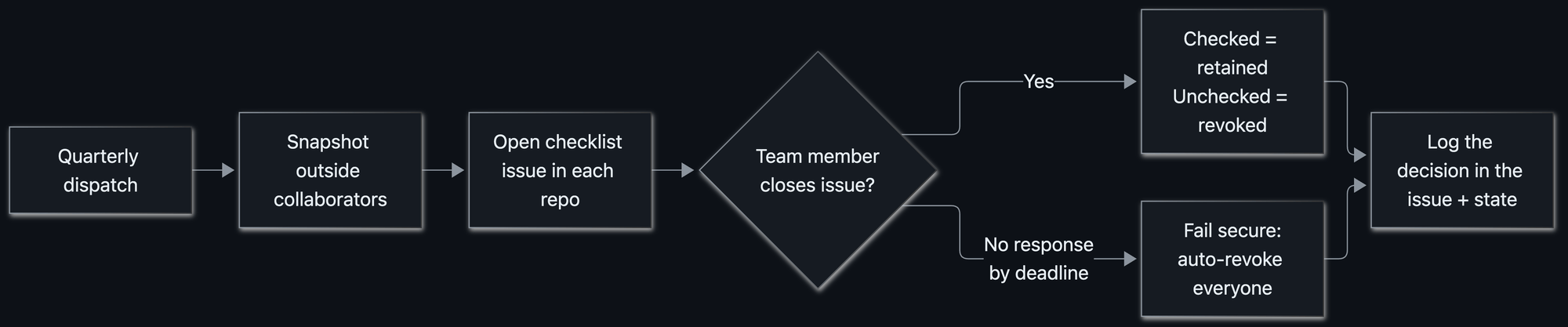
The principle of failing secure dictates that inaction must never result in preserved access. If an access review notification is sent to an organization member and goes unanswered by a strict deadline, the system automatically revokes the collaborator’s permissions. By making secure outcomes the default state, Evergreen eliminates the security gaps created by administrative negligence or overlooked notifications.
Simultaneously, the platform adheres to a strict non-destruction policy regarding codebases. Evergreen is structurally prohibited from deleting a repository or its internal contents. Repositories identified as stale are archived rather than destroyed, ensuring they remain recoverable if needed. Furthermore, every modification to access permissions is permanently recorded within the repository’s dedicated tracking issue. This transparency allows administrators to reverse erroneous permission changes simply by copying the logged data into an AI assistant or text editor for quick remediation.
Under the hood, the application leverages standard, out-of-the-box platform features rather than exotic dependencies. A dedicated controller repository acts as the system’s central clock and memory archive. Four scheduled workflows execute repository dispatch events on a quarterly cadence, orchestrating the multi-step lifecycle of access reviews and staleness evaluations.
Chronology of the Automated Maintenance Lifecycle
Evergreen executes its administrative responsibilities across a structured quarterly timeline, balancing proactive notifications with rigid enforcement deadlines.
The maintenance cycle spans a four-week period each quarter, initiated by scheduled automated workflows:
- Day 1: Stale Repository Review. The system scans the organization for repositories lacking recent human activity and opens a formal warning issue within those specific codebases.
- Day 8: Access Review. The platform snapshots all current outside collaborators and generates an interactive checklist issue inside each relevant repository.
- Day 16: Stale Repository Cleanup. Repositories that remain inactive following the initial warning period and grace window are automatically archived.
- Day 23: Access Cleanup. Any access reviews that remain unresolved by authorized personnel trigger automatic revocations for the listed collaborators.
Reviews are intentionally scheduled to open two weeks prior to the execution of cleanup routines, providing teams with a mandatory grace window. This deliberate pacing prevents abrupt administrative actions and ensures that temporary manual interventions cannot inadvertently accelerate the timeline. Additionally, all workflows support manual dispatches, granting administrators the flexibility to trigger specific steps on demand.
Transparent State Management and Issue-Ops
A defining architectural characteristic of Evergreen is its approach to state tracking. Rather than depending on an external database or bespoke logging pipelines, the application stores every repository’s status as an individual JSON file within the controller repository under a structured directory.
These JSON snapshots record critical metadata, including the last activity timestamp, active collaborators at the time of the review, renewal logs, decision timestamps, and associated tracking issue numbers. Because this state data resides directly within a version-controlled repository, the commit history functions as a comprehensive, immutable audit trail. Security and compliance teams can execute standard historical commands to determine precisely when, why, and by whom a collaborator’s access was altered.
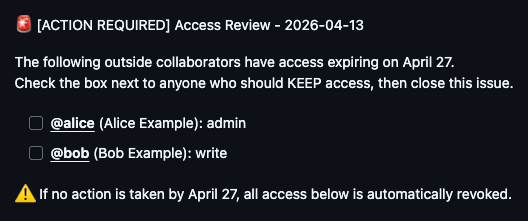
To interact with repository managers, Evergreen utilizes an "Issue-Ops" model, communicating directly through GitHub issues rather than external dashboards or email alerts. When an access review initiates, the application generates a concise checklist issue within the target repository. Authorized team members review the listed outside collaborators, check the boxes next to individuals who require continued access, and close the issue.
Upon closure, webhooks capture the event, parse the checklist selections, preserve permissions for verified collaborators, revoke access for unverified accounts, and post an automated receipt comment detailing the exact changes made. To safeguard the integrity of this process, the application enforces strict authorization controls. If a user without appropriate privileges attempts to close a review issue, the application automatically reopens the ticket and posts an explanatory notice, ensuring that security decisions remain restricted to authorized personnel.
Resolving Ownership Ambiguities
In large enterprise organizations, determining who is ultimately responsible for a specific repository can prove challenging. To prevent review notifications from getting lost, Evergreen employs a sophisticated fallback mechanism to identify the correct stakeholders.
The system evaluates ownership hierarchies dynamically, checking repository-specific metadata, team assignments, and organizational metadata to route notifications to the most appropriate internal owners. This automated resolution eliminates the need for administrators to maintain separate, error-prone spreadsheets mapping repository ownership across the enterprise.
Deploying Automation Safely at Enterprise Scale
Deploying automated access management across a massive developer ecosystem requires rigorous safety protocols to prevent operational disruptions. GitHub implemented several foundational strategies during the rollout of Evergreen to ensure a seamless transition.
Prior to enforcing active changes, the application was deployed using a comprehensive dry-run mode. This configuration logged every intended write operation without modifying active repositories or permissions, enabling engineers to analyze the system’s projected decisions against real-world scenarios.
Furthermore, extensive communication campaigns preceded the rollout, ensuring that organization members were fully aware of upcoming review cycles and expected actions. To maintain real-time observability, Evergreen emitted structured log data to monitoring infrastructure, allowing engineers to identify and resolve edge cases—such as repositories with disabled issues or unusual permission sets—before they impacted operations.
Addressing Platform Rate Limits
Automating administrative tasks across thousands of repositories introduces significant technical considerations regarding platform constraints, particularly secondary rate limits governing content creation, such as opening issues and posting comments.
To operate sustainably within platform parameters, Evergreen incorporates proactive rate-limiting strategies by design. The application processes repositories in controlled batches, introduces deliberate pauses between content-creating API calls, and incorporates idle periods between operational batches. By pacing its execution dynamically, the system avoids hitting rate limits without requiring reactive back-off protocols.
Implications and Broader Industry Impact
The introduction and operational success of Evergreen highlight a broader shift in enterprise software management toward self-governing infrastructure. As regulatory compliance standards become more stringent and security threats increasingly target third-party integrations, organizations can no longer rely on sporadic manual audits to secure their development environments.
By demonstrating that complex administrative workflows can be constructed entirely from native platform features—such as actions, webhooks, and version-controlled state files—GitHub provides a replicable blueprint for engineering organizations worldwide. The methodology emphasizes that effective security hygiene does not require cumbersome external tooling; rather, it requires embedding routine, transparent, and fault-tolerant automation directly into the development workflow.
As enterprises continue to scale their remote workforces and reliance on external partnerships, tools like Evergreen establish a new standard for balancing collaborative agility with uncompromising security governance.