Simplifying Windows Server Domain Integration with Automated AWS Elastic Beanstalk Active Directory Joining

Many enterprise-grade Windows applications are architected with the fundamental expectation that they will operate within a secure, managed Active Directory (AD) environment. Whether an intranet portal relies on Windows Integrated Authentication for seamless single sign-on, a database application requires the security of Windows authentication over static connection strings, or a fleet of servers must ingest configuration profiles via Group Policy, the requirement remains the same: the underlying infrastructure must be a recognized member of the corporate domain. Historically, fulfilling this requirement within the AWS Elastic Beanstalk ecosystem has been a source of significant operational overhead for DevOps teams.
For years, engineers were forced to implement complex, manual workarounds to ensure domain membership. This typically involved crafting intricate custom scripts within .ebextensions—scripts that had to securely retrieve domain credentials, programmatically rename instances to prevent collisions, execute the join command, and manage the subsequent system reboots. Furthermore, this process had to be idempotent and perfectly repeatable, as Auto Scaling events would trigger the process anew for every instance added to the fleet. Maintaining these scripts effectively turned infrastructure management into a bespoke development project, diverting engineering resources from core application features to the maintenance of administrative plumbing.
A Paradigm Shift in Cloud Automation
In a significant update to its cloud management capabilities, AWS has introduced native support for Active Directory domain joining directly within the Elastic Beanstalk configuration layer. By utilizing the new aws:elasticbeanstalk:windows:activedirectory namespace, administrators can now delegate the entire domain-join lifecycle to the platform. This feature eliminates the need for manual script maintenance and credential storage, as the instances now authenticate the join process using their own IAM instance profiles.
This shift marks a departure from the "DIY" approach to infrastructure configuration. By integrating this logic into the platform’s launch sequence, AWS ensures that every instance—whether it is the primary server in a test environment or a member of a massive, auto-scaled production fleet—is domain-joined before the application deployment phase begins. This capability supports AWS Managed Microsoft AD, Simple AD, and self-managed directories connected via AD Connector, offering flexibility across diverse hybrid cloud architectures.
Chronology and Operational Mechanics
The transition from manual scripting to native integration follows a strict, orderly sequence designed to ensure stability and security. When a developer triggers an environment launch with the appropriate configuration, the following steps occur automatically:

- Provisioning: The instance initializes within the specified Virtual Private Cloud (VPC).
- Pre-Deployment Join: Before the application code is deployed, the instance invokes the Directory Service CreateComputer API. This operation is authorized through the instance’s IAM role, ensuring that no sensitive administrative passwords are hard-coded in the deployment configuration.
- Identity Resolution: The instance performs a hostname update. By default, Elastic Beanstalk replaces the standard IP-derived hostname with a unique identifier derived from the instance ID. This is a critical security and operational improvement, as it prevents name collisions in the directory that could occur if IP addresses were recycled across multiple deployment cycles.
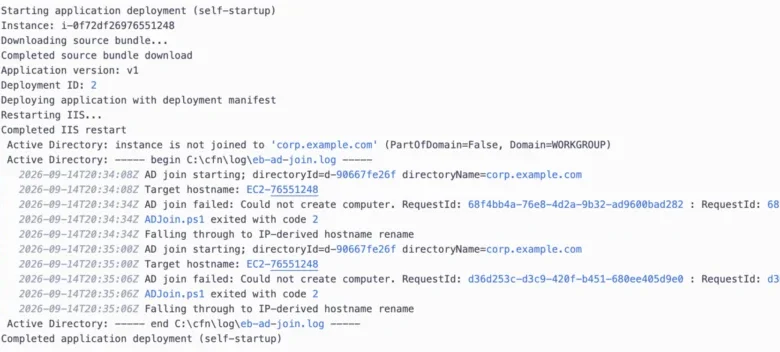
- Validation: The platform verifies the success of the join. If successful, the deployment proceeds. If a failure occurs—due to network misconfiguration, IAM permission gaps, or missing Organizational Units (OUs)—the system is designed for resilience. The deployment is not aborted; instead, the instance reverts to a standard workgroup configuration, and the failure is logged for immediate inspection.
Data-Driven Resilience and Error Handling
One of the most notable aspects of this update is its approach to error handling. In traditional, script-based setups, a failure to join the domain often caused an entire deployment to stall, leading to "Ready" status timeouts and complex debugging sessions. The new Elastic Beanstalk implementation prioritizes service availability.
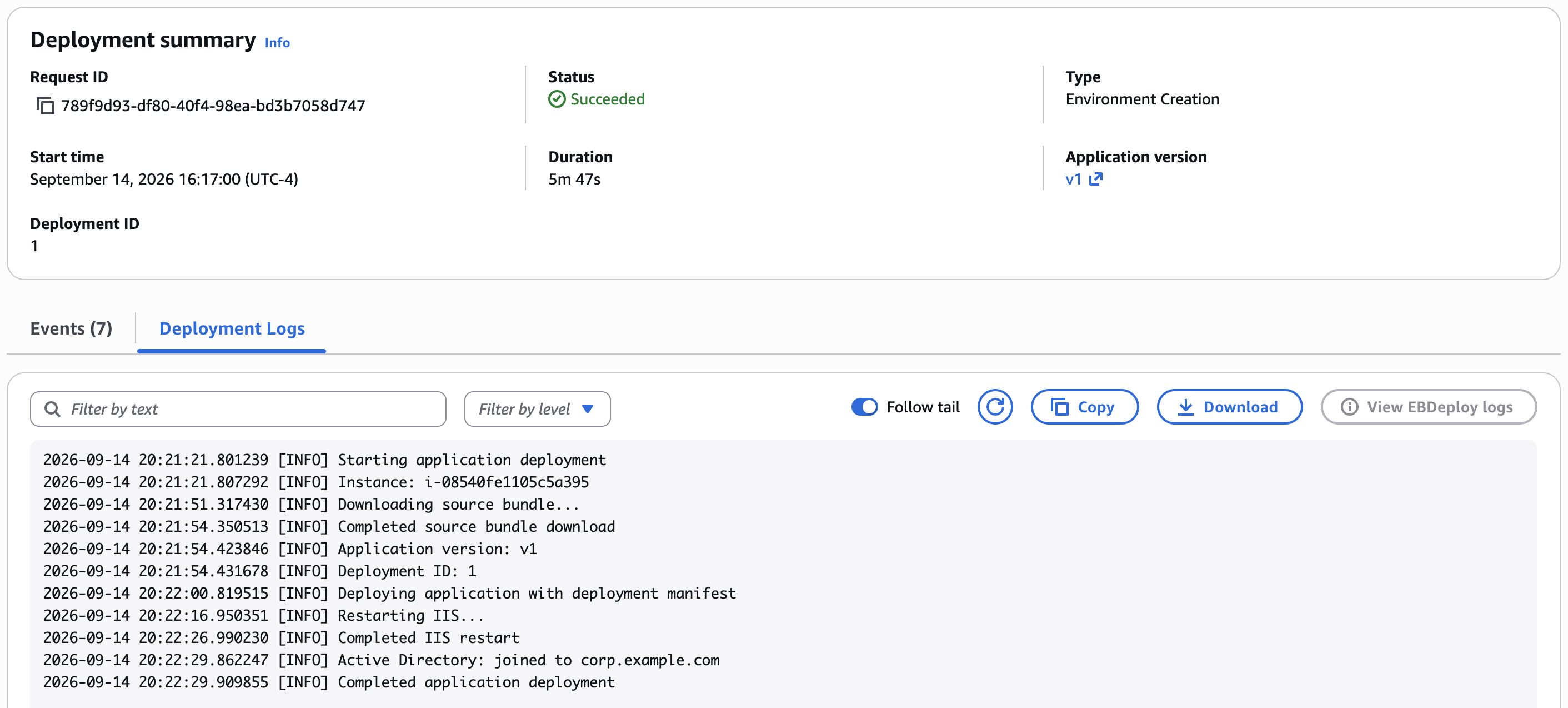
If an instance fails to join the domain, the environment remains in a "Ready" state, ensuring the application remains reachable. The system then populates the deployment logs with detailed diagnostic data, including the output of the failed join command. By offloading these logs to Amazon S3, AWS provides a centralized repository where engineers can troubleshoot issues without needing to establish RDP sessions into the failed instances. This visibility is essential for rapid incident response, particularly when scaling out to meet high traffic demands at off-peak hours.
Strategic Implications for Enterprise IT
The removal of custom join scripts has several far-reaching implications for organizations currently managing large-scale Windows deployments. First, it significantly reduces the "security surface area." By removing the need to store or rotate domain admin credentials within configuration files or secret managers, the risk of credential leakage is effectively eliminated. The use of IAM roles—which are ephemeral and scoped to the specific task of computer object creation—aligns with the "Principle of Least Privilege."

Second, this update enables greater architectural consistency. In many enterprises, different teams often manage different aspects of the infrastructure. By standardizing the join process within the Elastic Beanstalk configuration, organizations can enforce a "Policy as Code" approach. A central IT team can mandate that all environment templates include the Active Directory configuration, ensuring compliance with corporate security standards without relying on individual developers to remember to include join scripts in their application bundles.
Expert Analysis and Industry Context
Industry analysts suggest that this move by AWS is a direct response to the persistent demand for a "cloud-native" Windows experience. As enterprises continue to lift and shift complex legacy applications to the cloud, the friction caused by domain-dependent software has remained a primary barrier to adoption. By automating the most tedious aspects of this transition, AWS is effectively lowering the total cost of ownership for Windows-based workloads.
"For too long, the ‘last mile’ of Windows deployment in the cloud has been held up by the complexity of Active Directory," says an infrastructure architect familiar with the update. "By turning the join process into a simple configuration property, AWS is enabling developers to focus on the application layer rather than the underlying domain mechanics. It’s an essential maturation step for the platform."
Implementation and Best Practices
For organizations looking to adopt this feature, the process requires careful attention to networking prerequisites. As outlined in the technical requirements, the VPC DNS resolution must be correctly configured to point toward the directory’s DNS servers. This is often the most common point of failure for new implementations. Ensuring that the DHCP options set for the VPC is correctly aligned with the Directory Service is a mandatory prerequisite for successful domain discovery.
Furthermore, while the automation handles the creation of the computer object, it does not handle the long-term lifecycle of those objects. Just as with physical servers, the directory will eventually accumulate "stale" computer objects if instances are frequently replaced. Organizations should integrate periodic cleanup tasks—using standard Active Directory tools or custom scripts—to maintain a clean and efficient directory structure.
Conclusion
The integration of Active Directory support into Elastic Beanstalk represents a significant leap forward in simplifying the management of enterprise Windows environments on AWS. By replacing manual, error-prone scripts with a robust, platform-native service, AWS has addressed a long-standing operational bottleneck. This, combined with improved error reporting and a focus on maintaining application availability even in the event of a join failure, provides a reliable foundation for mission-critical Windows applications. As businesses continue to migrate and modernize, these automated infrastructure components will be crucial for maintaining both security and operational velocity.
Related posts: