Securing the Software Supply Chain: Implementing Zero-Trust Dependency Gates in AWS CodeBuild

The modern software development landscape is facing an unprecedented security crisis, characterized by a meteoric rise in supply chain attacks. As organizations increasingly rely on open-source libraries to accelerate development, the integrity of these dependencies has become the primary vector for sophisticated cyberattacks. According to research published by JFrog in 2026, the industry recorded a 451% year-over-year increase in malicious npm packages. This staggering statistic underscores a fundamental flaw in traditional CI/CD pipelines: the practice of downloading unverified code directly from public registries during the build process.
In the standard development lifecycle, developers frequently use package managers like pip or npm to fetch dependencies from public repositories. Under this model, there is no inherent verification process that ensures these packages are free from vulnerabilities or malicious intent. Consequently, a compromised package can be ingested into a container image, pushed to a registry, and deployed into a production environment long before security scanners identify the threat. By the time a vulnerability is surfaced via a Common Vulnerabilities and Exposures (CVE) alert, the software is already operational, necessitating a costly, reactive cycle of emergency patching, re-testing, and redeployment.
The Structural Vulnerability of Modern Build Pipelines
The root cause of this security gap is the lack of policy enforcement at the point of ingestion. When a build is initiated in environments like AWS CodeBuild, the process typically follows a "pull-everything" approach, trusting whatever manifest is defined in the project configuration. Security teams often rely on post-deployment scanning, which, while necessary, is fundamentally reactive.
This creates a "time-to-remediate" deficit. When a critical vulnerability is discovered in a transitive dependency—a dependency of a dependency—the development team must first identify which images are impacted, perform a root-cause analysis, and then restart the entire build and testing cycle. In a complex, high-velocity environment, this manual overhead can consume days of engineering effort, leaving the organization exposed to potential exploitation throughout the duration of the incident response.
To counter this, security architects are moving toward a zero-trust dependency model. This approach dictates that no package should enter the build environment without being evaluated against a set of predefined security policies. By implementing a gate at the moment of download, organizations can ensure that only compliant, safe code is integrated into their software artifacts.
Implementing the Curation Gate: A Technical Framework
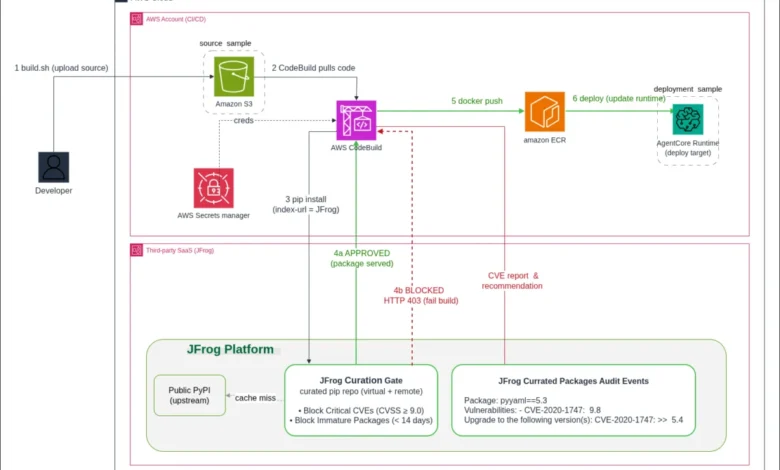
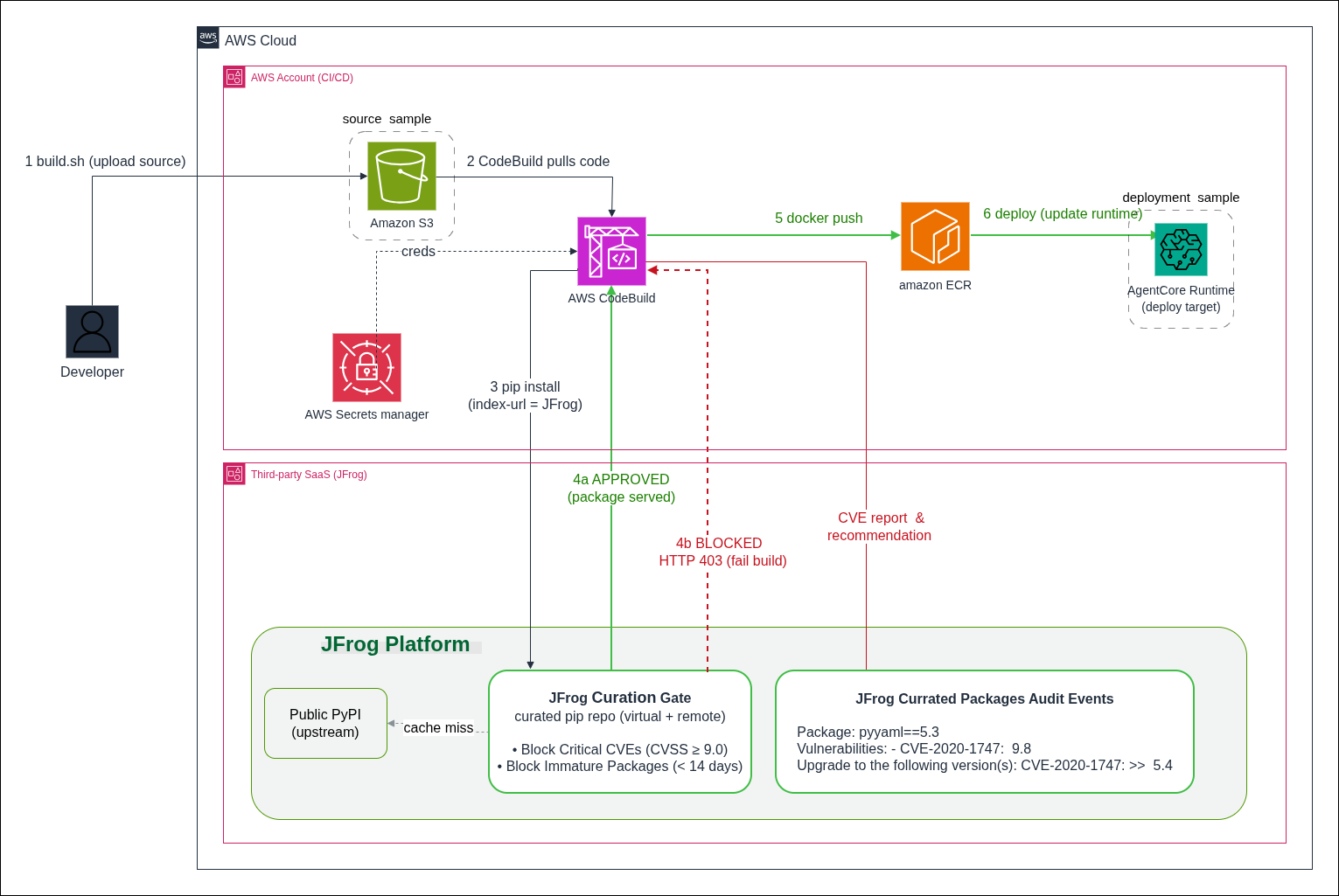
To operationalize this zero-trust model within AWS CodeBuild, organizations are integrating JFrog Curation. This tool functions as a gatekeeper that intercepts requests to public registries. When a developer triggers a build, the package manager is reconfigured to resolve dependencies through a JFrog Artifactory virtual repository. As packages are requested, Curation evaluates them against organizational policies in real time.
If a package meets the security threshold, it is served to the build environment. If it violates a policy—such as containing a critical CVE with a CVSS score of 9.0 or higher—Curation returns an HTTP 403 (Access Denied) error. This failure happens before the code is ever compiled into an artifact. Consequently, the build fails safely, preventing the creation of a vulnerable container image.
The implementation requires a structured approach to the CI/CD pipeline, consisting of three distinct phases: pre-build, build, and post-build.
In the pre-build phase, the focus is on environmental configuration. The pipeline installs the JFrog CLI and reconfigures the package manager (e.g., pip) to direct traffic through the Artifactory instance. This redirection is crucial; it abstracts the security gate away from the application code, ensuring that developers can maintain their existing workflows while the infrastructure handles the verification.
During the build phase, the Docker build process is executed. By passing the curated index URL as a build argument, the process ensures that all dependencies listed in the requirements.txt file are subjected to the Curation policy. This phase serves as the critical juncture where the security policy is enforced.
Finally, the post-build phase handles the logic of success or failure. If the build succeeds, the image is pushed to Amazon Elastic Container Registry (Amazon ECR). If the build fails due to a blocked package, the pipeline triggers a reporting script that queries the Curation audit API. This provides the developer with immediate, actionable feedback: identifying the specific package, the reason for the block, the CVE identifier, and recommended remediation steps or alternative, compliant versions.
Data-Driven Security and Industry Implications
The implications of this shift extend beyond simple risk mitigation; they represent a fundamental change in the economics of software maintenance. By shifting security left, companies significantly reduce the "re-work" tax associated with vulnerable deployments.
Industry analysis suggests that the cost of fixing a vulnerability during the build phase is an order of magnitude lower than fixing it after the software has been deployed to production. When an organization blocks a package at the gate, they save the time required for vulnerability triage, incident response meetings, and the emergency patching of production systems.
Furthermore, the integration of Curation and Software Composition Analysis (SCA) tools like JFrog Xray provides a layered defense. While Curation acts as the preventive gate for new imports, Xray provides continuous detection for existing artifacts. Together, these tools form a comprehensive governance framework that addresses both the "front door" (new packages) and the "warehouse" (already cached artifacts).
Strategic Adoption and Best Practices
For organizations looking to adopt this framework, the transition should be approached as an iterative process.
- Define Policies: Start with high-impact policies, such as blocking critical CVEs (CVSS 9.0+). Once the team is comfortable with the workflow, extend policies to include license compliance, malicious package detection, and warnings for lower-severity vulnerabilities.
- Standardize Infrastructure: Utilize Infrastructure as Code (IaC) to ensure that the JFrog Artifactory configuration is consistent across all development, staging, and production pipelines.
- Automate Feedback: Ensure that the failure messages provided by the CI/CD pipeline are human-readable. Providing developers with a clear path to resolution—such as recommending a secure version of a package—reduces friction and encourages adoption of the new security standards.
- Visibility: Use the audit logs generated by the Curation service to gain insights into the types of packages being requested and the common sources of risk within the organization. This data can inform future procurement and architecture decisions.
Conclusion
The rising tide of software supply chain attacks has rendered traditional, "trust-by-default" development models obsolete. The ability to intercept and evaluate dependencies at the point of download is no longer an optional luxury but a necessity for any organization operating at scale.
By integrating JFrog Curation into the AWS CodeBuild pipeline, teams can move from a state of constant, reactive patching to one of proactive, automated defense. This transition not only enhances the security posture of the organization but also empowers development teams to build faster with the confidence that their foundation is secure. As the industry continues to grapple with the complexities of open-source security, the implementation of automated, policy-driven gates will become a hallmark of mature, resilient DevOps practices. The goal is clear: to prevent the entry of risk, ensure the integrity of the artifact, and ultimately, protect the end-user.