Redefining Cloud Scalability: Unikraft CEO Felipe Huici Discusses Millisecond MicroVMs and the Future of Serverless Sandboxing

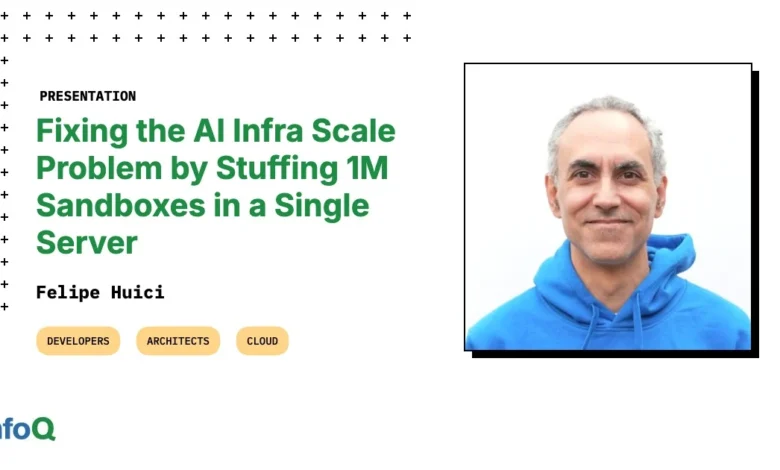
The landscape of cloud computing has long forced developers into a frustrating triage: choose blazing-fast execution speed, uncompromised workload isolation, or massive resource density, but rarely expect to harness all three simultaneously. Speaking at a recent technology conference in London, Felipe Huici, CEO and co-founder of Unikraft, presented a compelling case that this architectural compromise is no longer necessary. By fundamentally rethinking the marriage between unikernels, lightweight virtual machine monitors (VMMs), and intelligent snapshotting mechanisms, Huici and his team have demonstrated that modern cloud platforms can achieve cold-boot times in the low milliseconds while maintaining the gold standard of hardware-level isolation.
The Evolution of Isolation Primitives in Modern Infrastructure
To understand the magnitude of Unikraft’s engineering breakthroughs, one must first navigate what Huici colloquially terms "isolation soup"—the sprawling ecosystem of runtime environments, containers, microVMs, and traditional virtual machines that populate today’s data centers. For decades, traditional virtual machines have served as the foundational bedrock of multi-tenant cloud security. By interposing a hypervisor directly onto bare-metal hardware, virtual machines ensure that a compromise in one guest operating system remains strictly partitioned from neighboring workloads.
However, this robust security posture historically carried a severe operational penalty. Traditional hypervisors like QEMU were designed for general-purpose computing, resulting in bulky codebases, sluggish boot sequences, and massive memory footprints. When the container revolution arrived courtesy of Docker, it promised an alluring alternative: near-instantaneous startup times and hyper-efficient resource sharing by leveraging the host operating system’s kernel. Yet, containers famously fail to provide absolute isolation, exposing the underlying host kernel to potential exploits and forcing cloud providers to wrap them inside heavier virtual machines—as seen in Amazon Elastic Container Service (ECS)—to patch security vulnerabilities.
This tension between security and performance catalyzed a decade-long research trajectory for Huici, tracing back to his doctoral studies at University College London (UCL) and subsequent work on high-speed packet processing. Early academic milestones included the development of ClickOS, a specialized virtual machine designed for network function virtualization that proved software could route packets at tens of gigabytes per second while booting in mere milliseconds. Despite earning academic acclaim—including nearly 28,000 citations for a seminal white paper comparing lightweight VMs to containers—the approach remained constrained by the arduous process of handcrafting custom virtual machines for every unique application.
From Research Lab to Open-Source Industrialization
Recognizing that manual engineering was not a viable path for mainstream enterprise adoption, Huici and his collaborators turned toward automation and open-source collaboration. Supported by the Xen Project’s incubator network, the team applied for and successfully launched the Unikraft project under the auspices of the Linux Foundation. Over a seven-year development cycle, the project focused on creating an operating system toolkit capable of automatically compiling unmodified applications—packaged via standard Dockerfiles—into highly specialized, lean unikernels that maintain compatibility with Linux application programming interfaces (APIs).
The core philosophy guiding Unikraft’s recent deployment architecture centers around minimizing the trusted computing base (TCB). In a traditional containerized environment, the shared host kernel spans tens of millions of lines of code, massively expanding the attack surface accessible to every running application. By contrast, a minimalist virtual machine built on a secure VMM reduces the shared code layer exclusively to the hypervisor, drastically enhancing multi-tenant security without sacrificing execution efficiency.
Achieving End-to-End Millisecond Performance in the Cloud
When Unikraft initially attempted to deploy its optimized unikernels onto mainstream cloud infrastructure using standard deployment pipelines, the engineering team encountered a harsh reality check. While local testing yielded cold-boot times of roughly 10 milliseconds, provisioning an instance via standard cloud dashboard APIs stretched that delay to nearly 30 seconds. Huici noted that a cloud platform is not merely an isolated image; it is an intricate orchestration chain comprising load balancers, proxies, lifecycle controllers, and virtual machine monitors.
To solve this latency bottleneck, Unikraft re-engineered every component of the request-response lifecycle. The platform now utilizes lightweight proxies that intercept incoming traffic, instantly query a central controller, and wake sleeping virtual machines via high-performance VMMs like Firecracker before unbuffering the user request. Crucially, the system leverages a sophisticated snapshotting architecture to bypass the initialization overhead of complex application runtimes, such as the Java Virtual Machine or heavy web browsers, which can otherwise take seconds or minutes to boot.
By capturing an exact memory snapshot of a fully initialized application, Unikraft can store a pre-warmed state on fast NVMe storage tiers. When a request arrives, the virtual machine resumes directly from the snapshot in approximately 10 milliseconds, effectively masking all application-level initialization delays. Furthermore, this snapshotting capability underpins the platform’s advanced operational features, including stateful scale-to-zero capabilities, memory forking for sub-agents, instant checkpointing, and live workload migration across physical servers.
Unlocking Hyper-Density Through Scale-to-Zero Architecture
The economic implications of millisecond cold starts extend far beyond mere user experience, fundamentally transforming data center economics through aggressive server density optimization. In a typical cloud deployment, servers run a mixture of active workloads and idle services that consume memory and CPU cycles while performing no productive labor. By implementing an automated scale-to-zero paradigm, Unikraft allows idle instances to drop into a standby state where they consume zero CPU and negligible memory resources.
This capability enables cloud providers to pack thousands—and potentially millions—of virtual machines onto a single physical server by over-provisioning based on concurrent active users rather than peak static allocations. However, pushing server density to extremes revealed unexpected hardware and kernel constraints. At scales exceeding 10,000 scaled-to-zero instances per host, the Linux kernel struggled with the sheer volume of virtual network interfaces (TAP devices), leading to kernel lock contention, bridge port limitations, and service crashes in networking utilities like Tailscale and NTP.
To overcome these hurdles, the engineering team implemented extensive kernel tuning, transitioned internal component communications entirely to shared memory rather than network protocols, and designed a multi-tiered snapshot storage hierarchy utilizing compressed differential snapshots on fast NVMe arrays. Empirical benchmarks measuring 100,000 concurrent VMs demonstrated that cold-start latency remains remarkably flat at roughly 10 milliseconds, while memory utilization for a million dormant virtual machines scales linearly at mere kilobytes of metadata per instance.
Real-World Applications: Headless Browsers and AI Agent Sandboxes
The practical utility of millisecond-responsive, highly isolated microVMs is particularly acute in modern artificial intelligence deployments, specifically regarding the execution of autonomous AI agents and headless browsers. Headless browsers such as Chromium are notoriously resource-intensive, frequently consuming between 4 and 16 gigabytes of RAM and requiring up to a minute to initialize. Because AI agents rely heavily on these browsers to retrieve web data asynchronously, maintaining fleets of always-on instances imposes prohibitive infrastructure costs.
By applying unikernel principles to minimalist Linux distributions, Unikraft enables headless browsers and arbitrary AI agent workloads to sit in a dormant, scaled-to-zero state until an agent demands web interaction. The sandbox wakes in milliseconds, executes the scraping or processing task, and instantly returns to a low-power standby mode. This architecture provides the stringent isolation required to contain potentially erratic or malicious agent behavior without sacrificing responsiveness or breaking enterprise budgets.
To bridge the gap between cutting-edge performance and existing enterprise tooling, Unikraft also introduced native Kubernetes integration via a custom virtual kubelet. By conforming to standard pod scheduling APIs, the platform allows organizations to leverage Kubernetes for high availability, self-healing, and cluster management while quietly executing microVMs under the hood—tricking the orchestration layer into believing pods are continuously running while managing actual resource consumption through rapid sleep-and-wake cycles.
Implications and Future Outlook of High-Density Cloud Infrastructure
The advancements articulated by Huici signal a potential paradigm shift in how cloud-native architectures are conceptualized and deployed. For years, the industry accepted that achieving enterprise-grade multi-tenant security required abandoning the operational simplicity of containers or resigning to the sluggish performance of legacy virtualization stacks.
As enterprises increasingly deploy autonomous AI systems, serverless functions, and microservice architectures at scale, the demand for instant-on, heavily isolated execution environments will only accelerate. Unikraft’s demonstration that engineering rigor can successfully reconcile speed, scale, and security suggests that the historical trade-offs of cloud computing may finally be dissolving, paving the way for a new generation of hyper-dense, highly responsive cloud platforms.