Inside the Ledger: A Comprehensive On-Chain Audit of the Emerging x402 Micro-Economy

The rapid proliferation of decentralized application architectures and machine-to-machine payment protocols has sparked widespread industry commentary regarding the viability of the x402 micro-economy. To look past the high-level rhetoric and examine actual economic settlement data, a comprehensive network audit was conducted on September 9, 2026. By pulling the complete public registry of the largest x402 service directory—encompassing all 680 listed services, their granular metadata fields, and a retrospective 90-day change feed—researchers mapped out where decentralized micro-transactions are actually clearing, which blockchain rails dominate the landscape, and the underlying vulnerabilities facing autonomous digital agents.
An Overview of the x402 Ecosystem Registry
As of the September 2026 data pull, the primary x402 public directory tracks 680 distinct services operating at the intersection of automated APIs and decentralized finance. Operational status checks indicate a largely stable infrastructure: 582 services (86 percent) remain actively online, while 60 are offline and 38 show degraded performance metrics. Trust markers remain exceptionally rare, with only 13 out of the 680 services (2 percent) holding an official verification badge.
The functional composition of the directory highlights a heavy emphasis on developer infrastructure and data processing. Data APIs make up the largest sector with 283 services, followed by artificial intelligence tools (116), financial products (82), and verification services (76), with the remainder spread across a long tail of niche utilities.
Pricing models within the ecosystem have adopted a heavily quantized structure. Out of the surveyed offerings, 235 services charge precisely $0.01 per request, 192 operate free of charge, 50 charge $0.02, 48 set their fees at $0.05, and 31 charge $0.10. Consequently, the median measured settlement sits exactly at $0.01. This data confirms that the x402 standard, originally conceptualized to facilitate cent-scale transactions for autonomous software agents, has been embraced literally by market participants.
Comparative Analysis of Blockchain Settlement Rails
Services integrated into the directory formally declare their intended settlement networks within their standard /.well-known/x402 discovery configuration files. An analysis of these declarations reveals overwhelming initial preference for the Base network, with 647 services (95 percent) citing support. Solana follows as the second most declared rail with 236 services (35 percent), trailed by Polygon with 55 declarations and Arbitrum with 40.
However, declarations represent technical capability and intent rather than actual economic activity. When evaluated against verified on-chain settlements over a trailing 30-day window, a notably different operational picture emerges:
- Base: 169 services with recorded volume, generating $2,190 across 27,213 transactions, averaging roughly $0.08 per transaction.
- Solana: 49 services with recorded volume, generating $1,830 across 36,320 transactions, averaging roughly $0.05 per transaction.
- Polygon: 15 services with recorded volume, generating $1,115 across 1,540 transactions, averaging roughly $0.72 per transaction.
This data underscores three critical insights regarding current market dynamics. First, Solana captures 74 percent of all measured x402 transactions (36,320 out of 48,937 total recorded volume events). This high transaction count is achieved with fewer than a third of the active services seen on Base, pointing toward high-frequency, low-value agent interactions. Nevertheless, buyer concentration is pronounced; a single service, designated as sniperx-x402, accounts for 21,698 of Solana’s transactions, representing approximately 60 percent of the network’s total volume. The remaining transactions are distributed across multi-rail protocols and a long tail of Solana-native applications.
Second, Polygon stands out as the primary venue for higher-value micro-services. Although it hosts a fraction of the transaction count, its average transaction value of $0.72 is roughly nine to fourteen times higher than that of Base or Solana. The services operating on Polygon are handling significantly larger economic payloads.
Third, the absolute scale of the measured economy remains modest. Calculating unique services, the total measured 30-day volume hovers around $2,624, translating to an average of approximately $87 per daily settlement across the entire ecosystem. (While aggregate figures by rail sum to roughly $5,100, this overlap is driven by 86 multi-rail services settling across multiple chains simultaneously). Furthermore, out of 361 measurable services, only 172 recorded at least one on-chain settlement over the 30-day period. The remaining 189 services feature confirmed payment addresses but yielded zero measured traffic, indicating dormant or newly deployed endpoints. Notably, Arbitrum—despite receiving 40 declarations—recorded zero verified on-chain settlements during the observation window.
The Challenge of Address Drift and Network Visibility
A significant finding from the audit involves the structural limitations of directory monitoring. Approximately 45 percent of the listed services (307 out of 680) operate on blockchain rails that fall outside the directory’s current measurement capabilities. This includes 63 percent of all services declaring Solana support (148 out of 236). Consequently, the bulk of the network driving the highest transaction volume operates with reduced direct visibility from aggregators.
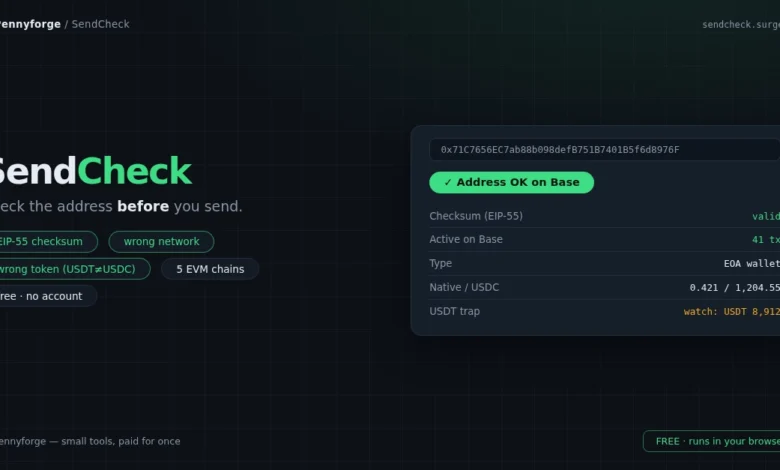
This lack of comprehensive monitoring exacerbates the ecosystem’s most persistent trust failure: x402 address drift, wherein a service modifies its payout destination without prior notice. On EVM-compatible networks like Base, addresses utilize EIP-55 checksum validation, ensuring that a single typographical error causes validating tools to automatically reject the transaction. In contrast, Solana relies on raw base58 encoding without a built-in checksum mechanism. An erroneous character in a Solana payout address can result in a string that appears syntactically valid while permanently misrouting funds.
Operational centralization further compounds this risk. Network analysis reveals that 126 services (19 percent) share their payout destination with other listings in the directory. The largest identified cluster involves a single wallet receiving funds for 45 distinct market-data and crypto-risk feeds. While this setup streamlines administrative accounting, it dramatically widens the blast radius of operational errors. A single unauthorized or unintended address rotation by the controller of a shared wallet instantly breaks dozens of dependent integrations simultaneously, highlighting the necessity for continuous programmatic monitoring of payment metadata rather than static website trust.
Buyer Concentration and Economic Sustainability
An evaluation of transaction originators reveals a heavy reliance on a narrow base of consumers. Among the 172 services exhibiting measured 30-day volume, 107 services (62 percent) rely on a single dominant buyer for 80 percent or more of their total revenue.
While proponents of machine-to-machine economies frequently forecast an expansive future characterized by millions of decentralized software agents engaging in continuous micro-transactions, the current economic reality is more concentrated. Today’s volume is largely sustained by a limited number of specialized agent fleets, automated scrapers, and algorithmic marketplaces. For service operators, maintaining robust connectivity with these key buyers is essential, as the loss of a single primary customer can render an endpoint economically unviable.
Implications for Protocol Architects and Developers
The empirical findings from the September 2026 audit offer vital lessons for engineers and entrepreneurs building within the x402 framework:
- Validate Infrastructure Beyond Declarations: Developers integrating automated payment routing must implement runtime verification checks to confirm that discovery documents match active on-chain settlement behavior, guarding against dormant endpoints and unverified rail declarations.
- Account for Address Drift Risks: Automated systems must incorporate real-time monitoring feeds to detect sudden shifts in payout destinations, particularly on non-checksummed rails like Solana, where malformed addresses can lead to irreversible capital loss.
- Prepare for Asymmetric Buyer Distribution: Applications designed for autonomous machine consumption should anticipate high customer concentration, ensuring that pricing models and capacity planning can withstand sudden shifts in fleet-level demand.
As the x402 ecosystem continues to mature past its initial experimental phase, bridging the gap between registry declarations and verifiable on-chain transparency will remain a central priority for developers seeking to build robust, fault-tolerant infrastructure for the automated web.