Why Your Website Should Never Stop Changing and How Autonomous Agents Are Redefining Digital Longevity

The lifecycle of a modern website typically follows a predictable, downward trajectory: a high-effort, high-fidelity launch followed by a slow, inevitable descent into digital obsolescence. For years, the industry standard has accepted this "day-one peak" as an unavoidable consequence of resource constraints. However, as the digital landscape accelerates, the gap between a site’s initial deployment and its actual relevance has widened significantly. New research and development from platforms like Fimo suggest that the future of web management lies not in human-led maintenance, but in autonomous, agentic systems capable of continuous optimization.
The fundamental problem remains that websites are living documents in a shifting marketplace. When a company updates its design language, pivots its messaging, or faces a new competitor, a static website becomes a liability. Industry analysts note that within 18 months of launch, the average business website experiences "design decay"—a phenomenon where the technical architecture remains functional, but the user experience and brand alignment have eroded. This decay is not caused by code failure, but by the accumulation of small, unaddressed discrepancies: uncompressed images, broken links, outdated meta-tags, and accessibility regressions that teams are too busy to remediate.
The Evolution of Web Maintenance: From Static to Agentic
Historically, web maintenance has been a manual process governed by ticket-based workflows. Development teams and designers prioritize feature launches over the granular, repetitive tasks required to keep a site "fresh." This creates a bottleneck. If a design system token changes, updating it across a large-scale enterprise site can take days of manual labor.
The introduction of autonomous agents—software entities capable of executing tasks within defined parameters—marks a pivot point in this timeline. By delegating the "eighty percent" of web maintenance—rule-bound, repetitive chores—to automated systems, organizations can theoretically maintain a site that improves every day.
For instance, an autonomous agent can monitor a site for accessibility compliance, ensuring that new content meets WCAG standards without manual oversight. If a design system update is pushed, the agent can propagate those changes across the site, fixing broken references and optimizing assets in the background. The goal is a "living" website that remains at its peak performance long after the initial launch team has moved on to new projects.
The Psychology of Autonomy: The "Line of Judgment"
Despite the technical feasibility of full autonomy, early adoption has been hindered by a deep-seated human resistance to ceding control. Pierre Burgy, lead architect behind the Fimo autonomous platform, emphasizes that the primary obstacle is not technical, but psychological. Users are hesitant to grant agents total agency because they perceive their website as a complex expression of brand identity that requires human "taste."
This resistance stems from a failure to distinguish between chores and judgment. Analysis of current web management workflows reveals that the vast majority of daily tasks—fixing broken links, updating CSS tokens, and ensuring mobile responsiveness—do not require human intuition. They require strict adherence to rules.
However, the "line of judgment" is subjective. For a graphic designer, a theme default (such as forcing dark mode) may be a critical brand statement that must remain under human control. For a backend engineer, the same setting may be a functional toggle that is ripe for automation. This realization has forced developers to abandon the "all-or-nothing" approach to autonomy in favor of granular, per-task control.
Building the Agent: A New Paradigm of Control
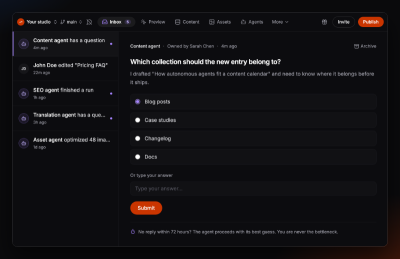
The transition from a "set it and forget it" model to a collaborative agentic model is changing how web platforms are built. In this new paradigm, users do not simply toggle "on" or "off" for autonomy. Instead, they act as architects of the agents themselves. By composing agents with specific permissions, a business can empower an accessibility agent to make autonomous corrections while keeping a content agent restricted to a "drafting and review" capacity.
This approach acknowledges that trust is earned over time. A common implementation timeline for these systems involves:
- The Observation Phase: Agents operate in "read-only" mode, logging recommended changes without executing them. This allows stakeholders to verify the agent’s logic against their own internal standards.
- The Restricted Execution Phase: Agents are given permission to modify low-risk elements, such as image compression or metadata updates, while continuing to report on more sensitive changes.
- The Collaborative Phase: As trust grows, the agent is granted broader authority, with human intervention required only for complex, high-judgment tasks.
This model shifts the role of the developer and the designer. Instead of being the hands-on maintainers of a site, they become the "policy setters" who define the boundaries within which the agents operate.
Broader Implications for the Digital Economy
The move toward autonomous websites has significant implications for the broader digital economy. As companies struggle to keep pace with rapid shifts in consumer behavior, the "frozen site"—a site that remains static for months or years—is becoming a significant business risk. A stagnant website often suffers from lower search engine rankings, higher bounce rates, and a diminishing brand reputation.
Economic data suggests that firms that invest in automated maintenance cycles experience a 15% to 20% increase in long-term site performance metrics. Furthermore, by automating the "eighty percent" of maintenance, organizations can redirect human capital toward high-value creative tasks, such as A/B testing user experience journeys, creating high-impact brand content, and developing complex new functionalities.
However, the shift toward agentic systems is not without its risks. The potential for "agent drift"—where an autonomous system makes a series of small, technically correct but contextually incorrect decisions—remains a concern for brand managers. This reinforces the necessity of transparency and auditability in autonomous systems. Any platform providing this service must offer a clear, chronological log of every change made, allowing human supervisors to revert actions or override decisions with ease.
Conclusion: The Future of Web Longevity
The industry is moving toward a future where the distinction between "launching" a website and "maintaining" a website becomes increasingly blurred. If the goal of the internet is to provide a repository of accurate, accessible, and high-performance information, then the reliance on manual human intervention to combat digital decay is unsustainable.
The future of the web will likely be defined by a hybrid model: humans providing the "taste" and the high-level strategy, and autonomous agents providing the consistency and the "always-on" optimization. By moving the line of autonomy to the place where it best fits the individual’s role, teams can finally move past the era of the "decaying" website. In this new landscape, the day a site launches is no longer its best day—it is merely the first day of its continuous improvement. As these tools mature, the standard for what constitutes a "professional" website will rise, leaving behind those who cling to the manual, periodic maintenance cycles of the past.