React Native 0.83 Officially Released with React 19.2, Major DevTools Upgrades, and Zero Breaking Changes

The React Native core team has officially announced the launch of React Native 0.83, marking a significant milestone in the framework’s development lifecycle. This latest release delivers a powerful suite of upgrades, headlined by integration with React 19.2, substantial performance monitoring tools, expanded web API compatibility, and a dedicated desktop application for developers. Notably, version 0.83 achieves a major engineering milestone by introducing zero user-facing breaking changes, allowing teams to upgrade existing codebases seamlessly without mandatory refactoring.
The rollout follows a rigorous beta and canary testing cycle, reinforcing the core team’s ongoing commitment to developer experience, performance optimization, and backward compatibility. With over 594 commits contributed by 56 developers globally, version 0.83 establishes a robust foundation for enterprise-scale mobile applications built on cross-platform JavaScript architecture.
Core Integration of React 19.2 and State-Preserving UI Controls
At the heart of React Native 0.83 is the integration of React 19.2, bringing cutting-edge rendering and state management primitives to mobile environments. The release introduces two flagship React features: the <Activity> component and the useEffectEvent hook.

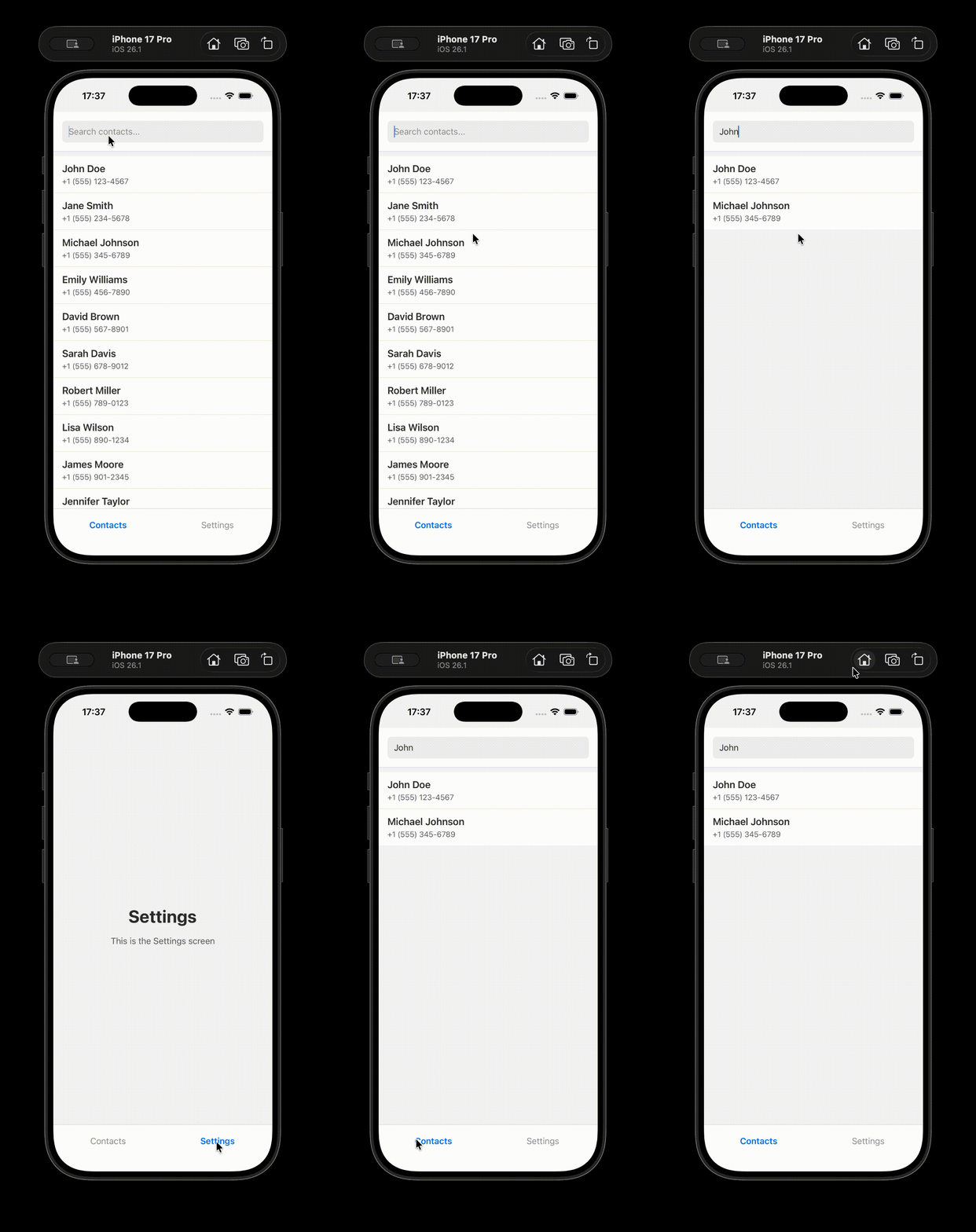
The <Activity> component offers an innovative alternative to traditional conditional rendering. Rather than unmounting UI trees when they are hidden—which typically destroys local component state—developers can wrap sections of their app in <Activity mode='hidden'>. This mode preserves the internal state, search histories, and user scroll positions while the component is out of view, ensuring that when the activity switches back to 'visible', the UI restores instantly without reloading or refactoring state logic.
Concurrently, the introduction of useEffectEvent addresses a long-standing challenge with the useEffect hook. Previously, developers often had to suppress ESLint warnings or include rapidly changing variables inside dependency arrays, inadvertently triggering unwanted re-renders. useEffectEvent allows developers to isolate non-reactive logic and event handlers from the surrounding effect code, ensuring cleaner codebases, improved linting compliance, and reduced execution overhead.
Security Context and Monorepo Dependency Management
The dependency on React 19.2 also brings important security considerations to light. Concurrent with the release, maintainers addressed community questions regarding recent critical security vulnerabilities discovered in React Server Components. The core team has explicitly clarified that React Native is not directly impacted by these vulnerabilities, as mobile applications do not rely on the vulnerable server-side packages.
However, organizations utilizing React Native within complex monorepo architectures are strongly advised to audit their workspaces for lingering vulnerable packages. The React Native team has confirmed that a subsequent patch release will upgrade all default React dependencies to version 19.2.1 to ensure optimal security posture across all integrated tooling.
Revolutionizing Mobile Debugging with React Native DevTools
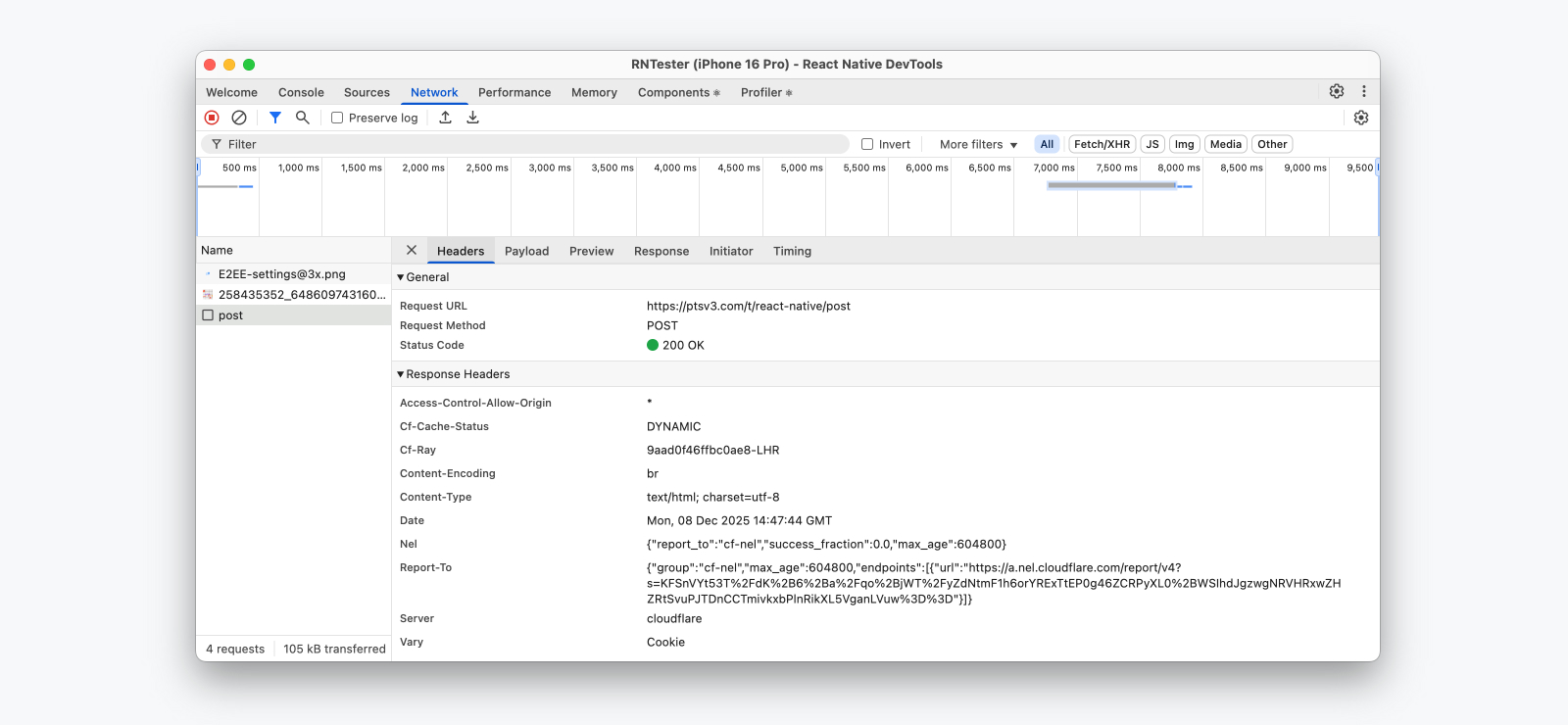
One of the most praised aspects of the 0.83 release is the comprehensive overhaul of React Native DevTools. Historically reliant on external browser instances such as Google Chrome or Microsoft Edge, DevTools now ships as a dedicated, bundled desktop application. This native desktop experience reduces configuration friction, improves responsiveness, and introduces native OS integration, including macOS Dock support.
Embedded within the new DevTools environment are two revolutionary features: advanced Network Inspection and Performance Tracing. The Network panel now captures all core HTTP traffic originating from fetch(), XMLHttpRequest, and <Image> elements. Developers can examine granular metadata, response previews, headers, and timings. Crucially, the newly added Initiator tab enables engineers to trace network calls directly back to the exact line of JavaScript source code that triggered them.
Complementing network analysis, the Performance Tracing suite provides a unified timeline visualizer. This tool correlates JavaScript thread execution, React rendering performance metrics, network activity, and custom User Timings (leveraging the standard Performance API). By offering a holistic view of runtime bottlenecks, the tools empower engineers to diagnose frame drops and lag spikes with unprecedented precision.
Expansion of Web APIs and Experimental Architecture Optimizations
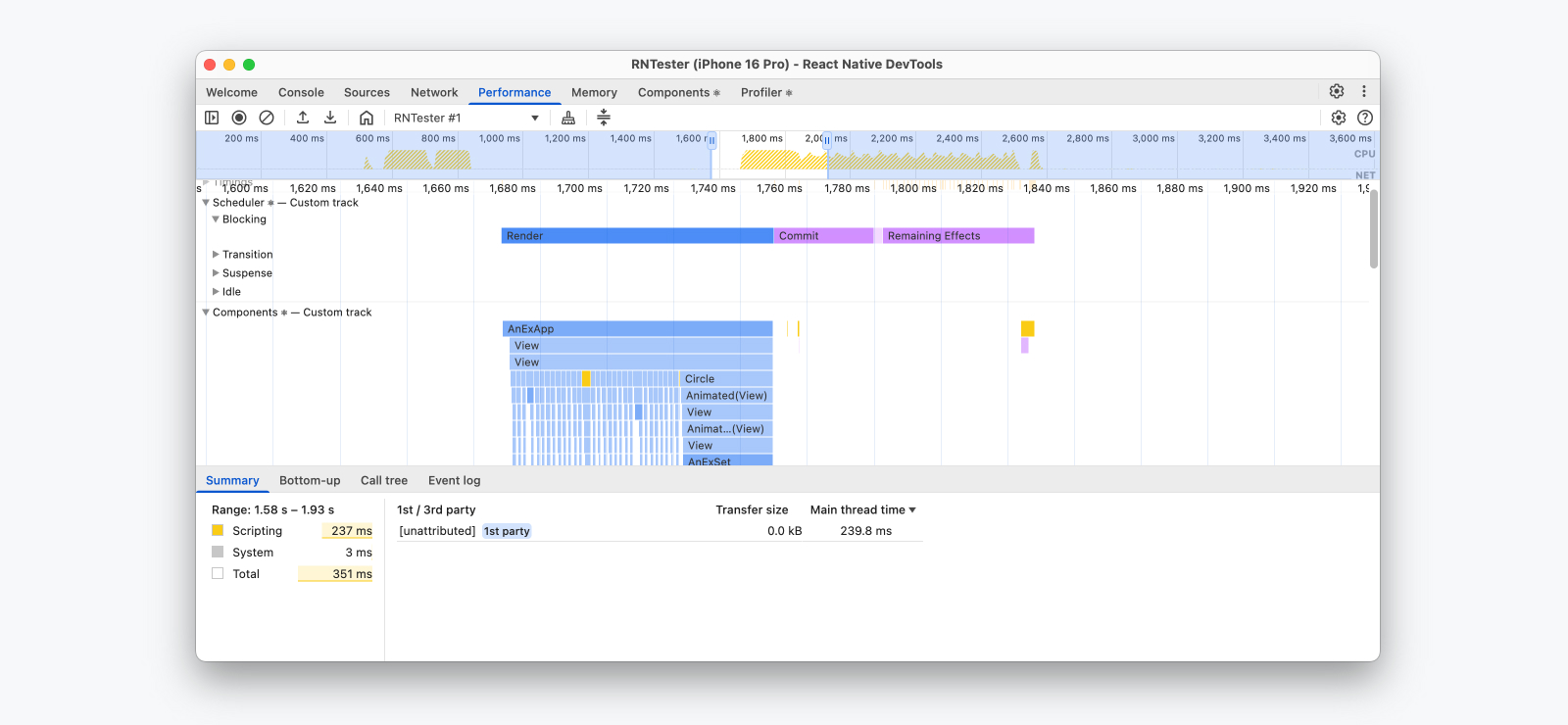
React Native 0.83 continues the ecosystem’s strategic convergence with standard Web APIs. Building upon the Performance API introduced in version 0.82, version 0.83 promotes Web Performance APIs to stable status. Features like PerformanceObserver are now fully functional in production builds, giving engineering teams reliable telemetry for capturing real-world user metrics in live applications.
Furthermore, the canary release channel of 0.83 introduces preliminary support for the IntersectionObserver API. This allows developers to monitor layout intersections between targeted elements and their ancestors asynchronously—greatly simplifying infinite-scrolling lists, lazy-loading images, and visibility-based animations.
On the compilation and engine front, version 0.83 deepens experimental support for Hermes V1. Featuring advanced compiler optimizations and virtual machine enhancements, Hermes V1 promises significant reductions in startup time and memory consumption, though adventurous developers must still build from source to evaluate its capabilities.
For iOS developers transitioning entirely to the New Architecture, version 0.83 introduces an experimental compilation flag, RCT_REMOVE_LEGACY_ARCH=1. When invoked during CocoaPods installation, this flag strips out legacy compatibility codebases. Internal benchmarks conducted by the React Native team on clean templates demonstrated meaningful improvements: build times dropped from 73.0 seconds to 58.2 seconds, while total binary size decreased from 51.2 MB to 48.2 MB.
Ecosystem Stability and Upgrading to Version 0.83

By achieving a release entirely free of user-facing breaking changes, the core team has demonstrated a maturation in versioning discipline. Codebases operating on React Native 0.82 can transition to 0.83 with minimal migration friction.
For project initialization, developers can spin up new instances using the updated command line interface:
npx @react-native-community/cli@latest init MyProject --version latest
Meanwhile, existing projects can utilize the official React Native Upgrade Helper to evaluate delta patches. For the broader mobile development ecosystem, framework integrations are already underway; notably, Expo has announced that React Native 0.83 will serve as the underlying foundation for Expo SDK 55, slated for release in January 2026. As version 0.83 assumes the mantle of the latest stable release, version 0.80.x has officially transitioned to end-of-life status, underscoring the rapid, yet stable, cadence of modern mobile development.