Linux 7.4 Merge Window Shatters Historical Records with Unprecedented Development Activity


The Linux kernel development cycle has reached a historic milestone, with the release of the 7.4 merge window resulting in an unprecedented surge of code contributions. Despite initial concerns regarding the timing of the release, which coincided with Linus Torvalds’ annual family vacation, the project successfully adhered to its traditional two-week schedule. By the time the merge window closed, the Linux kernel had absorbed nearly 20,000 commits, setting a new benchmark for project velocity and highlighting the evolving nature of open-source contribution patterns in the era of artificial intelligence.
A Chronology of the Merge Window
The process began roughly two weeks ago when Linus Torvalds opened the merge window for Linux 7.4. Recognizing that his personal travel schedule might create potential friction, Torvalds warned the kernel development community that the merge window might require an additional week to process the expected influx of patches. However, the robustness of the Linux development model proved its resilience. Despite his physical absence and the inherent complications of remote coordination, Torvalds successfully finalized the first Release Candidate (RC1) on the standard two-week timeline, ensuring that the release cadence remained consistent with historical patterns.

The volume of activity during this period was, by all accounts, anomalous. While a standard merge window typically manages between 14,000 and 15,000 commits, Linux 7.4 eclipsed these figures significantly. The resulting shortlog—a condensed summary of changes—spanned an exhaustive 24,000 lines, serving as a testament to the massive scale of integration efforts undertaken by maintainers and contributors worldwide.
Quantitative Analysis of Kernel Growth
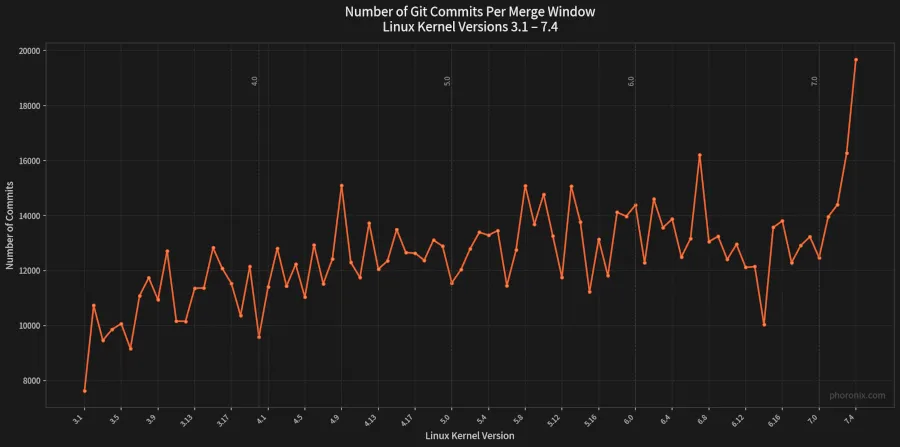
The scale of the 7.4 update is best understood through comparative historical data. According to analysis conducted by Phoronix, which tracked every merge window since the release of Linux 3.1 in 2011, the 7.4 cycle is objectively the largest in the history of the project. With 19,671 commits logged, it surpassed the previous record-holder, Linux 7.3, which processed 16,267 commits.
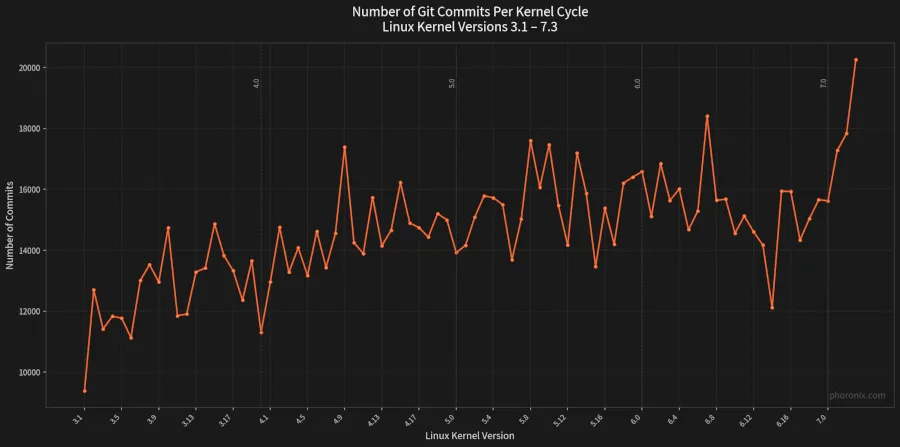
This trend is not an isolated event but rather the continuation of a sustained growth pattern. Every merge window following the release of Linux 7.0 has consistently topped its predecessor. The jump between 7.3 and 7.4 alone represents an increase of more than 3,400 commits. Furthermore, when examining entire development cycles, the total volume of code management has reached staggering heights. Linux 7.3 was the first cycle to break the 20,000-commit barrier in aggregate, and 7.4 is currently pacing to either match or exceed that threshold once all supplemental fixes and late-stage contributions are accounted for.

The physical size of the source tree has grown in tandem with this activity. Prior to the release of RC1 on November 1, the repository size was measured at approximately 41.6 million lines of code. This is a notable increase from the 41 million lines recorded during the 7.3 release. It is important to note, however, that these metrics include blank lines, documentation, and comments; the actual functional source code constitutes roughly 455,000 lines of this total volume, reflecting the complexity of modern hardware support and system architecture.
The Influence of Artificial Intelligence
One of the most significant takeaways from the 7.4 merge window is the evolving role of AI-assisted development. Linus Torvalds has explicitly identified the surge in AI-generated or AI-assisted patches as a primary driver of this increased volume. These tools are being utilized by contributors to identify bugs, suggest refactoring strategies, and draft patches for complex hardware drivers.
Torvalds has expressed a pragmatic view regarding this influx. While many AI-generated patches require human intervention or significant rewriting before they are considered stable enough for the mainline kernel, he prefers that this work be integrated early in the merge window rather than as reactive fixes during the later Release Candidate stages. The hope among senior maintainers is that as AI tools become more sophisticated, these contributions will transition from being "experimental" to becoming a standard, high-quality component of the kernel development workflow.
Drivers and Technical Composition
The content of the 7.4 update is as diverse as it is voluminous. A significant portion of the patch—nearly one-third—consists of AMD GPU header files. These files contain essential register definitions required for hardware operation. While Torvalds has advised the broader community to focus on other areas of the code, noting that these headers are largely structural, their inclusion underscores the immense effort required to maintain hardware compatibility in a rapidly evolving market.
When combined with other driver updates, hardware-specific code accounts for approximately two-thirds of the total patch set. The remaining third is distributed across the core pillars of the Linux kernel, including:
- Networking Stack: Improvements to protocol handling and throughput efficiency.
- Rust for Linux: Continued integration and hardening of the Rust language subset within the kernel.
- BPF (Berkeley Packet Filter): Enhancements to observability and security tracing capabilities.
- Memory Management: Optimization of page handling and virtual memory subsystems.
- Filesystems: Performance improvements and bug fixes for core storage drivers.
- Tooling: Updates to utilities like
perfandselfteststhat ensure system stability and performance profiling.
Strategic Implications: The LTS Factor
Beyond the technical contributions, market pressures also influence the scale of kernel releases. It is widely expected that Linux 7.4 will serve as the next Long-Term Support (LTS) release. This designation is highly significant for the enterprise ecosystem, as it guarantees extended maintenance and security support from the kernel maintainers.
The anticipation of an LTS release often motivates vendors and hardware manufacturers to push their code into the mainline earlier to ensure it receives long-term backing. This creates a "bottleneck effect" where stakeholders prioritize stability and feature completion, resulting in larger, more comprehensive merge windows. The combination of AI-accelerated patch development and the strategic importance of the 7.4 LTS designation has created a perfect storm for the record-breaking activity observed over the past two weeks.
Broader Industry Impact
The scale of the 7.4 merge window suggests that the Linux kernel project is successfully navigating a period of unprecedented expansion. The ability to process nearly 20,000 commits in a fortnight without compromising the integrity of the release candidate is a testament to the effectiveness of the maintainer hierarchy and the distributed nature of the Linux project.
For the wider software industry, this event serves as a bellwether for the future of large-scale collaborative software development. As AI tools continue to permeate the engineering lifecycle, the ability for human maintainers to manage, review, and integrate automated contributions will be the deciding factor in project scalability. The Linux kernel, by maintaining its rigorous standards while adapting to new methodologies, continues to demonstrate that it remains the most stable and critical piece of software infrastructure in the global economy.

As the kernel team moves into the testing phase for 7.4, the community remains focused on stability. The sheer volume of code introduced during the merge window necessitates a vigilant testing period, with a focus on ensuring that the AI-assisted patches and the massive influx of AMD header updates do not introduce regressions in existing system architectures. For now, the successful navigation of this record-breaking merge window stands as a landmark achievement in the project’s history, signaling a robust and ambitious path forward for the Linux operating system.