AWS Announces General Availability of Continuum for Code Vulnerabilities to Streamline Threat Remediation and AI-Driven Patching

The landscape of cybersecurity is undergoing a radical and relentless transformation, driven largely by the proliferation of frontier artificial intelligence models that have drastically shortened the window between vulnerability disclosure and weaponized exploitation. In this climate of escalating cyber threats, Amazon Web Services (AWS) has officially announced the general availability of AWS Continuum for code vulnerabilities. This advanced security service is engineered to fundamentally change how enterprise organizations detect, validate, prioritize, and remediate application security flaws. By bridging the critical gap between raw vulnerability telemetry and actionable engineering tasks, AWS Continuum addresses one of the most persistent bottlenecks in modern software development: the overwhelming volume of scanner alerts and the painstaking manual effort required to verify and fix them.
Background and Context of the Evolving Threat Landscape
For years, security teams managing expansive application estates have been inundated with an astronomical volume of alerts generated by traditional security scanners. It is not uncommon for large enterprises to process thousands of vulnerability findings daily. However, a significant portion of these alerts represents phantom risks—vulnerabilities that may be unreachable over a network, unexploitable within a specific architectural context, or already effectively neutralized by existing runtime controls.
Compounding this operational fatigue is the rapid evolution of threat actor capabilities. Leveraging sophisticated AI models, malicious actors can now analyze newly published vulnerability disclosures and synthesize functional, weaponized exploit code in a matter of minutes. This asymmetry creates an immense pressure cooker for development and security operations teams. Traditional severity scoring frameworks, such as the Common Vulnerability Scoring System (CVSS), often fail to provide nuanced context. A critical vulnerability residing on an isolated, development-only utility script is frequently assigned the same generic severity score as a medium-risk flaw situated merely one architectural step away from a core financial database or customer authentication pipeline.
Historically, confirming whether a reported vulnerability presented a genuine, exploitable path to sensitive assets required hours, if not days, of meticulous manual investigation by senior security engineers. Once confirmed, shipping a secure, reliable fix demanded extensive cross-functional coordination between security personnel, infrastructure teams, and application developers. Because assessing the blast radius of a code modification without deep business context is fraught with peril, remediation cycles routinely spanned days or weeks. AWS Continuum was developed specifically to eradicate this friction by automating the heavy lifting of proof, prioritization, and patch generation.
The Architecture and Mechanics of AWS Continuum
At its technical core, AWS Continuum operates by synthesizing deep contextual intelligence from two primary operational domains: internal code repositories and live cloud environments. To establish this comprehensive visibility, organizations deploy an AWS Continuum collector within the specific AWS accounts and regions where their workloads execute. This collector continuously harvests vital resource details, leveraging services like AWS Config alongside intricate network configuration parameters.

By ingesting this telemetry, Continuum constructs a sophisticated, dynamic context graph. This graph maps out inter-service dependencies, identifies data ownership, traces network reachability, and categorizes the data sensitivity of every component within the application estate. Consequently, the service develops a granular understanding of which systems represent high-value enterprise assets—such as customer data repositories, high-throughput payment processing pipelines, and centralized identity providers. When a vulnerability is discovered, Continuum ranks the issue not merely by a static metric, but by evaluating how closely its potential attack path intersects with these crown-jewel systems.
Furthermore, Continuum subjects each finding to rigorous automated verification. Rather than relying solely on abstract signatures, the service evaluates the vulnerable code path through advanced static analysis and, when feasible, executes reproducible exploits within an isolated, secure sandbox environment. For verified issues, Continuum generates comprehensive proof-of-concept documentation detailing the exact reproduction steps, the complete attack path, supporting source code analysis, and a definitive assessment of the potential blast radius. It also cross-references the finding against existing runtime defenses to determine whether current infrastructural controls would successfully intercept the validated attack vector.
Streamlined Remediation and Human-in-the-Loop Governance
One of the most distinguishing features of AWS Continuum is its ability to transition seamlessly from vulnerability detection to active remediation. For every confirmed issue, the service formulates a targeted fix—whether that entails a precise code patch, a dependency version upgrade, or an infrastructure configuration adjustment. Continuum then opens this remediation directly within the connected code repository as a structured pull request.
Crucially, AWS has engineered Continuum with a strict human-in-the-loop governance model. The generation and delivery of a patch do not equate to automatic deployment; the final decision and ultimate authority remain firmly in the hands of engineering and security teams. Developers review the proposed pull request, which includes the complete risk assessment, remediation summary, and underlying proof data directly within their native Git workflow.
Looking forward, AWS has outlined plans to introduce configurable autonomy features. As organizations build historical trust and confidence in specific classes of remediation, they will be empowered to define operational guardrails—such as mandatory test coverage thresholds, strict scope bounds, and historical success rates—allowing Continuum to apply certain categories of verified patches automatically.
Operational Deployment and Workflow Integration
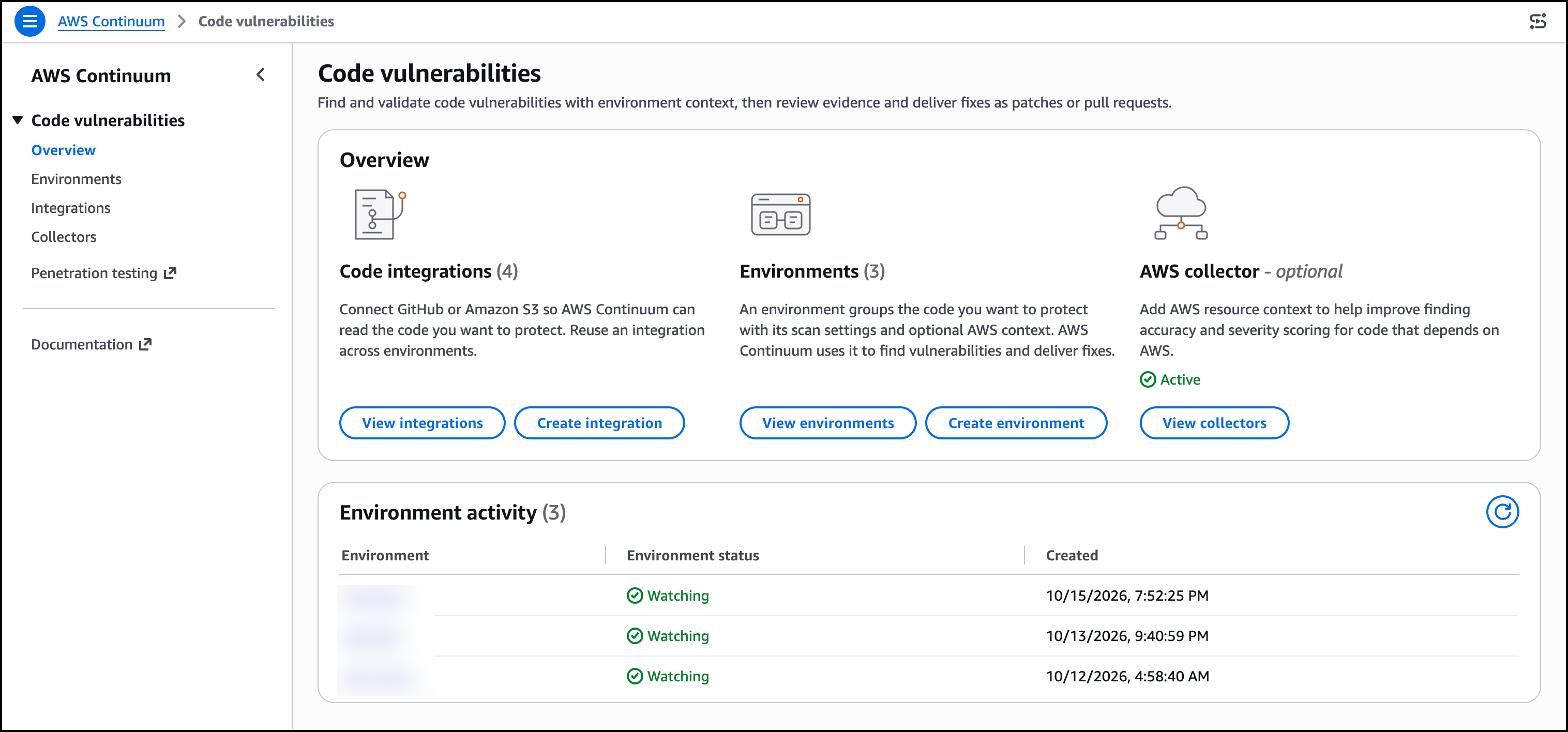
The deployment of AWS Continuum for code vulnerabilities has been designed for seamless integration into existing developer workflows. Administrators begin by accessing the AWS Continuum console and navigating to the dedicated code vulnerabilities management interface. The onboarding process requires establishing an environment by connecting a designated code source, which can be accomplished via native GitHub integration or through an Amazon S3 bucket configured as a repository source.
When utilizing Amazon S3 as a code repository, standard prerequisites dictate that the storage bucket must reside within the identical AWS account and region where AWS Continuum is enabled, with access securely provisioned via an AWS Identity and Access Management (IAM) role assumed by the service. Administrators can subsequently deploy the AWS Continuum collector to inject real-time infrastructure context into the analysis engine.
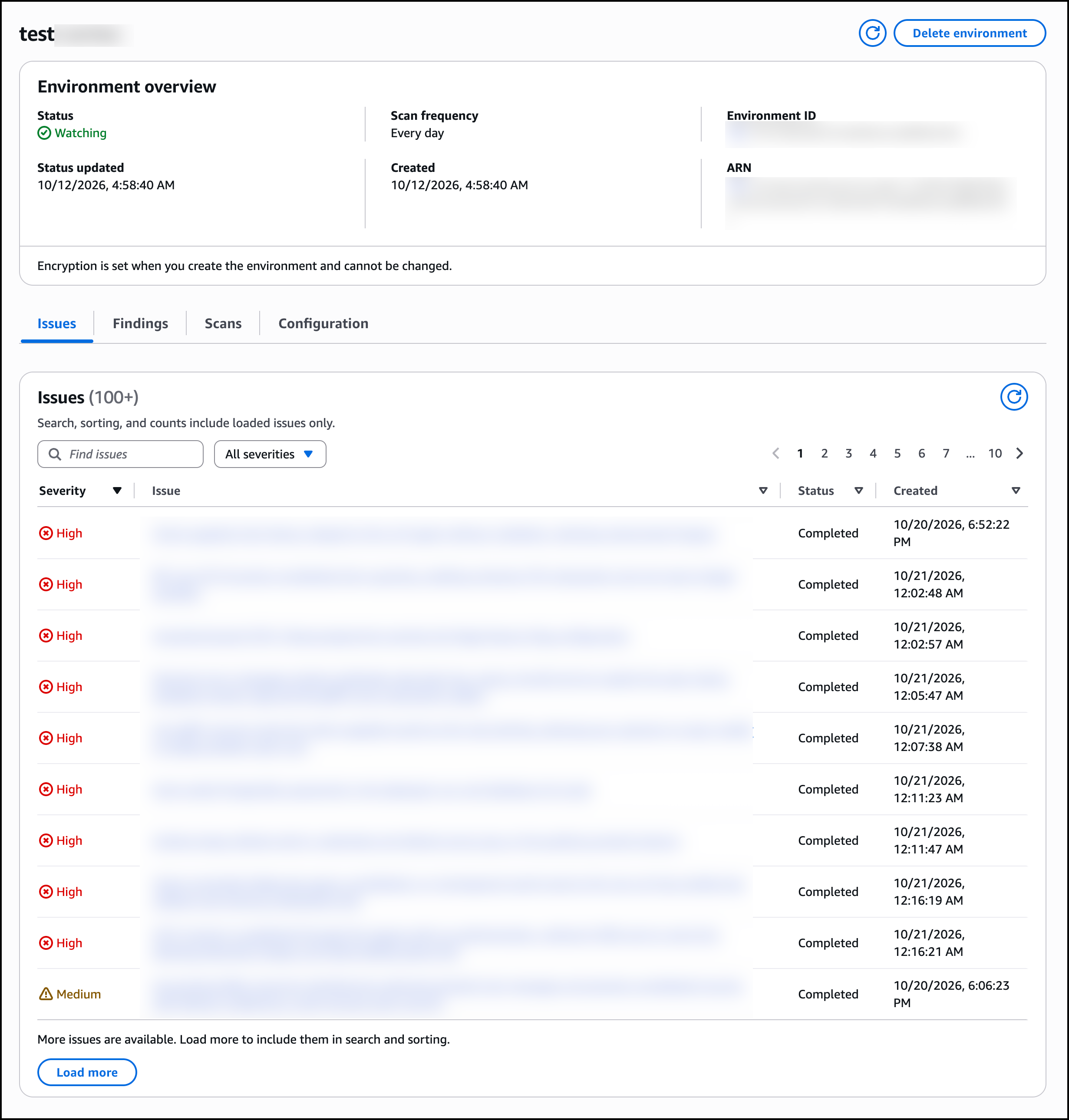
The centralized Overview dashboard provides security leadership with a unified pane of glass displaying active code integrations, associated environments, and the real-time health status of deployed AWS collectors. Within individual environments, the Issues tab replaces traditional, chaotic raw scanner outputs with a curated, prioritized inventory of validated security findings. Each item displays its verified severity level, current lifecycle status, and precise chronological creation metrics.
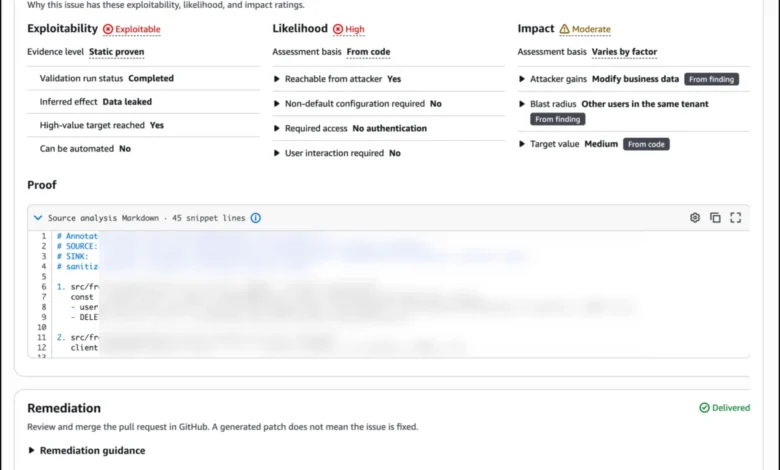
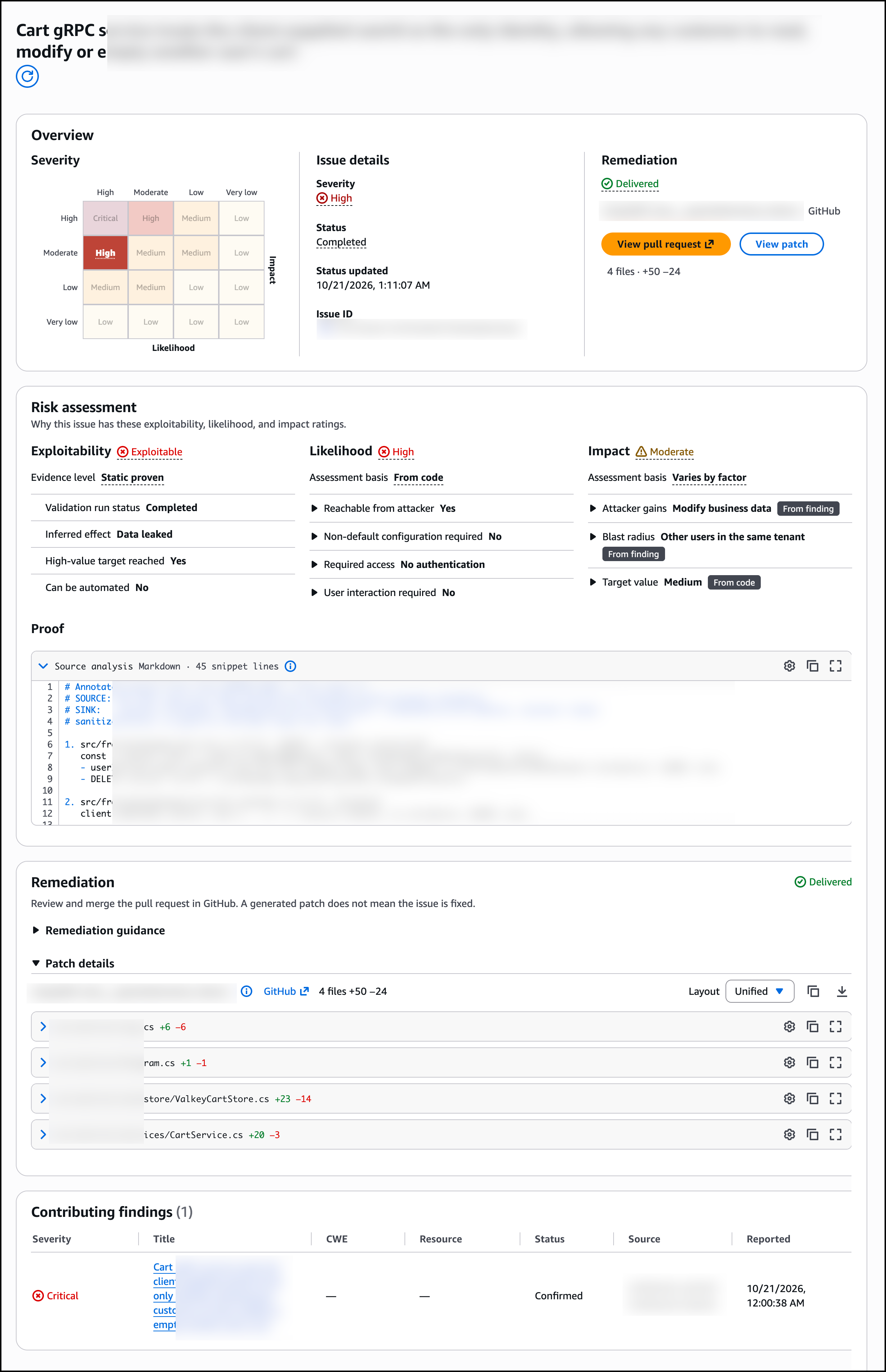
Selecting an individual issue reveals an exhaustive breakdown of the risk profile. The Risk assessment panel categorizes exploitability status—such as statically proven verdicts—alongside likelihood metrics determined by network reachability, authentication requirements, and user interaction prerequisites. Impact assessments explicitly define the potential consequences, such as unauthorized modification of business data or lateral movement within a tenant boundary. The integrated Proof section outlines the exact source analysis, while the Remediation panel presents the specific files modified, lines added, and lines removed within the affected microservice, such as a cart or checkout service.
Industry Implications and Broader Economic Impact
The commercial launch of AWS Continuum arrives at a pivotal moment for the software industry, where technical debt and security backlogs routinely impede business agility. By drastically reducing the investigative overhead associated with application security, the service promises to alter the economic calculus of vulnerability management.
Historically, organizations faced a difficult trade-off between velocity and security. Pushing code rapidly often meant accumulating an unmanageable debt of unresolved security alerts, while prioritizing exhaustive manual remediation frequently resulted in sluggish product release cycles. By automating the verification, contextualization, and patch-generation phases, AWS Continuum enables engineering organizations to maintain high deployment velocities without compromising their defensive posture. Furthermore, by translating complex security telemetry into standard developer-friendly pull requests, the service fosters a collaborative culture of shared security responsibility between dedicated security teams and software developers.
Availability and Regional Deployment
At launch, AWS Continuum for code vulnerabilities is immediately available to customers operating within the US East (N. Virginia) and US West (Oregon) AWS Regions. Comprehensive pricing structures, tiered based on application scale and scanning frequency, are detailed on the official AWS Continuum pricing portal. Enterprise organizations seeking to evaluate the service can access detailed architectural patterns, prerequisite checklists, and step-by-step configuration workflows via the official AWS Continuum User Guide and product documentation pages, with ongoing technical support available through standard AWS enterprise channels.