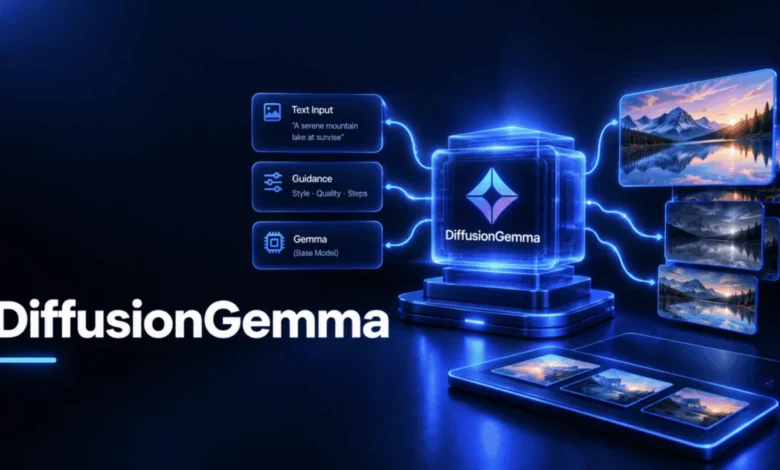
DiffusionGemma: A New Era of Parallel Text Generation and the Shift Beyond Autoregression

The landscape of generative artificial intelligence reached a significant technical inflection point on June 10, 2026, when Google DeepMind unveiled DiffusionGemma. This experimental open-source model represents a fundamental departure from the standard autoregressive architecture that has defined the large language model (LLM) industry since the inception of the Transformer architecture in 2017. By applying the principles of diffusion—a technique primarily responsible for the rapid advancement of image synthesis tools like Stable Diffusion—to language generation, Google has challenged the long-standing paradigm of token-by-token sequence prediction.
The release of DiffusionGemma is not merely an incremental update to the existing Gemma family; it is a structural experiment. Built upon the Gemma 4 26B Mixture-of-Experts (MoE) architecture, the model utilizes 26 billion total parameters, though only 3.8 billion are active per token, denoted by the "A4B" identifier. This design choice highlights a commitment to efficiency and computational throughput, positioning the model as a potential blueprint for future architectures that prioritize hardware utilization over simplistic sequential generation.
The Mechanics of the Diffusion Shift
To understand the gravity of this release, one must first recognize the inherent limitations of traditional autoregressive models. Standard LLMs—including GPT-4, Claude, and the original Gemma—function through a process of causal, left-to-right generation. Each token is predicted based on the preceding context, then appended to the sequence to serve as part of the input for the next step. This process is inherently bottlenecked by memory bandwidth. Because the model must load its full set of weights from VRAM to generate a single token, the compute-heavy GPU cores often remain idle while waiting for data to arrive from memory.
DiffusionGemma resolves this by abandoning the "one-at-a-time" approach. Instead, it treats text generation as a denoising process. The model initializes a 256-token "canvas" consisting of random noise and simultaneously refines the entire block through multiple iterative passes. Under Google’s "Uniform State Diffusion" framework, tokens are not locked in sequence. Instead, tokens with high confidence assist in resolving those with lower confidence, allowing the entire sequence to snap into coherence simultaneously.
This methodology shifts the primary burden from memory bandwidth to compute. Because the model is processing a large block of data in parallel, the GPU is kept consistently busy, significantly improving efficiency on high-end hardware. For sequences exceeding the 256-token canvas limit, the model employs "block-autoregressive denoising." Once a block is fully resolved, it is committed to the model’s Key-Value (KV) cache using standard causal attention. This hybrid approach ensures that while the initial generation is parallel and iterative, the long-form context remains stable and coherent.
Chronology and Development
The trajectory leading to the release of DiffusionGemma reflects a broader industry trend of experimenting with non-autoregressive architectures. While image and video diffusion models have matured rapidly, applying these concepts to the discrete and highly structured nature of human language has remained a formidable challenge.
- Pre-2025: Research into non-autoregressive language models (NARs) focused primarily on addressing the "quality gap"—the tendency for parallel models to produce repetitive or incoherent text compared to autoregressive counterparts.
- Early 2026: Google DeepMind researchers successfully demonstrated that bidirectional attention within a block could allow for self-correction—a capability impossible in traditional models. If a token’s confidence score drops during the denoising process, the sampler can re-noise it and attempt a correction, providing a mechanism for internal error checking.
- June 10, 2026: Google officially released DiffusionGemma under the Apache 2.0 license, providing developers with the weights, the model architecture, and the necessary integration hooks for Hugging Face Transformers and vLLM.
Technical Requirements and Hardware Accessibility
One of the most notable aspects of the release is its accessibility for high-end consumer hardware. While the full, unquantized version of the model requires enterprise-grade infrastructure—specifically GPUs with over 60GB of VRAM, such as the NVIDIA A100 or H100—the quantized version is optimized for an 18GB VRAM footprint. This effectively places the model within the reach of users running high-end consumer GPUs, such as the NVIDIA RTX 4090 or 5090.
The software stack, however, requires strict adherence to new standards. The model necessitates transformers version 5.11.0 or higher. This version pin is not merely a recommendation; it is a structural requirement due to the specialized DiffusionGemmaForBlockDiffusion class, which handles the complex denoising loops that standard AutoModelForCausalLM classes cannot accommodate.
Implications for Production and Inference
The inclusion of vLLM support at launch signals that Google views this technology as more than just a research curiosity. By integrating the denoising loop into vLLM’s serving engine, Google has enabled developers to deploy DiffusionGemma in production environments. The configuration for this deployment requires specific adjustments, such as setting a canvas_length of 256 and utilizing an entropy_bound sampler.
The "entropy_bound" configuration is particularly critical. It dictates that only the most confident tokens are committed during each step of the denoising process, while the less certain tokens remain open for revision. This creates a "thinking" effect, where the model essentially performs iterative refinement before finalizing its output. Google has further bolstered this by including an explicit "thinking mode," which allows the model to utilize a separate reasoning channel to process complex queries before delivering a final response. This mirrors the behavior of advanced reasoning models but does so through the lens of diffusion rather than chain-of-thought prompting alone.
Broader Impact on the AI Industry
The introduction of DiffusionGemma carries profound implications for the future of LLM development.
- Efficiency Gains: By shifting the bottleneck from memory bandwidth to compute, DiffusionGemma proves that there is significant headroom for performance optimization. As hardware architectures evolve, the ability to leverage massive parallel processing for text generation may render traditional autoregressive generation obsolete for many applications.
- The Rise of Self-Correction: The capacity for a model to re-noise and re-generate tokens mid-process provides a new pathway for reducing "hallucinations." In theory, if a model can detect low-confidence tokens during its own denoising phase, it can rectify errors before they become permanent parts of the output.
- Multimodal Integration: While the model outputs only text, its ability to ingest text, images, and video as a unified input stream demonstrates that the diffusion process can be effectively grounded in multimodal context.
However, industry analysts note that DiffusionGemma is not a panacea. For massive, high-concurrency cloud deployments, the mature batching and inference techniques developed for standard autoregressive models still hold a performance advantage. Google DeepMind has been transparent about this, framing DiffusionGemma as an "experimental model" and a "research and development preview."
The model’s release serves as a litmus test for the developer community. By providing the tools for local, single-user, low-concurrency deployment, Google is effectively crowdsourcing the refinement of this architecture. If the community can demonstrate that the denoising loop is as robust for general-purpose tasks as it is for the specific use cases highlighted by DeepMind, it is likely that future iterations of the Gemma series—and perhaps other flagship models—will begin to integrate diffusion-based components into their core architectures.
In conclusion, DiffusionGemma represents the most significant shift in language modeling since the introduction of the Transformer. While it currently exists in a state of experimental flux, its potential to optimize GPU utilization, enable internal self-correction, and provide a more compute-efficient future for AI makes it one of the most critical developments of the 2026 technological calendar. As developers continue to experiment with the block-diffusion process, the industry will likely see a move toward hybrid architectures that leverage the stability of causal attention for long-term history and the speed and flexibility of diffusion for immediate generation.