Critical Zimbra Collaboration Suite Vulnerability Exploited to Facilitate Large-Scale Mailbox Data Theft

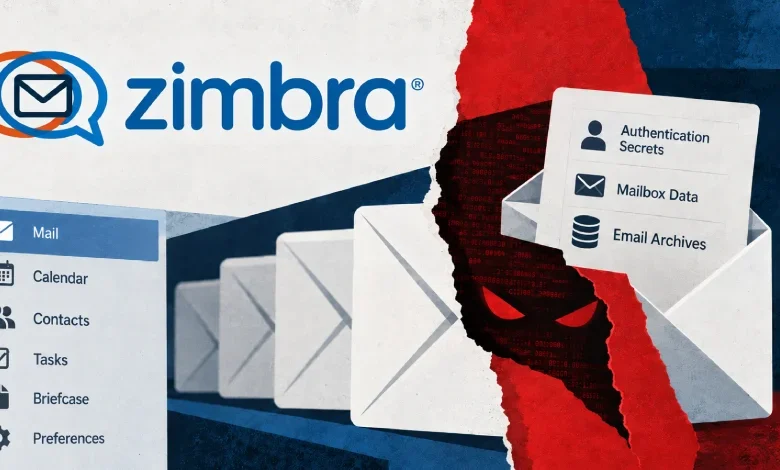
A sophisticated campaign targeting internet-facing mail servers has leveraged a high-severity security flaw in the Zimbra Collaboration Suite (ZCS) to conduct unauthorized command injection, deploy persistent web shells, and exfiltrate sensitive organizational communications. The vulnerability, tracked as CVE-2026-73570, carries a CVSS score of 8.9 and has been actively weaponized by threat actors to compromise the integrity of mail infrastructure across multiple global regions and industry sectors.
Anatomy of the Vulnerability: CVE-2026-73570
The flaw resides in the handling of Simple Network Management Protocol (SNMP) notifications within the Zimbra platform. Specifically, it functions as an unauthenticated operating system command injection vulnerability. When the optional "zimbra-snmp" package is installed and SNMP notifications are enabled, the application fails to properly sanitize input, allowing an attacker to execute arbitrary system commands with the privileges of the "zimbra" service account.
The exploitation process is alarmingly straightforward, requiring only a specially crafted SMTP request. Because the vulnerability does not require user interaction or pre-existing authentication, any internet-exposed Zimbra server with the vulnerable configuration is a potential target. Once the attacker triggers the injection, they gain a foothold that allows for the installation of JSP-based web shells, which provide a reliable, persistent back door into the underlying operating system.

Chronology of the Exploitation and Disclosure
The timeline of this incident highlights the rapid pace at which threat actors move once a vulnerability is identified. The discovery and subsequent mitigation cycle occurred as follows:
- July 20, 2026: Zimbra releases version 10.1.20, containing the security patch for the SNMP command injection flaw.
- July 28 – August 7, 2026: Microsoft telemetry identifies two distinct, automated scanning tools probing for the injection path. These probes were diagnostic, intended to confirm command execution without yet deploying full-scale malicious payloads.
- August 13, 2026: The vulnerability is publicly disclosed, alerting the broader security community to the risk.
- Late August 2026: CERT Polska provides the first public reports of active exploitation, offering guidance on how administrators can audit their systems for signs of compromise.
- August 24, 2026: The U.S. Cybersecurity and Infrastructure Security Agency (CISA) formally adds CVE-2026-73570 to its Known Exploited Vulnerabilities (KEV) catalog, mandating that all U.S. federal agencies patch their systems by this date.
Sophisticated Post-Exploitation Tactics
Once the initial command injection is successful, the attackers employ a multi-layered approach to ensure persistence and maximize the utility of the compromised environment. According to research from the Microsoft Security Research team, the threat actors prioritize redundancy. By deploying multiple JSP web shells across both the Jetty and mailboxd application paths, they ensure that if one back door is identified and removed, the environment remains compromised.
A notable component of this campaign is the use of "Zimdown2," a custom Go-based binary downloader. This tool serves as an installer for "Zimclient2," a sophisticated remote-access agent. Zimclient2 provides attackers with a robust suite of capabilities, including interactive shell access, bidirectional file transfer, and SOCKS5 proxying, which allows the threat actors to tunnel traffic through the compromised mail server and pivot into internal corporate networks.
To evade detection, the attackers have been observed manipulating system permissions. In certain instances, they temporarily enabled write access to public directories to facilitate the deployment of a web shell, only to revert those permissions immediately afterward. This technique is designed to bypass basic automated security audits that look for insecure directory configurations.

Furthermore, the attackers demonstrated an understanding of persistence mechanisms beyond simple web shells. They have been observed configuring systemd services, creating local user accounts, adding SSH authorized keys, and modifying cron jobs to ensure that their access remains viable even after a server reboot or a service restart.
Data Exfiltration and Credential Harvesting
The primary objective of this campaign appears to be the mass theft of organizational data. Upon gaining control of the ZCS, the attackers deploy a specific Go-based implant designed to parse sensitive configuration files, such as "/opt/zimbra/conf/localconfig.xml." By extracting credentials stored within these files, the attackers can forge connection strings to the underlying MySQL and LDAP instances.
This level of access allows the threat actors to export entire database tables, granting them access to email archives, authentication credentials, and cryptographic certificates. In one documented instance, the attackers attempted to exfiltrate a large archive of mailbox backups. The exfiltration method itself was highly modern: the actors downloaded the legitimate "AzCopy" utility from Microsoft’s official repositories and utilized it to upload the stolen data to an Azure Blob storage account via a shared access signature (SAS) URL. While the evidence did not confirm the successful completion of this specific transfer, the methodology illustrates a concerted effort to utilize cloud-native tools to bypass traditional egress filtering.
Broader Implications for Enterprise Security
The exploitation of CVE-2026-73570 serves as a stark reminder of the risks associated with internet-facing collaboration tools. Because mail servers are inherently required to be accessible to the outside world, they present a constant, high-value target for opportunistic attackers.

The reliance on specialized, high-privilege service accounts like "zimbra" creates a centralized point of failure. When an application-level vulnerability is combined with weak privilege isolation, an attacker can transition from a remote code execution event to full administrative control of the server in minutes.
Furthermore, the use of legitimate administrative tools like AzCopy to facilitate data exfiltration—often referred to as "living off the land"—presents a significant challenge for security operations centers (SOCs). Traditional signature-based detection is often ineffective against such tactics, as the binaries being executed are digitally signed and trusted by the operating system. Security teams must instead rely on behavioral analytics, such as identifying unusual outbound traffic to cloud storage providers or the execution of administrative commands from non-standard processes.
Recommendations for Remediation
Given the severity of the threat, immediate action is required for any organization running an unpatched version of Zimbra Collaboration Suite.
- Patching: The most effective defense is to upgrade to ZCS version 10.1.20 or later. Patching should be treated as an urgent priority for any internet-facing server.
- Configuration Hardening: If an immediate patch is not feasible, organizations should immediately disable the "zimbra-snmp" package and turn off SNMP notifications.
- Access Restriction: Administrators should restrict access to the SNMP and SMTP interfaces to trusted IP addresses only, effectively creating a firewall-level barrier against unauthorized probing.
- Forensic Auditing: Organizations should inspect their server logs, particularly "/var/log/zimbra.log," for evidence of unexpected service restarts. Additionally, they should scan temporary and web application directories for unknown files, particularly JSP files or suspicious scripts that do not align with known deployment baselines.
- Secret Rotation: If a server is suspected to have been compromised, simply removing the web shells is insufficient. Organizations must rotate all authentication secrets, LDAP passwords, and database credentials, as these are likely to have been harvested during the intrusion.
As this situation continues to develop, it is clear that the actors behind these attacks are well-resourced and capable of adapting their tactics to maintain persistence. Organizations that utilize ZCS must remain vigilant, prioritize the principles of least privilege, and ensure that their monitoring capabilities are focused not just on perimeter defense, but on detecting the anomalous post-exploitation behavior that characterizes modern, high-impact cyberattacks.