Critical Security Vulnerability in Elementor Plugin Exposes Millions of WordPress Sites to Administrative Takeover

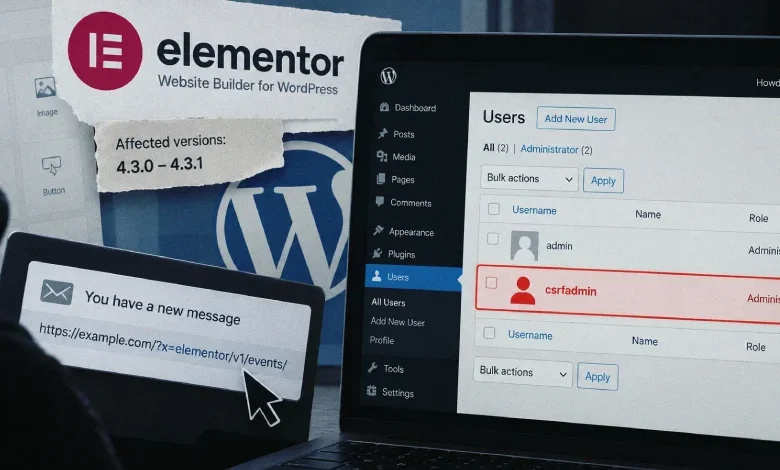
A high-severity security flaw recently discovered within the Elementor Website Builder plugin has placed over two million WordPress installations at risk of unauthorized administrative takeover. The vulnerability, which functions as a Cross-Site Request Forgery (CSRF) exploit, allows unauthenticated threat actors to bypass security measures and execute arbitrary REST API actions on behalf of a logged-in user. With the Elementor plugin serving as a cornerstone of the WordPress ecosystem—boasting over 10 million total active installations—the discovery has prompted urgent calls for site administrators to update their software immediately to prevent potential site compromise.
Technical Anatomy of the Vulnerability
The flaw, identified by a security researcher operating under the alias "Saggre," resides specifically within the Editor Events module introduced in versions 4.3.0 and 4.3.1 of the plugin. According to the technical analysis provided by the WordPress security firm Patchstack, the vulnerability originates from a failure in the plugin’s CSRF protection mechanism.
The Editor Events module was designed to facilitate specific internal communications within the WordPress dashboard. However, the implementation included a flaw where the system skipped CSRF protection for any cookie-authenticated REST API request, provided the string "elementor/v1/events/" appeared anywhere within the request URI.
Because the request URI includes query strings—which can be manipulated by an attacker crafting a malicious link—the protection bypass becomes trivial. By simply appending a parameter that includes the "elementor/v1/events/" string to a request, an attacker can effectively disable security checks for the entire REST API surface of the target site. This is not limited to Elementor-specific functions; it extends to the WordPress core API and any other plugins installed on the site.
The implications are severe. An attacker could craft a link that, when clicked by a site administrator, silently triggers a background process to create a new user account with administrative privileges. Once the account is created, the attacker gains full control over the website, potentially leading to data exfiltration, malware distribution, or the complete destruction of the site’s infrastructure.
The Mechanism of Exploitation
One of the most alarming aspects of this vulnerability is the simplicity of the attack vector. Unlike many sophisticated cyberattacks that require complex social engineering or the injection of malicious JavaScript, this exploit requires only that a logged-in administrator clicks a link.
The link does not need to be hidden behind a complex script or a compromised webpage. It can be distributed through standard communication channels, including:
- Hyperlinks embedded in phishing emails.
- URLs shared in chat applications or instant messaging platforms.
- Malicious links hidden within public comments on a blog or forum.
Once the administrator clicks the link, the browser automatically includes their authentication cookies, authorizing the request to the REST API as if it were a legitimate administrative action. Patchstack noted that in a default WordPress configuration, the exploit can be used to register a new administrator user in seconds, granting the attacker a persistent "backdoor" into the system that remains even after the initial link is closed.
Chronology of Discovery and Remediation
The timeline of the vulnerability highlights the importance of responsible disclosure in the cybersecurity industry.

- Initial Discovery: The flaw was identified by the researcher "Saggre," who recognized that the Editor Events proxy could be tricked into ignoring security headers.
- Responsible Disclosure: Following the discovery, the details were shared with the Elementor security team, ensuring they had sufficient time to develop a patch before the vulnerability became public knowledge.
- Patch Release: Elementor responded by releasing version 4.3.2 earlier this week. This update specifically addresses the bypass by tightening the validation logic within the Editor Events module, ensuring that the CSRF protection cannot be circumvented via arbitrary query strings.
- Public Disclosure: Once the fix was verified and deemed effective, Patchstack and other security researchers released the advisory to warn the millions of site owners who had not yet updated their installations.
Supporting Data and Scale of Impact
Elementor is one of the most widely used page builders in the world, with its market share reflecting the massive scale of the potential impact. WordPress.org statistics indicate that while the plugin is active on more than 10 million sites, the specific versions affected by this flaw—4.3.0 and 4.3.1—were installed on approximately 2 million websites.
The disparity between the total user base and the affected user base is due to the rapid update cycles common in the WordPress plugin ecosystem. However, even with a 20% infection surface, the sheer number of sites potentially vulnerable to a full takeover is significant. Given the prevalence of WordPress in both small business and enterprise web environments, the potential for mass exploitation was high had the vulnerability remained undiscovered or unpatched.
Analysis: The Risks of REST API Extensibility
The Elementor vulnerability serves as a case study for the security challenges inherent in modern web development. The WordPress REST API is a powerful tool that allows for seamless interaction between different parts of a site. However, as this case demonstrates, it also creates an expansive "attack surface."
When developers create proxy modules to facilitate internal API communication, they must ensure that those proxies do not inadvertently grant permissions to unauthorized users. The "filter" logic used by the Elementor developers—searching for a specific string in a URI—is a common, yet brittle, way to manage security. It highlights a critical lesson for plugin developers: security measures should rely on robust, context-aware authentication and authorization checks rather than simple string matching, which is easily bypassed by URL manipulation.
Implications for Site Security Management
For website administrators, this incident reinforces several best practices:
- Automated Updates: Relying on manual updates for security-critical plugins is a risk. Enabling automated background updates for plugins can ensure that critical patches are applied as soon as they are available.
- Principle of Least Privilege: Administrators should avoid staying logged in to their WordPress dashboard when browsing the web. If a user is not authenticated as an administrator, the CSRF exploit cannot trigger administrative actions.
- Audit Logs: Maintaining active audit logs can help site owners identify unauthorized account creation. If an unexpected administrative user appears in the system, security teams can trace the account creation back to the API request, allowing for rapid containment.
- Vulnerability Monitoring: Subscribing to security advisories from sources like Patchstack, Wordfence, or the official WordPress security blog is essential for staying informed about vulnerabilities in the plugins that power one’s infrastructure.
Official Responses and Future Outlook
Elementor has been proactive in addressing the issue, and their prompt release of version 4.3.2 is an example of effective vulnerability management. While the company has not issued a detailed public statement regarding the internal process that led to the oversight, the swiftness of the update indicates a mature response to security feedback.
In the broader context of WordPress security, this incident is unlikely to be the last of its kind. As the platform continues to evolve and move toward more API-driven architectures, developers must prioritize "security by design." This means incorporating security testing—specifically focusing on CSRF and privilege escalation—into the development lifecycle before code is ever pushed to the public repository.
For now, the immediate danger has been mitigated for those who have updated their plugins. However, the "long tail" of unpatched sites remains a concern. Thousands of WordPress sites are often left unmaintained for months or years, creating a permanent pool of vulnerable targets for automated botnets. Cybersecurity experts strongly advise that any site owner currently running a version of Elementor earlier than 4.3.2 should perform an immediate update and conduct a security audit to ensure no rogue accounts were created while their site was exposed.
As the digital landscape becomes increasingly complex, the reliance on third-party plugins will remain a double-edged sword. While tools like Elementor empower users to build professional-grade websites without extensive coding knowledge, they also necessitate a higher level of vigilance regarding software maintenance and security hygiene. By treating every plugin update as a critical security task, site administrators can protect their digital assets against the ever-evolving tactics of modern cyber adversaries.