AMD Challenges Nvidia Dominance with New Helios AI Rack System and Bold 1.4 Trillion Dollar Market Forecast

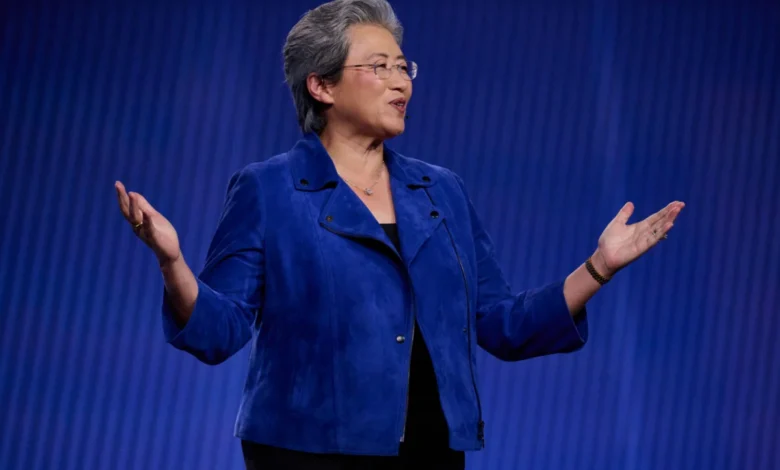
At the packed Advancing AI conference in San Francisco, Advanced Micro Devices (AMD) officially signaled a new phase in the global semiconductor wars, unveiling a high-performance, rack-scale computing architecture designed to dismantle Nvidia’s longstanding hegemony in the artificial intelligence sector. Dr. Lisa Su, AMD’s Chair and CEO, introduced the "Helios" system to an audience of industry leaders, engineers, and investors, positioning the hardware as the definitive solution for the world’s most sophisticated AI laboratories. The announcement was accompanied by a staggering market projection, with Su forecasting that the AI accelerator market will balloon to $1.4 trillion by 2030—a figure that would make the AI chip segment alone as large as the entire global semiconductor industry is today.
The Helios system represents a strategic pivot for AMD, moving beyond the sale of individual components to providing fully integrated, "rack-scale" infrastructure. These systems are essentially supercomputers in a box, combining hundreds of processors, advanced networking, and specialized cooling into a single, high-density unit. As frontier AI models like GPT-5 and its successors demand ever-increasing levels of compute, the industry is shifting away from piecemeal data center builds toward these pre-configured, massive-scale architectures. By launching Helios, AMD is directly challenging Nvidia’s Grace Blackwell and Vera Rubin platforms, which have previously been the only viable options for gigawatt-scale AI deployments.
The Architecture of Helios: Scaling to the Frontier
The Helios rack system is engineered specifically for the "agentic AI" era, a phase of development where AI models do not merely respond to prompts but act as autonomous agents capable of complex reasoning and multi-step problem-solving. According to Dr. Su, Helios is the industry’s "highest-performance AI rack," built to handle the rigorous training and inference requirements of frontier models. While specific technical benchmarks were highlighted during the presentation, independent analysis suggests that Helios competes aggressively with Nvidia’s upcoming Vera Rubin architecture, potentially surpassing it in specific memory bandwidth and energy efficiency metrics.
The move to rack-scale systems is a response to the physical limitations of modern data centers. As power density increases, traditional air cooling is becoming obsolete. Helios is designed to integrate with liquid-cooling infrastructure, allowing for higher clock speeds and more cores per square foot. This efficiency is critical for the "gigawatt-scale" data centers being planned by tech giants, where electricity consumption is as much of a bottleneck as chip availability. AMD’s ability to deliver a full-stack solution—comprising the GPUs, CPUs, networking, and software—is intended to provide a "plug-and-play" experience for hyperscalers who are currently desperate to increase their capacity.
A Blue-Chip Roster of Partners and Customers
The success of any new hardware platform depends on its adoption by the "Hyperscalers"—the handful of companies with the capital to build multi-billion-dollar data centers. AMD’s Thursday announcement was bolstered by a formidable list of partners who have already committed to deploying Helios. Microsoft, Meta, Oracle, Anthropic, and OpenAI were all cited as key customers for the new system.
Microsoft CEO Satya Nadella confirmed that the Helios system would become a cornerstone of the Azure AI infrastructure. This expansion is significant, as Microsoft has historically been the primary driver of Nvidia’s revenue. By diversifying its fleet with AMD Helios racks, Microsoft is seeking to reduce its dependency on a single supplier and optimize its cost-per-token for AI inference.
Simultaneously, AMD announced a strategic partnership with Anthropic, the creators of the Claude LLM. This deal involves the deployment of up to two gigawatts of GPU capacity via the Helios system. This partnership is one of the largest infrastructure commitments in AMD’s history, signaling that the company is no longer just a "second source" for chips but a primary architect of the world’s AI backbone. The scale of this deployment—measured in gigawatts rather than chip counts—underscores the massive energy requirements of the next generation of AI.
The Roadmap to 2027: Introducing Venice-X
While Helios was the centerpiece of the conference, Dr. Su also looked toward the future of the Central Processing Unit (CPU) in the data center. AMD introduced the "Venice-X" CPU, based on the Zen 6 architecture, which is slated for a 2027 release. In the AI era, the CPU plays a critical "head node" role, managing data movement and feeding the power-hungry GPUs.
The Venice-X is expected to be a powerhouse of high-performance computing (HPC). Early specifications suggest it will feature up to 96 cores and a massive 1152 MB of 3D V-Cache. This specialized memory technology allows the processor to store more data closer to the execution cores, drastically reducing latency in complex workloads. By integrating Venice-X into future iterations of its AI racks, AMD aims to eliminate data bottlenecks that currently plague large-scale AI clusters. The 2027 timeline for Venice-X suggests that AMD is maintaining a relentless release cadence, attempting to match or exceed the annual update cycle pioneered by Nvidia.
The $1.4 Trillion Vision and the Rise of Agentic AI
Perhaps the most discussed moment of the Advancing AI conference was Dr. Su’s revised market forecast. In previous years, AMD had predicted a total addressable market (TAM) for AI accelerators of roughly $400 billion by 2027. The jump to $1.4 trillion by 2030 represents a profound shift in how the company views the longevity of the AI boom.
Dr. Su attributed this exponential growth to the transition from simple "Chatbots" to "Agentic AI." She explained that when a user interacts with an AI agent, the compute requirement is significantly higher than a standard query. "When you ask the agent to do something, it actually has dozens of steps," Su noted. "It has to reason, it has to call tools, it has to access data, and it has to keep doing it over and over until it solves the problem."
This iterative process—often called "inference-time compute"—means that the more an AI thinks before it speaks, the more GPU cycles it consumes. This shift suggests that the demand for chips will not plateau once the initial models are trained. Instead, the daily operation of millions of autonomous agents will create a permanent, high-baseline demand for silicon. Su argued that GPUs will continue to dominate this market because the underlying algorithms are still in their "infancy," requiring the programmable flexibility that GPUs offer compared to more rigid, specialized ASICs (Application-Specific Integrated Circuits).
Competitive Dynamics: A Duopoly in the Making
For the past two years, Nvidia has enjoyed a near-monopoly in the high-end AI chip market, at times commanding over 90% market share. This dominance has led to supply shortages and record-high margins. AMD’s emergence with a competitive rack-scale system like Helios provides the market with a necessary alternative.
Industry analysts suggest that AMD’s strategy is built on three pillars: performance parity, open software ecosystems, and supply chain reliability. By utilizing the ROCm open software platform, AMD is attempting to lure developers away from Nvidia’s proprietary CUDA ecosystem. Furthermore, by partnering with TSMC for its advanced packaging needs, AMD is positioning itself to capture the spillover demand that Nvidia cannot fulfill.
The rivalry is no longer just about who has the fastest chip, but who can build the most efficient ecosystem. Nvidia’s "NVLink" interconnect technology has been a major moat, allowing its chips to communicate at lightning speeds. With Helios, AMD is leveraging its own high-speed interconnects and the Infinity Architecture to prove it can match Nvidia’s "system-on-a-chip" approach at the "system-on-a-rack" level.
Chronology of Development
The journey to the Helios announcement has been several years in the making:
- Late 2023: AMD launches the MI300 series, its first major challenge to Nvidia’s H100, gaining traction with Meta and Microsoft.
- January 2025: Initial concepts for a rack-scale system are teased at industry events, signaling AMD’s move toward integrated infrastructure.
- January 2026: A prototype of the Helios rack is displayed at CES, showcasing its physical footprint (comparable to two compact cars) and liquid-cooling capabilities.
- July 2026: The Advancing AI conference serves as the formal commercial launch, with Helios moving into the deployment phase for 2026-2027.
- 2027 and Beyond: The planned launch of Venice-X and the scaling of Helios to meet the $1.4 trillion market demand.
Broader Economic and Industrial Impact
The implications of AMD’s aggressive expansion extend beyond the tech sector. The $1.4 trillion projection suggests that AI will be the primary engine of global economic growth for the next decade. If Su’s forecast holds true, the capital expenditure required to build this infrastructure will necessitate a massive realignment of global finance, with trillions of dollars flowing into data center construction, energy production, and semiconductor manufacturing.
However, this growth also brings challenges. The "gigawatt-scale" deployments mentioned by AMD highlight the urgent need for a revolution in the power grid. As AI labs move from consuming megawatts to gigawatts, the strain on local utilities will become a matter of national policy. AMD’s focus on energy efficiency in the Helios system is not just a technical feature but a prerequisite for the industry’s survival.
In conclusion, AMD’s Advancing AI conference has redefined the company’s trajectory. By moving from a component manufacturer to a provider of massive-scale AI systems, and by setting an audacious $1.4 trillion target, Dr. Lisa Su has made it clear that AMD does not intend to play second fiddle to Nvidia. As the Helios systems begin to ship later this year, the tech industry will watch closely to see if this new hardware can indeed power the "agentic AI era" and reshape the landscape of modern computing.
Related posts: